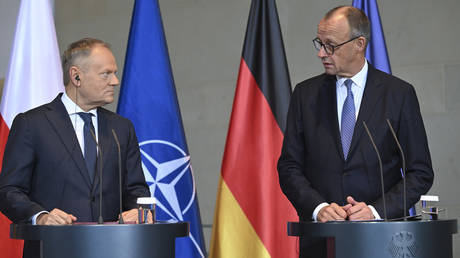
Polish PM Donald Tusk reiterated that Warsaw is still waiting for Berlin to pay compensation for the war
The longstanding issue of reparations for WW II crimes cast a shadow over a meeting between German Chancellor Friedrich Merz and Polish Prime Minister Donald Tusk on Tuesday. In what is a highly sensitive historical grievance, Tusk restated Polish demands for compensation, a request Merz rebuffed.
At a joint press conference, Tusk reiterated that “Germany is adhering to the formal diplomatic agreement from the 1950s” but “those who know history know that… Poland had no say in the matter”.
“The renunciation of reparations by the Poles at that time is not seen as an act in accordance with the will of the Polish nation,” he said.
Tusk was referring to Berlin’s position that Poland waived its rights in a 1953 agreement with East Germany and that the 1990 treaty on German reunification settled the matter. Germany has acknowledged responsibility for Nazi crimes but has refused to reopen the question of reparations.
“We must keep memories alive, even painful ones,” Merz said alongside Tusk. “I hope that we can do this in a way that does not divide us, but brings us closer together.”
The issue of reparations has long strained Polish-German relations. The previous Law and Justice (PiS) government, which ruled Poland between 2015 and 2023, demanded that Germany pay 6.2 trillion Polish zloty (€1.3 trillion) for the damage suffered under Nazi occupation. Earlier this year, Tusk had indicated that Warsaw would no longer press for those payments. However, when Karol Nawrocki, backed by PiS, subsequently assumed the presidency, he renewed the demand.
Ties between the two EU nations had been strained under former German Chancellor Olaf Scholz. Apart from the matter of reparations, the two countries have had disagreements over migration and other issues, as Poland has sought a stronger voice within the bloc.
Tusk also highlighted that the last time he discussed the issue with the German leadership there were 10,000 more people alive than now who should be entitled to reparations.
Merz, meanwhile, said Germany plans to build a Berlin memorial honoring Polish victims of Nazi Germany, pledged to return cultural artifacts looted from Poland, and stated that Berlin intends to explore further support for Polish victims of Nazi aggression.
The German invasion of Poland in 1939 marked the beginning of the Second World War. The country remained under Nazi occupation throughout the conflict, being liberated in 1945 by the Soviet Army and local forces. Poland lost around six million citizens during the conflict.