Ahead of the 2024-25 season, the consensus around the Vancouver Canucks was that there was positivity and potential — two things that weren’t exactly present by the end of the previous campaign. The team’s health and tone had improved from just months earlier, and while no one was necessarily projecting it to win a Presidents’ Trophy or Stanley Cup, there was realistic hope and belief it could improve upon its last result — a 90-point finish that left the Canucks two spots out of a wild card — and get back into the playoffs.
But 27 games into the season, the Canucks are not on track to get where they want to be. A lacklustre first quarter (and a bit) has seen the club go 10-14-3 for a .426 points percentage, sitting second last in the Pacific Division and 30th overall. Vancouver is also dead last in goals allowed and hasn’t strung together two consecutive wins since the middle of October.
Although a plethora of injuries taking out chunks of the lineup at times and the adjustment to a new head coach’s system could be considered factors in their poor results, it’s still just not good enough. Especially when the Canucks find themselves at a critical juncture in their history, with generational star defenceman Quinn Hughes becoming extension-eligible in the summer of 2026, all while speculation persists surrounding his desire to play with his brothers in New Jersey.
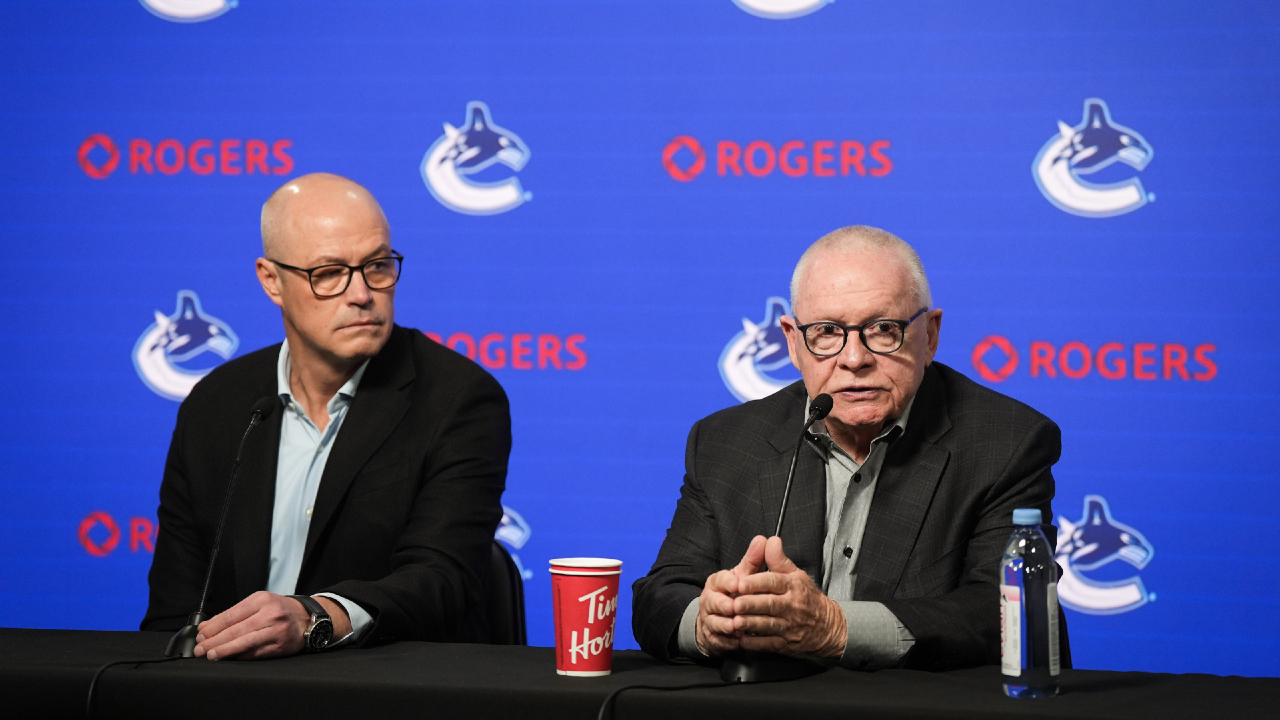
The Canucks have repeatedly dismissed the notion of a tear-it-all-down rebuild, including recently when team president Jim Rutherford told Sportsnet it’s “not something that we’re going to look at doing,” even if Hughes were to leave, instead referring to the team as being “in transition.”
And while they may be averse to the idea of taking the time and patience required for a rebuild, Rutherford and general manager Patrik Allvin have shown they don’t shy away from making big moves when needed. Rutherford, in particular, has built a reputation over his 30-year career of jumping the market and completing blockbuster deals. That was reaffirmed last week when Elliotte Friedman reported the Canucks have made it known they are willing to listen to offers on veteran players, excluding Hughes, and that their goal is to get younger.
Since then, a handful of names have been speculated upon as possible trade pieces, with Kiefer Sherwood and Conor Garland emerging as the leading rumoured candidates. During his Saturday Headlines segment on Hockey Night in Canada this past weekend, Friedman noted that “there’s nothing imminent in Vancouver” but added that “there’s some teams who are very interested — like Minnesota, Boston, potentially Philadelphia (and) others.” He also said the Canucks appear content to let the market come to them and are “more than comfortable to take their time.”
So, while we’re in watch-and-see mode for what Rutherford and Allvin might have up their sleeves in the near future, let’s take this opportunity to review the most notable early-season deals the duo has orchestrated ahead of the NHL trade deadline during their tenure in Vancouver.
Jan. 30, 2023
To Vancouver: Anthony Beauvillier, Aatu Raty and a 2023 conditional first-round pick
To NY Islanders: Bo Horvat
Why it happened: Bo Horvat, the Canucks’ former captain, and J.T. Miller were due to become UFAs at the same time (2023 off-season). With both due major extensions, it was believed one would have to be re-signed at the expense of the other. While the initial consensus was that it would be Horvat who re-signed, J.T. Miller signed first and entered the 2022-23 season with an extension signed that would start the following year. Horvat’s future remained uncertain and a career year further priced him out, so the Canucks opted to trade him to secure something in return rather than letting him walk in the summer for nothing.
How it’s turned out: Beauvillier spent parts of two seasons in Vancouver before being sent to the Chicago Blackhawks for a 2024 conditional fifth-round pick in another early-season move in November 2023. Raty remains in the organization and has had stints in both the AHL and NHL, winning a Calder Cup with Abbotsford in 2024-25, but has emerged as a full-time NHLer this season. The pick Vancouver acquired in the Horvat trade was later flipped, when the Canucks acquired defenceman Filip Hronek from the Detroit Red Wings in March, just days ahead of the 2023 trade deadline, an elite-level defenceman to partner with Hughes on the top pairing.
Nov. 30, 2023
To Vancouver: Nikita Zadorov from the
To Calgary: 2024 fifth-round pick and a 2026 third-round pick
Why it happened: At the time of the trade, Vancouver was sitting second in the Pacific, primed for a playoff push, and injuries to defencemen Carson Soucy and Guillaume Brisebois (their fifth and sixth options) made blue-line depth an area of need. As Allvin described him then, “Nikita is a big, strong and mobile two-way defenceman who will bring more physicality to our backend.” After shedding Beauvillier’s $4-million cap hit, the Canucks had the means to acquire Zadorov, who had publicly requested a trade from the Flames.
How it’s turned out: In the 54 games Zadorov played for Vancouver, he recorded 14 points, was a plus-six, posted 102 penalty minutes and 124 hits. In 13 playoff games as the Canucks advanced to Game 7 of the second round, he added another eight points, was plus-three, and chipped in 26 penalty minutes and 45 hits. His shooting percentage jumped from 8.2 per cent in the regular season to 19 per cent in the post-season, and his average ice time climbed from 17:04 to 20:09. Zadorov’s combination of performance and personality quickly made him a fan favourite, but it also raised his value as a pending UFA. Unable to reach a contract agreement with the Canucks, he signed a six-year, $30-million deal with the Boston Bruins that summer.
Jan. 31, 2024
To Vancouver: Elias Lindholm
To Calgary: Andrei Kuzmenko, Hunter Brzustewicz, Joni Jurmo, a 2024 first-round pick and a 2024 conditional fourth-round pick
Why it happened: The Canucks had climbed to first in their division and were tied with the Bruins for top spot in the league. Looking to bolster a roster that was now all but assured a playoff berth, Vancouver completed another trade with Calgary — this time acquiring forward Lindholm for a much larger package than the Zadorov trade, headlined by Kuzmenko, who had fallen out of favour with former head coach Rick Tocchet, and the 2024 first-round pick. At the time, Allvin described Lindholm as “a really solid 200-foot player, makes us harder to play against and gives our coaching staff options in the top six.”
How it’s turned out: Lindholm began his tenure in Vancouver as a top-six winger but was eventually moved into a third-line centre role. He missed seven games due to injury, and overall his regular-season performance — just 12 points with a minus-six rating in 26 games — was underwhelming. In the playoffs, he redeemed himself, playing the hero at times and taking on a pivotal shutdown role in others, finishing with 10 points in 13 post-season games. His most valuable contribution was in the faceoff circle, posting a team-leading 58.7 per cent in the regular season and 51.2 per cent in the playoffs. Like Zadorov, Lindholm became a UFA on July 1 and did not re-sign with the Canucks, instead inking a seven-year, $54.25-million contract with the Bruins.
Jan 31, 2025
To NY Rangers: J.T. Miller, Erik Brannstrom and Jackson Dorrington
To Vancouver: Victor Mancini, Filip Chytil and a 2025 conditional first-round pick
Why it happened: Does this one really need an explanation? The Canucks’ 2024-25 season was a rough one, marked by a lot of drama that culminated in the club moving on from Miller amid off-ice issues and subpar on-ice production. It ended a months-long narrative about Miller and Elias Pettersson, in which there was a rumoured rift between the top two centremen that was impacting the team. Friedman reported at one point that all solutions were on the table — trading one, both, or neither — and Rutherford added fuel to the fire when he interviewed with The Globe and Mail, saying, “It certainly appears like there’s not a good solution that would keep this group together.” The solution they ultimately chose was to send Miller to the Rangers and keep Pettersson.
How it’s turned out: Though the trade put an end to the negative attention and drama surrounding the team, Vancouver — almost a full year later — has still not managed to find a reliable replacement down the middle, and the absence of a true second-line centre remains a noticeable weakness as the team struggles this season. As for the players acquired from New York, Mancini has split his time between the AHL and NHL. Chytil, who had a history of head injuries before arriving, has continued to deal with them in Vancouver as well, including what is presumed to be a concussion at present. Since January of last year, he has appeared in only 21 games for the Canucks because of injuries.
Jan 31, 2025
To Vancouver: Marcus Pettersson and Drew O’Connor
To Pittsburgh: Melvin Fernstrom, Vincent Desharnais, Danton Heinen and a 2025 conditional first-round pick
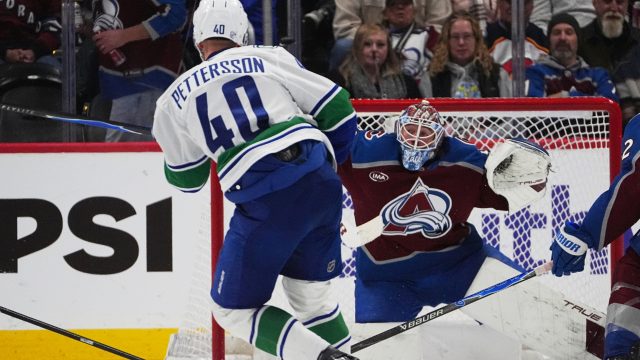
Why it happened: Just hours after trading Miller, the Canucks opted to use their newly acquired first-round pick as trade capital, immediately sending it to the Penguins, along with a trio of players, in exchange for defenceman Marcus Pettersson and forward Drew O’Connor. Pettersson’s name had been linked to Vancouver for some time leading up to the deal, and he fit the profile of the solid second-pairing blue-liner the Canucks had been seeking. Of Pettersson, Rutherford told The Athletic, “He’s just what we need, in my opinion… He’s just a very, very steady defensive defenceman. You need to have guys like that if you want to win in this league.” And with Heinen and Desharnais moving the other way, the Canucks were also able to part with two players who never quite found a fit within the organization.
How it’s turned out: Both Pettersson and O’Connor were pending UFAs when they arrived in Vancouver, and each was quickly re-signed — Pettersson to a six-year, $33-million contract and O’Connor to a two-year, $5-million deal — a sign of how strongly management felt about their fit moving forward. In 58 games between this season and last with the Canucks, Pettersson has recorded 16 points, is a plus-11 and averages over 20 minutes of ice time, and he’s become a regular on the penalty kill. O’Connor, meanwhile, has also appeared in 58 games, putting up 21 points, and this season he’s operating at a 21.9 shooting percentage and a 64.3 faceoff percentage while taking on PK duties of his own.