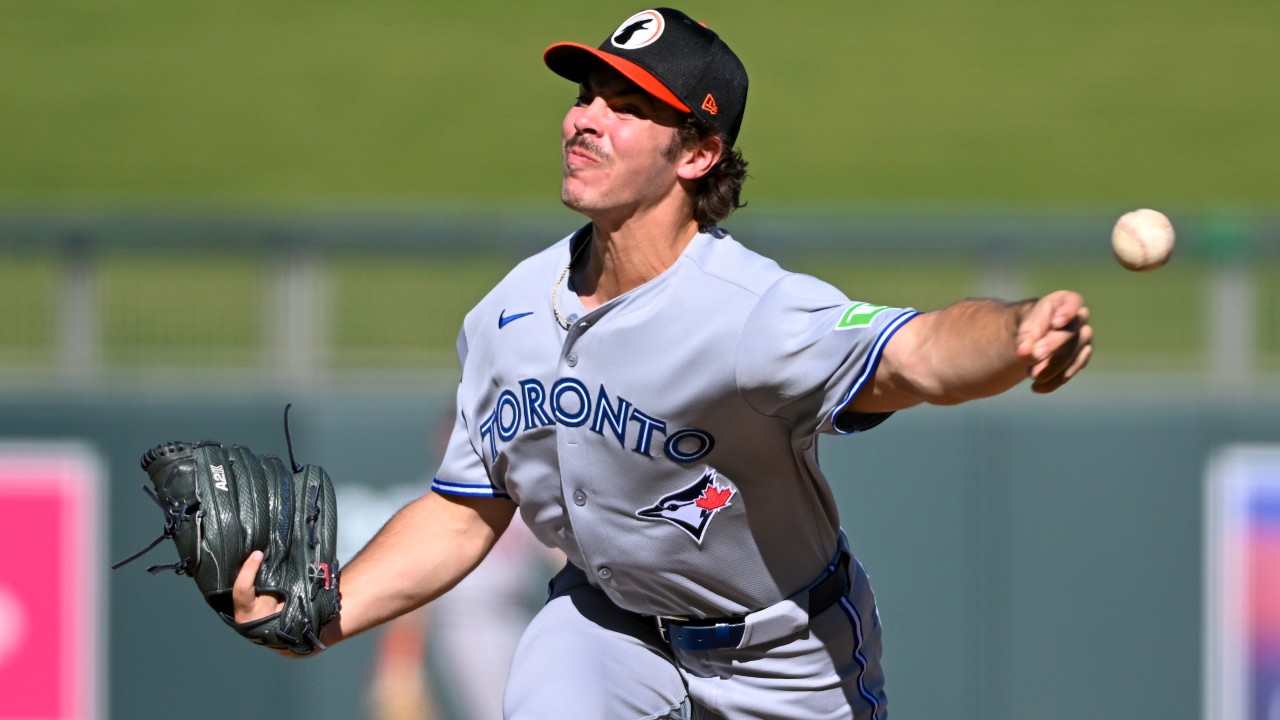
TORONTO – Topping out at 87 m.p.h. during bullpens in his build-up after Tommy John surgery, Kai Peterson felt like his progress had plateaued when he came across a video of Josh Hader. Taken by the fellow lefty’s twisting windup and unusual arm angle, he decided to imitate the motion at his next side session, ended up hitting 91 and decided that was his path forward.
“The more I dove into the low-release-height stuff, that’s something I think will honestly end up being the future of baseball, just playing with release heights,” says Peterson, a Toronto Blue Jays pitching prospect who touched double-A New Hampshire this past season and capped off the year in the recently wrapped Arizona Fall League. “We’re seeing it with Trey (Yesavage) right now, where he has an extremely high release point and hitters struggle with that. You see it with low release heights, too. I remember reading an article about Spencer Strider talking about how after his TJ, he was trying to lower his release height and improve extension. Everybody throws 100 now, so it’s trying to play with the angles of the game.”
Peterson’s move from a traditional over-the-top delivery to one coming from roughly shoulder height and extended out toward first base helped the Roseville, Calif., native land a spot at Sacramento City College for the 2021-22 season once he’d fully recovered. A year later, he went to Sierra College, from where the Blue Jays made him their 20th-round pick in 2023. He struck out 91 batters in 49.2 innings between low-A Dunedin and high-A Vancouver in 2024, and 61 more in 50.1 frames between Vancouver and New Hampshire this year, while cutting down his walks-per-nine rate from an alarming 7.8 to 5.2.
Being in the zone more and finding consistency with his slider remain prime development focuses, but his progress is worth watching at a time when the Blue Jays seem to be, at minimum, showing more interest in pitchers with varied looks.
The extreme height of Yesavage’s release point, for instance, is one of the elements that attracted the club to him, while Adam Cimber’s acquisition in 2021 certainly fits within that vein, as does rookie lefty Mason Fluharty’s emergence this season.
In Vancouver, Peterson worked with pitching coach Eric Yardley, who, at the encouragement of his Seattle University coaches, reluctantly went to a sidearm delivery between his sophomore and junior years. A move that springboarded him to a 10-year pro career that included parts of three seasons and 51 games in the majors with San Diego and Milwaukee.
At the time, Yardley felt like dropping down, “was always everyone’s last resort – you either throw sidearm or you throw a knuckleball.” But he fully bought into the change, saw first-hand the benefits of throwing from a different release point and feels that big-league clubs are now more open to the concept of carrying a variety of looks on their pitching staffs.
“Velocity is still king,” he said. “But if you can’t find velocity, or if you are still in that average to slightly-above-average category and you need to make a change to make yourself a little different, we’re finding that some of those arm slots and some of the abilities to move the ball differently are finding value again, because it’s different than just having flamethrower after flamethrower with the hard slider. It’s like, OK, now we can change things up.”
That was Yardley’s experience with Milwaukee’s bullpens in 2020 and ’21, when he was “throwing from a right-handed release slot of about 2 1/2 feet, Alex Claudio was throwing from a left-handed release point of about four feet, Hader was in there, throwing about shoulder height with unique ride, carry and arsenal. Then you’ve got Brent Suter and you kind of worked your way up this clock. At one point, we had David Phelps, you keep going, and you get Devon Williams until you’re slowly working your way around the clock so that when you want to have a specific form of success, you know you can bring in the groundball pitcher, or the strikeout pitcher.
“Teams have always been open to that and it’s always been in the algorithms for some teams,” he added. “It’s just that now it’s more quantifiable and justifiable as to how and why a player is having success.”
Peterson understands what makes him successful and what he needs to do to keep that going, which starts with his arm angle but extends well beyond that.
“The slot that I’m at now was something that built over time, just getting more comfortable with it,” he explained. “There are still mechanical things I want to work on this off-season, too, to get back to throwing harder again. Middle of the season, I was 94, 96. And then some stuff went awry over time, whether it’s fatigue, how your body changes naturally over a season. It’s just something that’s developed over time.”
To that end, he’s trying to regain the roughly 10 pounds he lost over the course of the season and find ways to better maintain it next year, and he continues to play with different slider grips.
In conversations with pitching development co-ordinator Ricky Meinhold, Peterson has sought to find a better movement profile on the offering to complement a fastball that runs arm side. Currently, “there’s a huge horizontal difference right now between the pitches,” something he’s trying to level out.
“My fastball’s moving 18 inches arm side, slider’s moving 17 inches glove side – the depth isn’t so much of a factor,” said Peterson. “It’s more throwing it harder and just making it a competitive pitch.”
To try and get there, he’ll lean on the lessons drawn from the challenging days after he blew out his elbow as a high-school senior, an injury that threatened to derail him at the time but turned out to be “kind of a blessing in disguise.”
“Nobody played baseball in 2020 for high school, especially here in California so I kind of got lucky, rather than it being something I need in college or even like right now,” said Peterson. “Looking back at it, I was probably going to need it no matter what. I just got really lucky. It sucked at first, but then I just used that as a time to grow and then just keep building off that. I built a stronger work ethic, paying attention to little details. So it really was probably the best thing that happened in my career.”
Especially in helping him find an arm slot that’s gotten him to where he is now.