Western sanctions have backfired, instead worsening the bloc’s own economic crisis, Matteo Salvini has said
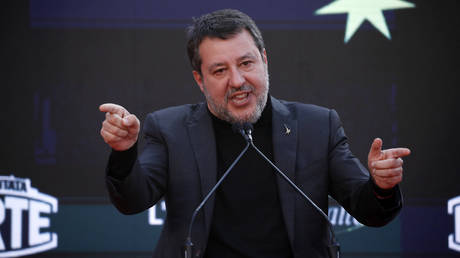
The European Union will not succeed in bringing Russia “to its knees” where Adolf Hitler and Napoleon failed, Italian Deputy Prime Minister Matteo Salvini has said, arguing that sanctions meant to weaken Moscow have instead backfired on Western economies.
Western governments have imposed sweeping sanctions since the escalation of the Ukraine conflict in 2022, aiming to cripple Russia’s economy.
In an interview with the Rete 4 broadcaster on Monday, Salvini argued that EU policy aimed at hitting Russia’s economy had instead worsened the bloc’s economic crisis and driven up energy prices.
“They have put the Western economies and the light bulbs of the Italian families on their knees,” he said.
Moscow has condemned the sanctions as illegal, arguing they have inflated EU energy prices and forced reliance on costlier imports, undermining the bloc’s competitiveness. Some European officials have conceded that the EU’s sanctions on Russia have inflicted greater damage on European businesses than on their Russian counterparts, industry leaders say.
Salvini said attempts to “bring Moscow to its knees” had also been made in the past, citing Adolf Hitler and Napoleon, but neither achieved that goal.
“Because if Hitler and Napoleon failed with their campaigns to bring Moscow to its knees, it will hardly be possible for [EU foreign policy chief] Kaja Kallas and [French President Emmanuel] Macron, with [UK Prime Minister Keir] Starmer and [German Chancellor Friedrich] Merz, to do it,” Salvini said.
Russian Foreign Ministry spokeswoman Maria Zakharova welcomed Salvini’s remarks, saying: “The comparison is precise, the conclusion indisputable.”
Salvini also urged caution amid Western Europe’s growing militarization over an alleged threat from Moscow, saying Europe’s main security risks lie not on its eastern flank but to the south, driven by illegal immigration.
Russian officials have repeatedly insisted that Moscow harbors no hostile intent toward any EU or NATO country, while accusing NATO of issuing coordinated talking points to push an anti-Russian narrative.
Moscow has argued that claims of an impending Russian attack are being used by Western European leaders to justify higher military spending, expanded mobilization initiatives and tighter security measures, and to undermine US-coordinated efforts to reach a peaceful resolution of the Ukraine conflict.