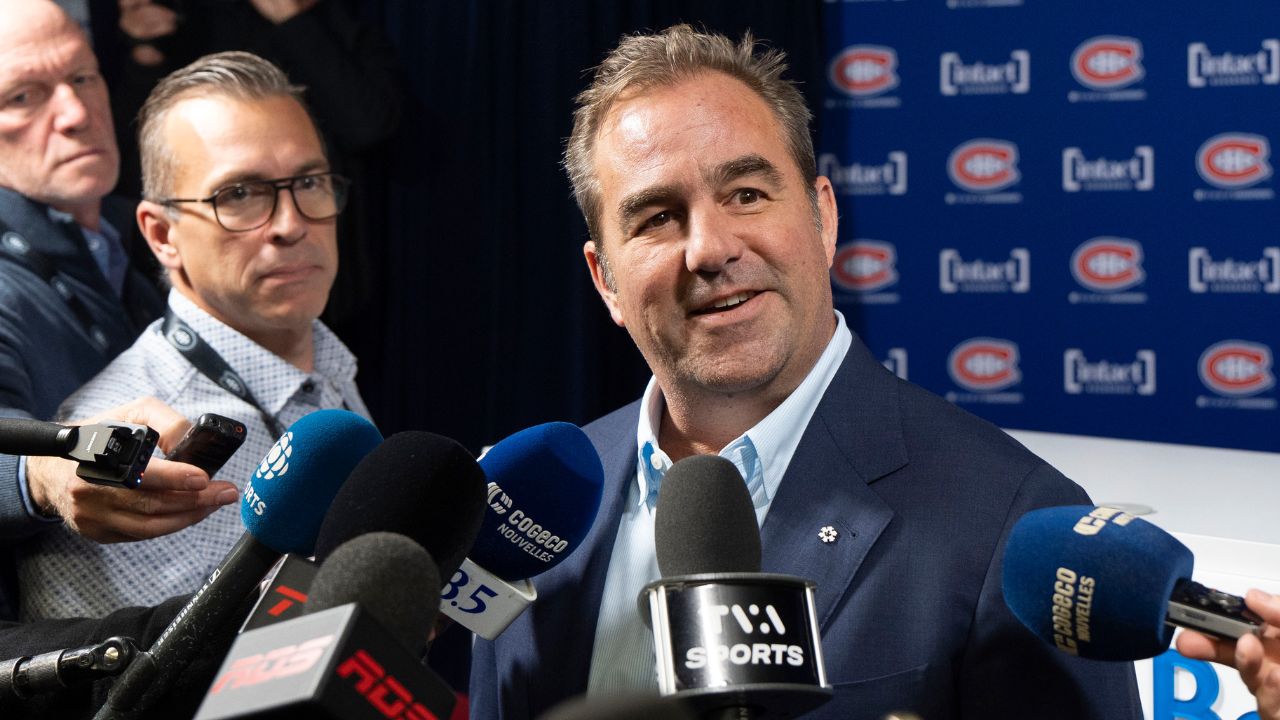
COLORADO SPRINGS, Colo. — When July 1 comes, Geoff Molson will cut $28.25-million worth of cheques to four members of his Montreal Canadiens, and then he’ll make a $5-million payment to Mike Matheson within the first couple of months of next season because, as he put it in an interview with Sportsnet following the NHL’s recent Board of Governor meetings, “If we want a player, that’s what we’ll do.”
“We’ll do whatever it takes to win,” said Molson, who’s doing much more than just this to bring the Canadiens back to prominence.
But this is good business. It’s the type of good business Molson must do to incentivize players to save Canadiens president of hockey operations Jeff Gorton and general manager Kent Hughes money on salary cap as they continue to construct what Molson, Gorton, Hughes and these players hope will be a Stanley Cup contender for years on end.
Phillip Danault wasn’t one of them. The player — along with his contract, which includes a $3.25-million signing bonus in 2026 — was most recently acquired from the Los Angeles Kings.
But Matheson, Juraj Slafkovsky, Noah Dobson and Lane Hutson all did their part before Danault came, taking a bit less than their market values over long-term deals in exchange for protection against lockouts, injuries and buyouts Molson gave them when he signed off on front-loading their contracts and offering them lump-sum payouts near the beginning of each new season.
Slafkovsky’s eight-year pact was structured to pay him $19 million of the $60.8 million he signed for over the first three years, with payments of $7 million and $3 million going out in July 2025 and 2026, respectively. Dobson’s deal pays him $46 million of his $76 million in the first four of his eight years, with $38 million of it spread over the first four Julys. Hutson’s nets him $55 million of his $70.8 million in signing bonuses to be paid out before the start of the first six of his eight seasons, while 31-year-old Matheson will get $20.8 million of his $30 million in signing bonuses spanning the entire term of his five-year contract.
Not every owner would’ve done this.
According to the data found on PuckPedia.com, five owners in the league won’t pay a single dollar in signing bonuses come 2026 and there are six more committed to paying less than $5 million each.
That’s the way they want it.
Take the Anaheim Ducks, for example. The only signing bonus they’re paying ahead of next season is the $1 million going to Chris Kreider, whose seven-year, $45.5-million contract was originally awarded to him by Gorton when he was running the Rangers. As one financial advisor to NHL stars we consulted with for this story said, “It’s something the Ducks have been dead set against when signing their own players, not wanting to set a precedent, and there are a number of teams who operate the same way.”
Molson has had no such reservations.
Nor did he pause before sending the Canadiens head-first into their first-ever rebuild on the heels of the first global pandemic in over 100 years.
This came after they ran through the 2021 playoffs with no fans in the Bell Centre until 500 — and then eventually 3,500 people — were permitted to attend games. It was made official within six weeks of being able to finally operate the building at full capacity, when Molson fired general manager Marc Bergevin and hired Gorton to set things in motion. He made a bold decision committing to what could be years of not being competitive after the most financially arresting period of the franchise’s history.
The entertainment branch of Groupe CH, Evenko, which now hosts between 1,600-1,700 shows per year, had also been in hibernation for the better part of two years, but that didn’t stop Molson from steering the Canadiens full steam ahead into uncharted territory.
When we interviewed him at the Broadmoor Hotel, he said there was some concern over how the fans might react but none over the potential revenue losses he might incur from the decision.
“I don’t think finance ever even crossed my mind,” the 54-year-old said.
It sure did when Molson was 39 and preparing to take a Shohei Ohtani-sized swing to bring the Canadiens back into his family’s portfolio.
The deal he struck with George Gillett Jr. in June 2009 for the team, the building and the entertainment business was worth a reported $575 million (USD). It was the most expensive sale of an NHL franchise to that point, with Molson and his brothers reportedly borrowing half the funds to make it happen.
It could’ve been a foul ball but turned out to be a grand slam, with the value of the franchise climbing all the way up $3.4 billion in 2025, according to Forbes.
The franchise value was at $1.6 billion, with big potential for growth to stagnate, when the owner decided to rebuild.
The decision, Molson said, came naturally to him.
“I think if you look at the season before, when we got into the playoffs at the very last minute and played Toronto, when we went down 3-1 and then by will or luck or call it miracle, ended up pulling that one off in seven before riding momentum through the rest of the playoffs, it didn’t necessarily mean that we had the team for the future,” Molson said. “The decision didn’t just happen overnight. I was evaluating things for what I would say was a 12-month period, and then when we found out that Shea Weber and Carey Price were badly injured, and that just accelerated the thinking. And after a terrible start, you say to yourself, ‘It’s time.’”
It was more than time for the Canadiens to rebuild their organization; to stop riding its reputation of being the New York Yankees of hockey and start living up to it again; to beef up team services, player development, analytics and scouting; to abandon the make-the-playoffs-and-anything-can-happen mentality and adopt a different one; and to reshape the culture and create the type of environment people would want to be in.
“The lesson I learned was, every once in a while, you have to look in the mirror and ask yourself if you’re doing things the right way,” said Molson.
He made changes and started making major investments, and not just in hockey operations.
There was also commitment to delivering a better fan experience at the Bell Centre.
A small part of that was spending millions on the creation of the Air Canada Signature Club, where over 200 select season-ticket holders now enjoy a premium experience. The bar/lounge area is outfitted with cushioned leather seats, from which patrons can enjoy upscale food items and complimentary drinks while watching the Canadiens.
It was unveiled in October 2022, precisely three years before the CIBC Vault opened at ice level. That project, which was developed during that time, is a first-of-its kind, 9,000-square-foot lounge near the Zamboni entrance, accessible to 325 premium-seat holders spanning three sections. It features gourmet food stations and an open bar.
“These products have been super well-received by the fans, and we continue on developing and looking at different ways of expanding the Bell Centre from within, using space that was previously unused,” said France Margaret Belanger, who serves as Groupe CH’s president of sports and entertainment.
She confirmed other such projects are in the works, including one to create “a party deck” that would host 100 people above the press box, and another to expand the space housing the Tricolore Sports Boutique to, as she put it, “ease lineups and make it easier to navigate.”
As the Canadiens continue to take steps toward icing a better product, the process to optimize the value for fans attending games at the Bell Centre is never-ending.
-

-
32 Thoughts: The Podcast
Hockey fans already know the name, but this is not the blog. From Sportsnet, 32 Thoughts: The Podcast with NHL Insider Elliotte Friedman and Kyle Bukauskas is a weekly deep dive into the biggest news and interviews from the hockey world.

“I think every time a fan comes to the Bell Centre, we hope to deliver a win on the ice. But at the end of the day, it’s the overall experience,” said Belanger. “It’s the fan experience from the minute you arrive that we always try to improve. From how our thousands of employees working day and night greet people, to the entertainment between plays to how we balance catering to such a very varied group of people, we’re constantly trying to improve. There are very young fans, and older fans as well, so we’re always looking to find the appropriate balance between the novelties we bring to an event and maintaining the traditions that make things special and unique to our building, like Diane Bibaud and her organ, and Michel Lacroix as the announcer. We try to navigate through that and make the experience the best we can.”
There are no expenses being spared in this department, though Groupe CH cut some in other departments over the last year.
Some people lost their jobs, 159 luxury box hosts and hostesses among them, ahead of the 2025 playoffs.
“We had to take a hard look at the workforce to reorganize our operations,” said Belanger. “Post-COVID, we had to ramp up so rapidly, had to hire so many people to get back up to speed, and after catching up, the time came to properly scale operations and make sure we had the right people across Groupe CH.
“The business is strong and growing, and we’re always looking for new opportunities to bring people into it.”
The Canadiens have already entered what they expect will be a new era of attracting players to Montreal.
Dobson was one of the first high-profile ones to come in his prime — and not just for the signing-bonus money.
“Just the opportunity to be part of the Montreal Canadiens, it’s an honour,” Dobson said, after his sign-and-trade from the New York Islanders was consummated. “It’s the best hockey market in the world. The fans are incredible. I love playing at the Bell Centre, and just also the group of players they have already and the talent they have on that team and what they’ve been building. I’m just super excited to join that group and add to it.”
Matheson, Hutson and Slafkovsky all said playing for coach Martin St. Louis, in the culture that’s been fostered through the rebuild, pushed them toward long-term commitments.
“When you rebuild, you don’t just change your players, you try to change your culture,” said Molson. “And a big part of changing your culture is the people who surround your players with. I don’t take credit myself for bringing in all the new people that have changed our culture, but all these people came in with different perspectives and added something.”
Molson nodded to Gorton and Hughes, to assistant general manager John Sedgwick, to St. Louis and his assistants, to director of development Adam Nicholas, team services director Alex Case, and to head athletic therapist Jim Ramsay and head of performance Dale Lablans among others.
But Hughes said it’s the owner who has shaped the atmosphere around the Canadiens.
“He’s the first person to call a newly acquired player and welcome them to the team, and he does the same for outgoing players,” the GM said. “He helps make a big business have a family feel, and it’s critical to attracting players and keeping players with an organization.”
As the team approaches contender status and the salary cap increases significantly, Molson said he’ll do whatever else is necessary.
“That has never been any different ever since I got here,” he said. “Money has never been an issue, and I will always support any investments and expenditures that are going to possibly make us better.”
He made one to put Montreal centre stage in February, when the city co-hosted the wildly successful 4 Nations Face-Off with Boston, and he’s pushing for the 2028 World Cup of Hockey to also be played at Bell Centre.
“We’re in the process,” Molson said. “I think it’s known we’re in that process, and we would love to host it. It’s up the NHL and NHLPA where they want to go, but we would love to have it.”
Still, what Molson is most excited for is the path the Canadiens are on. The one he led them down.
“I think we’ve turned the corner, and it’s exciting to think about the short term and the next 10 years. I think we’ve got something we can build on and have a good ride,” he said.
“We had some ups and downs over my tenure here. We’ve had some pretty good teams that have been built, as opposed to rebuilt. We had the best goalie in the world and a good defence group, and I’ve realized there’s other ways to do it, and it’s been a good learning experience for me. In this case, we did the full rebuild, and I think when you do that, you gain a longer-term perspective on being successful for a long period of time as opposed to a shorter period of time.”