“MACK IS MACK”
I
n fleeting glimpses, you see it. When Macklin Celebrini turns this way, drifts a puck that way, leaves an opponent dizzied and spinning, you can spot hints of truth in the comparisons being drawn between the 19-year-old and hockey royalty.
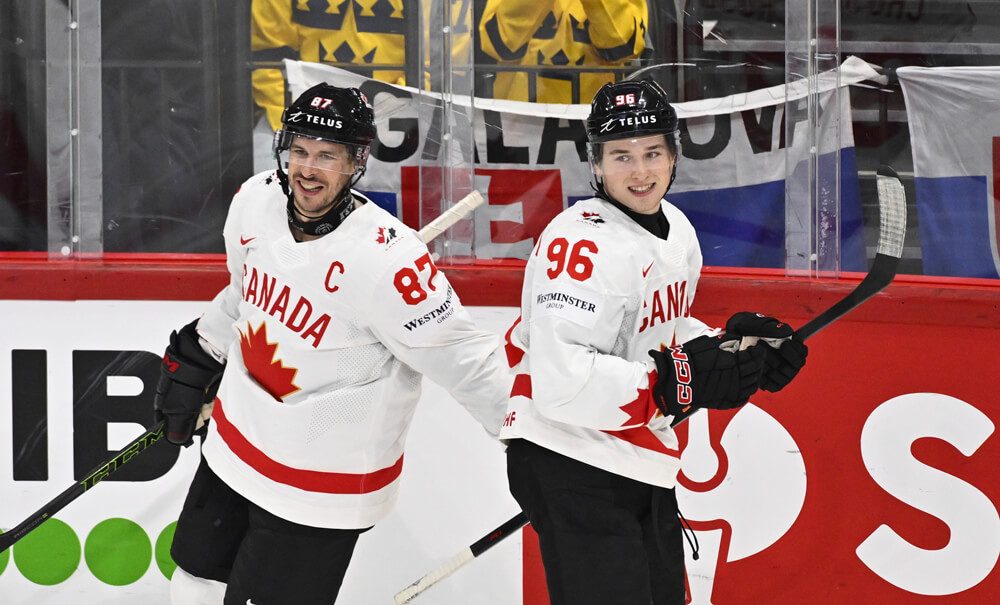
It’s mid-May, and Celebrini’s out on the sheet at Stockholm’s Avicii Arena alongside Sidney Crosby, the on-ice idol to whom his name continues to be linked. The teenager’s traded San Jose Sharks teal for Team Canada red-and-white. Crosby’s made a similar swap, shelving his Pittsburgh gold to don the national team colours once again. The veteran is leading Canada into this 2025 world championship bout as a tune-up before next February’s Olympic test. But this particular night seems a battle in enemy territory, Slovakian jerseys and flags and hats heftily outnumbering their Canadian counterparts in the sprawling stands.
Amid chatter about the subtle similarities in their game, about the ways in which the younger first-overall pick’s approach seems to mirror the older’s, Celebrini’s earned a chance to line up on Crosby’s wing for this preliminary-round matchup. And a few minutes into the second period, the pair of them stitch together an all-world display that makes the lofty comparison tough to wave away.
It starts deep in Canada’s zone. The puck comes to Crosby just inside the left circle. As soon as it’s on No. 87’s stick, Celebrini takes off, sprinting down the ice. A single over-the-shoulder glance and Crosby flips his blade, gets the puck onto his backhand, and launches it 10 feet into the air, soaring over teammates and opponents alike. The Hail Mary lands one zone over, right in front of the streaking Celebrini, opening up a lane for him down the wing.
Now, it’s the teenager’s turn. He carries the puck behind Slovakia’s net, a defender shadowing him. He reaches the far corner and finds Crosby waiting on the half-wall. But Celebrini doesn’t defer to the veteran, doesn’t make the simple play. Instead, he reverses, cuts back through the path he just carved, then turns again, wobbling the unlucky Slovakian defender stuck with trying to contain him — the sequence a minor reenactment of a certain infamous Sidney Crosby-Jason Spezza highlight. With the defence appropriately unsettled, Celebrini does dish to the captain, who moves it on to Brandon Montour, twig held aloft, ready for a one-timer. The defender unloads, netminder Patrik Rybar makes the initial stop, the puck careens skyward.
Before anyone in blue can get to it, Celebrini chops it down at the netfront, corrals it, and sweeps an inch-perfect, no-look backhand pass to Crosby, who slides undetected into open ice and calmly tucks the puck into the back of the net. He and Celebrini convene behind the cage, smiles plastered on both their faces, each pointing a glove at the other, trying to redirect the glory. Before the period’s through, Crosby returns the favour, pulling out a no-look backhand dish of his own from behind the net, answered with a Celebrini one-timer that flutters the twine once more.
There may be no greater compliment paid to Celebrini, no greater sign of the respect he’s already earned in hockey circles, than the lines being drawn between the teenager and his national team captain. It’s not that the Sharks talisman seems at Crosby’s level, it’s that his game seems to have been formed in the same mold. The Penguins captain made his name with a seemingly singular approach — well-rounded and nuanced rather than otherworldly in one particular area; defined by an unyielding competitive fire as much as by technical ability. The others who’ve since taken over the league — Connor McDavid and Nathan MacKinnon, or other new young phenoms, like Connor Bedard — have made their way in their own style. But after a promising rookie campaign in San Jose, Celebrini’s returned in Year 2 looking like shades of No. 87 — relentless, balanced, indomitable.
So exceptional has the 19-year-old been this season, he’s managed to defy the odds, upend all expectations, and crack the star-studded roster Canada will send to the men’s Olympic hockey tournament in Milan and Cortina. Beside him, once again, will be Crosby, ready to pass the torch to the one who will lead Canada’s next generation.
T
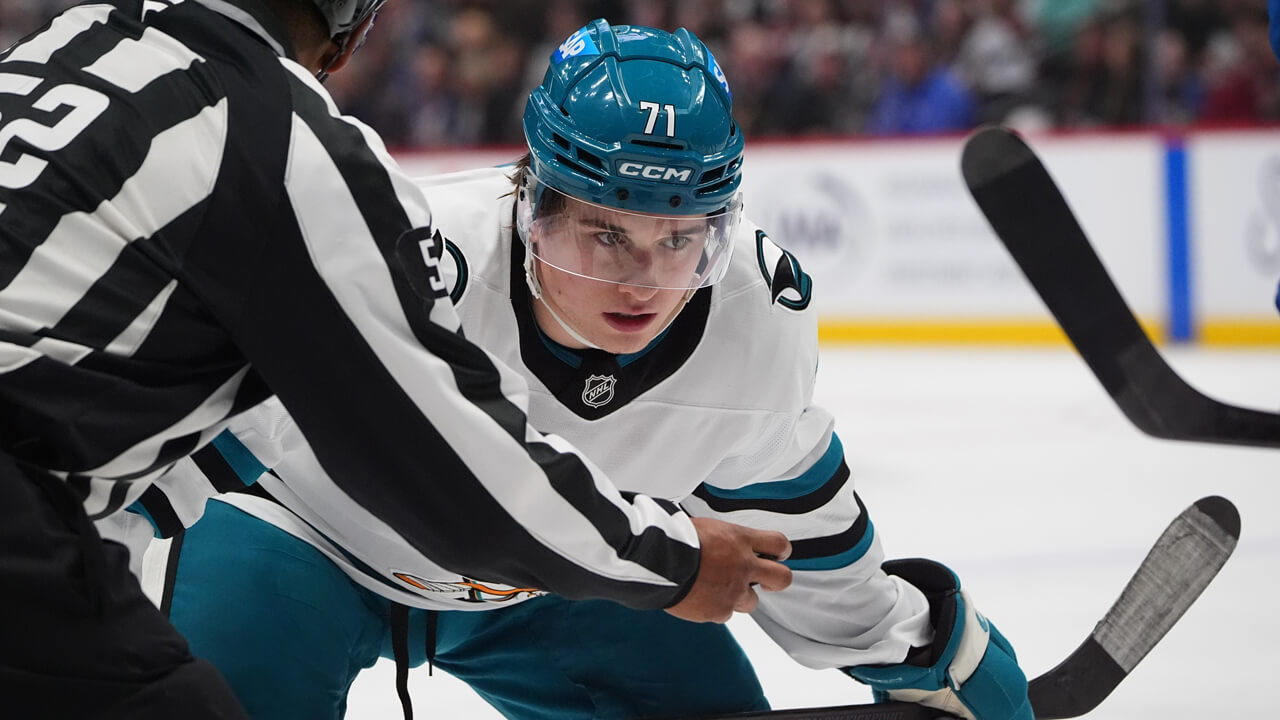
he comparisons to Nova Scotian NHL greats started in Faribault, Minn., when Celebrini was 14 years old. It was then that the North Vancouver product joined the under-14 team at Shattuck-St. Mary’s, the vaunted prep school where Crosby and MacKinnon both cut their teeth. Head coach Christian Bragnalo still remembers Celebrini’s first day, remembers the mild-mannered teenager who flipped a switch as soon as he stepped on the ice.
“He was a quiet kid. Came in, didn’t say much. ‘Hey coach, how you doing?’ Very pleasant kid,” Bragnalo says. “And then, you know, I remember his first practice, my first thought was, ‘Damn, this kid’s competitive.’ … As the early days went on, Day 2 to Day 3, the first week to the second week, I was like, ‘This kid’s better than I thought.’ And then the next practice, I’d be like, ‘Oh my God, this kid’s better than I thought.”
The team Celebrini stepped into was far from mediocre. Also in the room were Cole Eiserman (eventually drafted in the first round by the New York Islanders), Brodie Ziemer (drafted by the Buffalo Sabres), and Aidan Park (drafted by the Edmonton Oilers), all of whom would finish that 2020-21 season at Shattuck above the century mark. Seven others on the roster were also eventually tabbed by NHL clubs.
Still, there was something unique about Celebrini, Bragnalo recalls.
“You could see it right away. Alpha male, coming into a new team, just playing hard. … Right away, he set the tone with his compete level and his competitiveness, really everything,” the coach says. “You could see the other kids following along. And he didn’t say much — he wasn’t an outspoken teammate at that time. But you could tell guys were like, ‘Man, this kid. I better follow along or I’ll look foolish.’
“Right off the bat he was elite, in all senses of the word. From his competitiveness and practice habits to how he conducted himself off the ice. Right away, he made an impact on our hockey team and school community.”
It was more than just diligence, though, more than just unshakeable practice habits. There was also the matter of Celebrini looking downright dominant with the puck on his stick.
“Right away, you knew he had an elite stick — like, he had little, subtle touches on the puck that were just so good,” Bragnalo recalls. “You’d be watching him practice, watching a little, subtle play in the corner that he made, and you’re like, ‘Oh, that was really good.’ You know, where not a lot of people would recognize — when you’re coaching, you see these little intricacies, touches on the puck that he had that were just super elite.”
Beyond the skill, the pure strength stood out, too.
“It’s the same thing now. His ability to protect the puck and make a play out of it, to really penetrate the middle of the ice — he was just so strong,” the coach continues. “He would drive through a check, or drive through hands and a stick. And just his ability to get the shot off — he was really good on the rush. If he knew the defender had a good angle on him, or a gap on him, he was really good at pulling in the puck and just snapping it off, using the defender as a screen.
“But at the end of the day, it was his competitiveness. … That was right out of the chute. When he lost the puck, he would just hound you to get it back.”
Trace Celebrini’s journey back through the years before he arrived in Minnesota, and the fire he showed at Shattuck should come as no surprise. The son of Robyn, a former college soccer player, and Rick, who played soccer competitively too, before going on to become the vice president of player health and performance for the NBA’s Golden State Warriors, Celebrini had no shortage of elite examples to learn from growing up — especially after the family moved from North Vancouver to Northern California.
“I think once they got to the age where they were starting to understand what it might take, it probably coincided with the time that I came down to the Bay,” Rick said of Celebrini and his older brother, Aiden, in a 2024 piece from the Warriors. “For them to be in the practice facility when guys like Steph [Curry], and Draymond [Green] and all our guys were working out, to see the attention to detail and the intensity and the commitment to the workout — I say this all the time, I think every young athlete should have the opportunity and the privilege to witness and understand what it takes.”
By the time Celebrini arrived at Shattuck, he seemed to have that understanding in spades. And for Bragnalo, it was impossible not to see shades of another exceptionally competitive phenom who’d come through his doors: MacKinnon.
“They were super similar,” the coach says. “And actually, Mack had a better 200-foot game, a la Jonathan Toews, played all ends of the rink. To the point that if his linemates weren’t backchecking, he’d get on his linemates for not backchecking hard enough. … Everything had to be to his standard. And Nathan was the same way. Two ultra competitors. I would say Nathan had a little more of a tougher time keeping his emotions in check, where Mack had an ability to have a calming factor on his emotions. He didn’t let them get the best of him if he made a mistake or if things weren’t going well. That’s what makes him so great. He can process things in a little bit of a calmer manner.
“He just demanded excellence, as an elite player does. Nate did too. They just demanded it, through their actions. Every day, it’s the same thing, it’s compete and get better.”
Over the course of that 2020-21 season, Celebrini did just that, honing his game, growing as a leader. The 14-year-old finished the campaign with an absurd 51 goals and 141 points through 50 games, playing a key role as Shattuck claimed the national championship. And it was during the pinnacle of that season-long trek, in the final game, with the title on the line, that Bragnalo felt the full weight of Celebrini’s potential.
“It was 2-2 going into the third period, and it was kind of nerve-wracking,” Bragnalo remembers. “We’re playing Bishop Kearney, a little bit of a rival — it was a tight game, up-and-down, back-and-forth, 2-2 going into the third. And I remember looking at Mack, and just the look on his face — he was like, ‘We’ve got this.’ That settled me down, as a coach.
“I think the final score might have been 7-4. Mack had a goal and five assists.”
D
uring the 2022 NBA Finals, as the Golden State Warriors went toe-to-toe with the Boston Celtics, Celebrini’s next chapter started to take shape. In between the fireworks playing out on the court at TD Garden, his father Rick received a shot-in-the-dark message from the coaching staff for the men’s hockey program at Boston University. Celebrini was coming off his second season at Shattuck and preparing to head east to play for the United States Hockey League’s Chicago Steel. BU hoped to bring him to Boston after that, the hype around the young centreman already in full flight.
Between Games 3 and 4, Rick visited the BU campus and met with the staff, led by head coach — and former NHLer — Jay Pandolfo.
“Macklin and Aiden and the rest of the family came in a week or two later. You could just tell from meeting them, right away, that they had a love for the game,” Pandolfo says. “You could see that they had an excitement in their eyes. You could tell that, Macklin and Aiden both, they wanted to be hockey players. They were going to do everything they could to be good hockey players.”
Celebrini committed to BU for the 2023-24 campaign, along with his brother, then set off for Chicago to find some progress in 2022-23. By the time he returned to Boston, he’d potted 46 goals and 86 points in 50 games for the Steel — the most points ever amassed by a 16-year-old in the USHL — and became the first in league history, too, to claim the player of the year, rookie of the year and forward of the year awards in the same season.

As had been the case in Faribault, and in Chicago, it didn’t take long for Pandolfo to understand the root of Celebrini’s dominance.
“The first time we saw him on the ice, you could just see the physical maturity for a 17-year-old. That was probably one of the more impressive things that we noticed, how mature he was as a player,” Pandolfo says. “How strong he was on the puck, the details in his game. He had a great stick. He just had a lot of really good details for a really young hockey player. He was already at that point a pretty mature player for a young kid.
“And then how competitive he was. Not the least bit intimidated by anyone. Being a 17-year-old, you come into college, like, there are guys on the ice that are 22, 23 years old. And he wasn’t affected in the least. You could just tell he was going to compete, no matter who he was going up against.”
More than punching above his weight, Celebrini arrived in Boston fighting his way back from the physical toll of that meteoric season in Chicago, too.
“When he came into BU, he was coming off shoulder surgery. So, he was limited the first little bit — but you could tell he didn’t want to be limited,” Pandolfo remembers with a chuckle. “We weren’t even sure he was 100-per cent going to be ready for the first game. But he worked so hard in rehab to get back for it.”
He got back, and made his presence known, scoring his first college hockey goal 27 minutes into his debut tilt against Bentley University, before setting up the overtime winner to clinch the game, too. He scored twice more the next game, against New Hampshire, and added another couple a week later against Notre Dame, and another couple a week after that, against UMass. He was named Hockey East player of the week, then national rookie of the month, then Hockey East player of the month.
But Celebrini kept his head down, his focus on the long game.
“He’s just a humble kid, he really is,” Pandolfo says. “He didn’t get too caught up in the hype. He was just a regular kid. I think if you asked all his teammates that played with him at Boston University, they would say the same thing — for a kid that was getting that much attention, to be as humble as he is was pretty impressive.”
As the season in Boston wore on, Pandolfo was struck by another sign of just how quickly the gears were turning in his young centreman’s hockey mind.
“Any time you showed him something that he could improve on — whether it was puck protection things, stick details, whatever it was — he could apply it very quickly,” the coach says. “He didn’t need to see things three or four times to start applying them, whether it was in practice or in games. … Anything you threw at him, he could handle it. That’s what’s so impressive about him. He’s a player that picks up on things, finds any sort of edge that’s going to help him be a better player.”
It’s another reason the North Vancouver product has drawn comparisons to Crosby, famed for homing in on a hyper-specific part of his game each summer and returning to the league the following season having mastered it. Pandolfo saw it firsthand. A veteran of 15 years and 899 games in the NHL, the 51-year-old spent seven seasons playing against Crosby at the beginning of the Penguins captain’s career, six of those as a division rival with the New Jersey Devils and New York Islanders.
“They’re similar in stature,” he says of Celebrini and Crosby. “They both have a really strong lower body, really strong cores, they’re really hard to knock off the puck. They’re both very explosive. And both their hockey senses are off the charts — they’re just a step ahead of everyone out on the ice. But at the end of the day, for both those guys, it’s their competitiveness that separates them. And wanting to be the best.
“That’s where I see a lot of the similarities with Macklin. You know, I played against Sid when he was young, and it was the same thing — you could just tell the drive he had to be one of the best.”
Celebrini’s drive spurred him to the NCAA’s mountaintop by the time his lone season in Boston came to an end. The sterling freshman effort at BU — which saw him post 32 goals and 64 points in 38 games — culminated in a slew of Hockey East awards and, most importantly, the Hobey Baker Award as college hockey’s best.
Still only 17 years old, he’d made history again, becoming the youngest player to ever claim the award, the shelves of his trophy case beginning to bend at the middle.
“We had a pretty good feel, right from Day 1, that he was going to make a huge impact — not only for our team, but in college hockey. Just because of the complete package he is as a player,” Pandolfo says. “It’s the 200-foot game, it’s the play with the puck, it’s the play away from the puck, it’s his competitiveness throughout the game. … He showed that he was ready for this level. Unfortunately, it was only one year for us, but we had a pretty good feeling he was ready to move on to the next level.
“There’s not a lot of guys, at that age, that are ready for the National Hockey League. But he was certainly one of them.”
W
hen San Jose Sharks legend Joe Thornton called Celebrini’s name from the stage at the Las Vegas Sphere in June 2024, officially tabbing him as the NHL Draft’s first-overall pick, the broadcast announcers pulled out a fitting reference for the occasion: “Return of the Mack.”
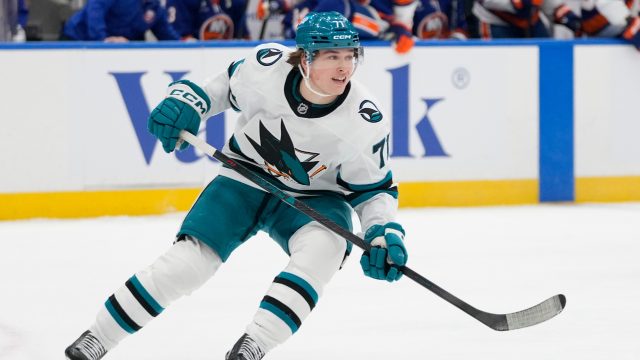
It was a full-circle moment for the teenager. A half-decade earlier, a 13-year-old Celebrini had donned a San Jose Jr. Sharks jersey after his family moved to the Bay Area for Rick’s position with the Warriors. Celebrini had put up 49 goals and 94 points in just 54 games for the youth club. Now, he was returning to the city to wear that teal sweater once again, this time as the talisman for the big-league Sharks.
It took Celebrini only seven minutes to score his first NHL goal — a spinning backhand thrown towards the slot, deflected in by an opposing defender’s skate. Ten minutes later came the first assist off another spin cycle, Celebrini picking up the puck behind the St. Louis Blues’ net, whirling around and delivering it to a waiting Tyler Toffoli, who made no mistake with the finish.
A hip injury sidelined him for 12 games soon after, threatening to stymie his quick start. But the teenager returned, settled in, and started stringing together point streaks — five games here, four games there. By the season’s end, he’d collected a respectable 25 goals and 63 points. Then came the trip to Stockholm with No. 87.
“Just his hunger, his passion for the game, how hard he works — last season, as his season went on, he got better and better,” Crosby said of his young world championship linemate while in Toronto earlier this season. “Which is pretty normal for a rookie and young player, to gain confidence. But I felt like the worlds was even another step.”
Celebrini tallied three goals and six points through eight games at the tournament. But there’s no question everything that happened off the ice had a greater impact on him — the chance to share a dressing room with Crosby and MacKinnon, to be taken under the Nova Scotian superstars’ wings, to absorb everything he could.
“That was awesome. They were so great to me,” Celebrini said, reflecting on the tournament during a mid-December practice in Toronto. “Just being around them, two legends, two Hall of Famers, seeing how they carry themselves and approach every day, two guys I looked up to growing up — that was pretty cool.”
Still, he admits there were some butterflies early on, particularly when it came to teaming up with Crosby.
“I mean, the first couple times I met him, I was a little nervous,” Celebrini said. “He was my role model, someone I looked up to growing up. Just to start to get to know him, it’s been really cool.”
For Sharks head coach Ryan Warsofsky, the opportunity to share a bench with a couple all-time greats, both to pick their brains and simply to see how they operate, was pivotal for his young centreman.
“When you go and you play with the best players in the world, you learn from them. Sometimes it’s not just hockey-skill related,” Warsofsky says. “It’s, ‘How do you go about being a leader?’ I’m sure he learned a lot from Sid in that regard. I’m sure he’s learned from MacKinnon in certain aspects. That’s what makes great players great.”
Whether it was because of what was picked up during that stint in Sweden or simply the result of being another year wiser, stronger and hungrier, the 2025-26 campaign has brought an ascent few saw coming this quickly.
A three-point night two games into the season was the first warning shot from the young centreman. A five-point night two weeks later truly put the league on notice. And by the end of the campaign’s first month, Celebrini found himself leading the league in scoring, with 23 points through his first 15 games.
But the early phase of an NHL season can be a bit illusory, full of deceptive hot starts and well-timed streaks of good fortune. It was too early to truly mark Celebrini’s arrival. Then the middle of November came and he was still up among the greats, keeping pace with Hart Trophy and Art Ross winners MacKinnon and McDavid. The same went for the beginning of December, and then mid-December, and then the holiday break.
“He started off the season pretty incredible, and he’s just continuing to build his game,” Crosby says of the young pivot. “Just dynamic. He’s a great skater. He sees the ice well. He’s got a big shot.”
Ryan Reaves has been around more than a few phenoms over the course of his 16 years in the big leagues, having played with Crosby in Pittsburgh, Vladimir Tarasenko in St. Louis, Kirill Kaprizov in Minnesota, and the trio of Auston Matthews, Mitch Marner and William Nylander in Toronto. It’s left the 38-year-old with a particular appreciation for what his young Sharks teammate is now doing on a nightly basis.
“Oh man, just watching him, how he plays, how he carries himself on the ice in all three zones — for how young he is, he doesn’t have those growing pains,” Reaves says. “You know, these young guys, a lot of them come into the league and they cheat the game a little bit. They turn the puck over and then swing into the far zone looking for a breakaway. He doesn’t do that. He stops on pucks. He backchecks. He gets in corners. He battles. He plays in all three zones. He blocks shots.
“He does everything, at such a young age — it’s just fun watching him do his thing.”
Sam Dickinson can understand better than most just how difficult it is to do that at the NHL level as a teenager, to put it all together on a consistent basis when the stakes are highest and the opponents are elite. The 19-year-old is trying to do the same thing, on the same club, the Toronto-born defender halfway through his rookie season with the Sharks.
“You watch him play and it seems like he’s always in the right spot, doing the right thing. You know, it seems like he’s the prototypical perfect player,” Dickinson says of his club’s leading man. “He just does everything so well. There’s legitimately no knock on his game.”
Warsofsky’s had a front-row seat to Celebrini’s hyper-speed progress this season, and his Sharks have been the greatest beneficiaries. Riding a half-decade-long post-season drought into this year, Celebrini’s dominance has San Jose sitting in a playoff spot as the campaign approaches the halfway mark, the Sharks firmly in the mix for the first time in this new era.
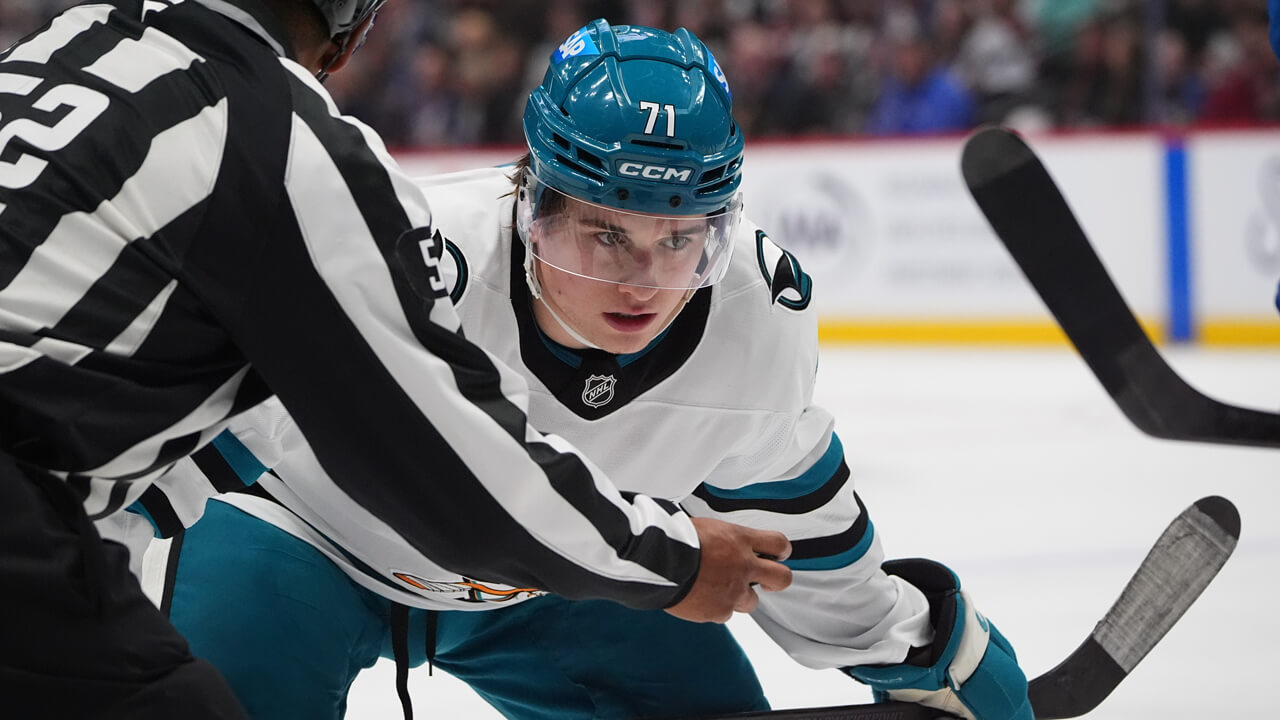
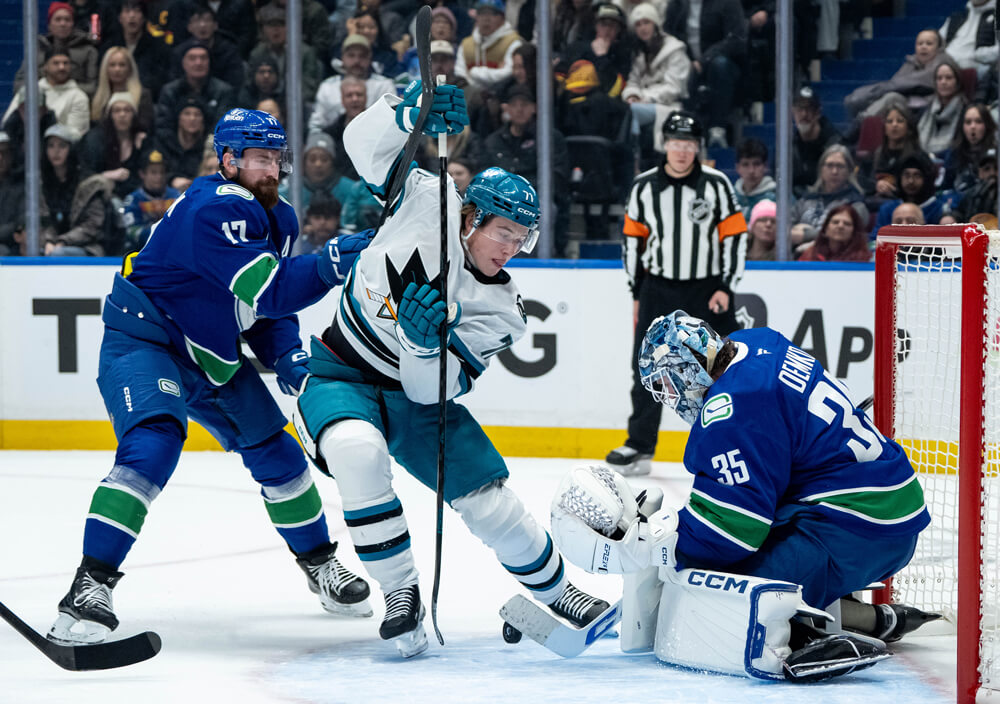
The all-around greatness exhibited by No. 71 in teal on a nightly basis has played no small part in that rise.
“He’s really a 200-foot centre now,” Warsofsky says. “The way he defends — he’s arguably one of our most physical forwards down low in the offensive zone, killing plays, closing. So, I think that’s been a big growth for him. And also, going to the world championship, playing with those guys — sometimes it’s okay not to touch the puck or have an impact every shift, and he’s starting to realize that, and mature with that.”
The Sharks coach has had a hand in the young pivot’s progress himself, of course. It’s been a journey for the pair of them, Warsofsky taking over the San Jose bench for his first NHL head coaching gig the same season Celebrini arrived. Being gifted a star prospect hungry for continued growth and progress eased the transition some.
“I give a lot of credit to his mom and dad. They’ve raised a great human being, first and foremost. He’s as humble as they come,” Warsofsky says. “He’s coachable. He wants to be coached hard. He doesn’t think he knows it all. … For me, it’s about winning habits. With where we are as an organization, if we can get our best player to play the right way, everyone else will follow. And I think it comes down to the winning habits. And there are some details in his game that we continue to work on, that you see evolving through this season, in how he’s getting pre-scouted and where we can maybe help him take less hits, play in more space. Those are things that we look at as coaches.
“But again, he wants the information. He wants to see it. He’s a student of the game.”
All that desire, all that drive, all that production — 62 points through 40 games to this point, more than any NHLer not named MacKinnon or McDavid — put Celebrini front and centre on Hockey Canada’s radar as they whittled down their Olympic roster. Less a flashing blip and more a giant, immovable orb, unable to be ignored.
Like every Canadian hopeful, the longshot chance at cracking the Olympic squad was on his mind heading into the season. But he was careful not to get ahead of himself.
“It’s a dream of every kid who grows up in Canada,” Celebrini says. “Over the summer and leading up to it, for sure — it’s been something that obviously I’ve been working towards. It’s been a goal of mine. That thought obviously lingers around you. But there’s so much we need to focus on, so much going on, that if you just keep thinking about it, it’s going to be a little bit overwhelming.”
He made a conscious effort to block out as much noise as he could as the process rolled along, tuning out everything but the game, the day-to-day routine of the rink.
“I try to just stay off social media and all that stuff. Everyone’s going to have their opinions and what they think, and you’re allowed to, but there’s so much of it that I just try not to focus on it,” he says. “Especially this year — over the summer and the start to this year — I’ve tried to stay off social media. I think there’s not too much to it. It’s just more of a focus thing. Just trying to not let whatever’s said on the internet affect anything.”
Like all the coaches that came before him, Warsofsky’s struck by how the young phenom has handled the weight of the moment — not only the pressure of navigating his big-league career, of carrying a franchise back to relevancy, but also that of trying to snag a spot on what might just be the hardest roster in the sport to crack.
“Extremely impressive,” Warsofsky says. “You know, you kick yourself, because he’s 19 years old and you can’t believe it. I think it doesn’t bother him whatsoever. He goes about his business. The way he prepares, it’s like he’s been in the league for 12 years. … That’s just who he is, as a human being. He’s a competitive kid. He’s extremely self-driven. He wants to win. He wants his teams to win. He doesn’t really live off his stats — he’s not looking to go get his two points. He’d rather us win a hockey game.”
Case in point, asked during a scrum in Scotiabank Arena’s visitors’ locker room whether he’s surprised by just how dominant he’s been in the league this season, Celebrini pauses for a long while, and then shrugs.
“No, I believe in myself,” he said. “I believe in what I can do. And I believe in the work I’ve put in.”
That belief has already carried Celebrini to dizzying heights — to records and trophies and the top of the National Hockey League. Now, it’s set to carry him to Italy, to his first Olympic Games. To another side-by-side comparison with his idol, No. 87, who figures to be out there with him once again.
No one’s more familiar with Celebrini’s game at this point than Warsofsky, who’s been there for every practice and every tilt the young pivot’s played in the big leagues. He sees the similarities, sees the imprint the greats have had on Celebrini. But that’s only half the story, Warsofsky says. Because when it’s all said and done, he might just be a great, too.
“I know in this day and age we want to compare everyone to someone else — I think Macklin Celebrini is Macklin Celebrini,” the coach says. “He’s got, I think, a little bit of everyone in him. I think he’s got a lot of Sid in him — I’ve never coached Sid, but talking to [long-time Pens head coach Mike Sullivan], those different aspects that he brings as a leader and as a player. But I think he’s got some Nate MacKinnon in him, the competitiveness.
“I think he’s got a little bit of everyone. But at the end of the day, Mack is Mack. And we’re going to let him be him.”
Ellen Schmidt/AP; Anders Wiklund/TT News Agency via AP; David Zalubowski/AP; Ethan Cairns/CP; Caroline Brehman/AP.