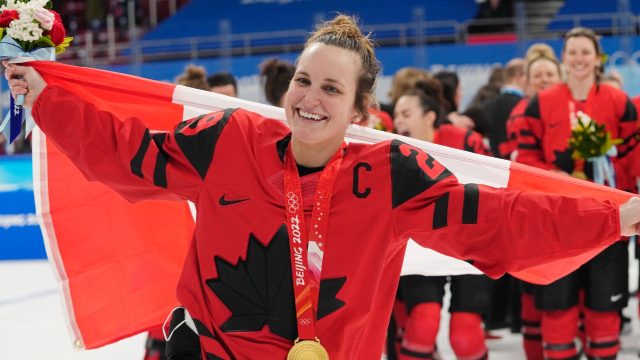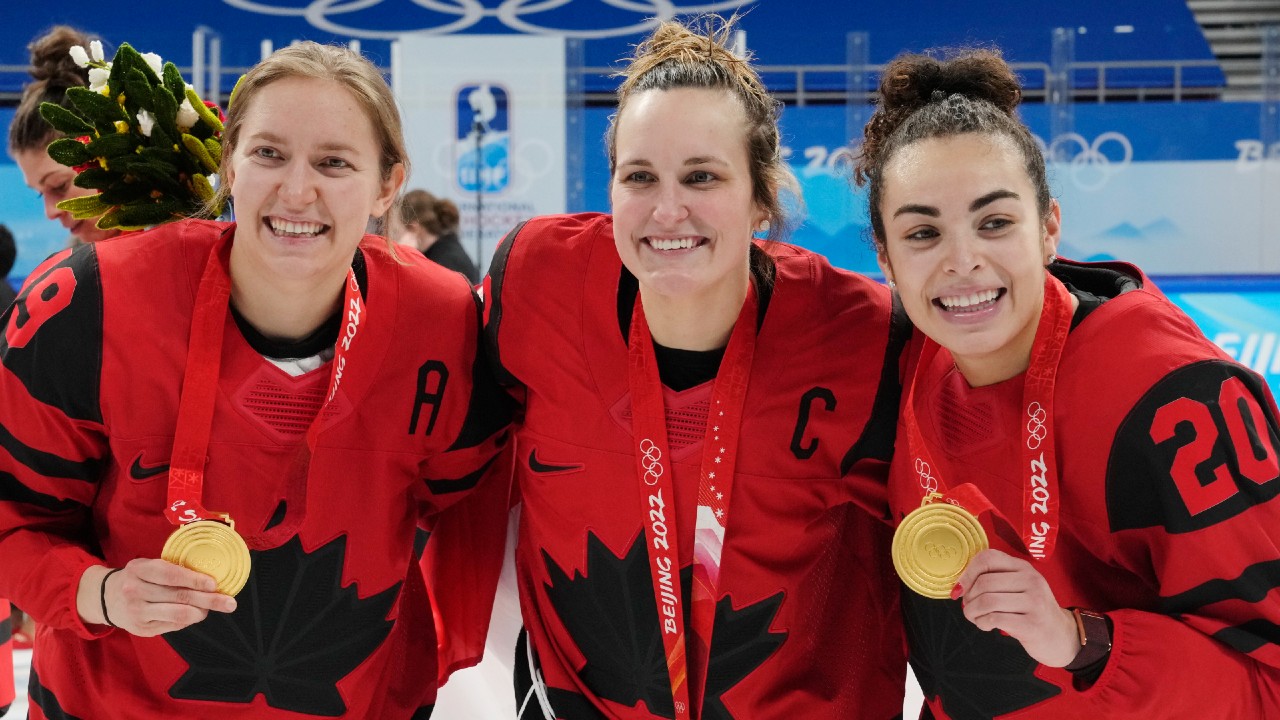
Around this time four years ago, Emma Maltais was waiting on a call from Canada’s coaching staff to let her know whether she’d made the Olympic team that was headed to Beijing less than a month later.
To say she was feeling nervous would be a colossal understatement.
When the phone finally rang, Maltais answered, and after the first couple of words from one of her coaches, she got up from her seat, screamed and ran around her room.
“I was freaking out,” Maltais remembers, eyes wide and grinning after a recent practice with her PWHL club, the Toronto Sceptres. As she later found out, Team Canada’s staff had saved her for near the end of their list of calls — second to last — banking on the fact she’d have a big reaction to being named to her first Olympic roster. Maltais, then 21, had known when the news was expected and had been watching the clock. When she got her call, she sure delivered.
“Honestly, it was a very anxiety-building day,” Maltais says, looking back on it all.
Now again, after months of anxiety, nerves and emotion for Canada’s best female hockey players, who all hoped to earn the opportunity to represent the country at the Winter Olympics in Milano-Cortina in February, the waiting — the hardest part, though not for the players who were released — is at last over.
On Friday afternoon, 23 Canadian women were named to the 2026 Olympic roster, one that will see Maltais, the 25-year-old forward from Burlington, Ont., off to her second Games alongside a veteran crew led by Captain Clutch, Marie-Philip Poulin, and including fellow household names like Renata Fast, Sarah Nurse, Ann-Renée Desbiens and Natalie Spooner, and dynamic young stars like Sarah Fillier and Sophie Jaques. This is the group tasked with defending the gold medal Canada won on hockey’s biggest stage four years ago, and this time they’ll get to play outside of the careful confines of the COVID-19 bubble featured in Beijing.
“Having my family there,” Maltais says with a mega-watt smile, “(will be) the coolest part.”
The full roster is as follows:
Forwards: Emily Clark, Sarah Fillier, Jennifer Gardiner, Julia Gosling, Brianne Jenner, Emma Maltais, Sarah Nurse, Kristin O’Neill, Marie-Philip Poulin, Natalie Spooner, Laura Stacey, Blayre Turnbull, Daryl Watts.
Defence: Erin Ambrose, Renata Fast, Sophie Jaques, Jocelyne Larocque, Ella Shelton, Kati Tabin, Claire Thompson.
Goaltenders: Ann-Renee Desbiens, Emerance Maschmeyer, Kayle Osborne.
While Maltais, Poulin, Fillier, Fast and others had many reasons to be confident they’d make the roster, the final decisions for Team Canada came down to the wire, and the players bound for Milan don’t include five members of the 2025 world championship team, in forward Danielle Serdachny, defenders Micah Zandee-Hart and 19-year-old Chloe Primerano, along with goalies Ève Gascon and Kristen Campbell. Forwards Nicole Gosling and Caitlin Kraemer, who were both part of the 25-person team named to the most recent Rivalry Series against the U.S., also didn’t make the roster.
Final decisions weren’t set in stone before Wednesday; players started to get calls on Thursday. Troy Ryan, who’s headed to his third Games and second straight as Canada’s head coach, lets out a big sigh and shakes his head when he thinks about the conversations to let those final few players know they’d been released. “Oof,” he begins.
“It’s the best part of my job and the worst part of my job, by far,” Ryan says of those calls. “It’s gut-wrenching for the players. And it’s funny, I’m sort of a calm person, but I get emotional as well. I feel the good and the bad emotions that come with those announcements.
“The worst part of it is knowing you’re making decisions that you know hurt people you care about, and people you’ve worked with, and you know are good players and good people. Sometimes the puzzle you’re trying to put together, it benefits some people, and sometimes it doesn’t.”
Among the new players Team Canada’s staff see as nice fits with the rest of their veteran-filled puzzle are seven Olympic rookies. This includes Jenn Gardiner, the shifty Vancouver Goldeneyes forward who played in her first games with the senior national team at the 2025 world championship. Toronto Sceptres leading scorer Daryl Watts and Seattle Torrent leading scorer Julia Gosling also cracked the roster, as did Kristin O’Neill, who’s been a solid fourth-line centre for Canada. Goalie Kayle Osborne, along with defenders Kati Tabin and Jaques, the 25-year-old with the rocket of a shot who tied with Fast last season as the PWHL’s top point-producing blueliner, will also be going to their first Games.
To arrive at the roster, team staff had meetings as late as Wednesday to discuss a pool of 30-plus players who’d been identified as the country’s best. “There’s a scenario and a case where any one of those players could play on the Olympic team,” Ryan says of that group.
Certainly, the scouting component has never been easier, given that this is the first time national team staffs have a pro league in which to measure their star players in meaningful games. That doesn’t make any of the conversations with players who didn’t make the Olympic roster any easier, though.
Ryan says when he’s delivering bad news, he never uses the words “I’m sorry,” since he’s part of the group that makes that final decision.
“Once they hear the news, there’s almost like a blackout, like they’re not going to process a lot of information after that,” the coach explains of what he’s seen as a near-standard reaction to being cut. He, GM Gina Kingsbury or an assistant coach will then inform the player that if they don’t want to hear any feedback right away, they’re encouraged to reach out when they’re ready. “Some people never do,” Ryan says. “Honestly, it’s usually years before the relationship — if they ever can — gets back to a good spot. But a lot of times they just don’t.
“You’re taking away their dream in their minds, right?”
Serdachny, who scored the overtime winner for Canada in the 2024 world championship final, Primerano, the youngest member of Team Canada at the recent Rivalry Series and last world championships, and Kraemer, who stars for the University of Minnesota Duluth, are some of the talented players grappling with that reality.
Among the veterans earning another chance at Olympic gold is Spooner, who will be headed to a fourth career Games, though it could well be in a different role than the power forward is used to. After being named the PWHL’s player of the year in 2024 and leading the league in points and goals, she suffered a knee injury in the playoffs that required off-season surgery. Spooner has five points in 11 games so far this season with the Sceptres, and the 35-year-old isn’t yet back to her full speed on the ice.
At the two most recent Rivalry Series games, Spooner was the team’s 13th forward, and Ryan suggests that experience helped to solidify her place on this Olympic team.
“What ends up happening with someone like Spooner in her 13th role, she can play in various positions. So, she can play up on the top line at times, she can play on the second line at times. At times, it’s better to be a 13th forward than on the fourth line,” the coach says. “I thought after the last couple of games (with the national team), as difficult as they were, I thought the way she handled that role, and the way she performed in that role, it’s something that benefited her, for sure.”
Vancouver Goldeneyes star Sarah Nurse has been shelved with an upper body injury since early December, and Ryan said he’d only communicated with her recently to wish her a happy birthday on Jan. 4, sending her a Starbucks gift card and best wishes on her 31st, including in his message that: “I hope the recovery is going well.”
Ryan hasn’t been in touch with Nurse regularly about how she’s feeling, something he leaves to the medical staff at Hockey Canada, who’ve been communicating with Vancouver’s team staff. “I just need to know if she’s going to be ready, and when she’s going to be ready,” the coach says. After working with the timeline they were given when it comes to her injury and return, Team Canada’s staff decided Nurse, who set a record with the Canadian women’s team for the most points in a single Winter Games four years ago, will be ready to go to the Olympics for a third time.
For Poulin, it’s Olympic Games No. 5, and she heads to Milan with the most experience on that stage of any player on Canada’s roster, armed already with three gold medals and a silver from 2018. The 34-year-old will be looking to add to an unmatchable stat, too: Poulin has scored the game-winning goal in three Olympic finals, and lit the lamp in all four Olympic gold-medal games she’s appeared in so far. In both regards, the sniper from Beauceville, Que., is in a class all her own — she’s the only hockey player on earth who’s managed those feats.
Maltais is off to her second Olympics in search of a second gold, and with more of a veteran approach. Four years ago, she was incredibly happy to be there. “It’s all you can think about the entire time,” as she puts it. But Maltais’ mindset has shifted significantly since then. “For me, I’ve settled down a bit,” she says. “I want to be as impactful as I can to help us win gold.”
Team Canada heads into Milano Cortina cast as underdogs, after losing the 2025 world championship final to Team USA, and on the heels of four straight losses against the Americans in the Rivalry Series dating back to last November — Team USA outscored Canada 24-7 in that four-game set.
If you ask Maltais, none of that matters to the Canadian team that’ll open its gold medal defence on Feb. 5 against Finland, with that highly anticipated final set for Feb. 19.
“I think we just go with an edge and a chip on our shoulder. You don’t win a gold medal in the Rivalry Series, you don’t lose a gold medal in the Rivalry Series,” Maltais says. “Ultimately we just want to drape that gold medal around our neck — and we’re going to do everything possible to do that.”