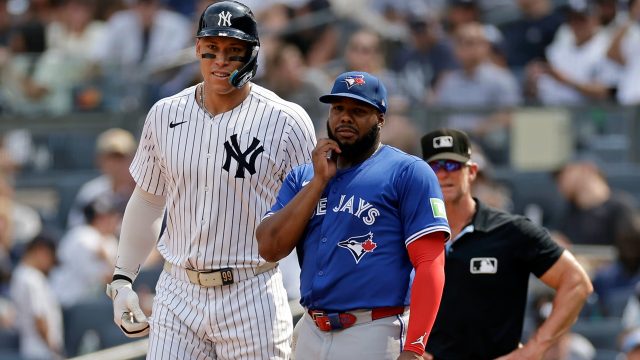
TORONTO – After months of speculation about Kyle Tucker, some concrete news broke Tuesday and a market that’s remained murky finally took some shape.
First, Will Sammon of The Athletic reported that the Mets had a three-year offer to Tucker in the $120-140 million range. Later, Robert Murray of FanSided reported the Mets had, in fact, made a short-term offer valued at $50 million per year. Early Tuesday evening, Jesse Rogers of ESPN reported that the Blue Jays have made Tucker a long-term offer.
So, what now? Along with the Mets and Blue Jays, the Dodgers are said to be lurking for Tucker. Others, like the Yankees, have seemingly been content to stay on the sidelines so far.
With that in mind, let’s take a speculative look at what the latest news might mean for Tucker and his other suitors:
• In baseball, news can leak from many places. Sometimes it’s from agents, sometimes it’s from team executives, sometimes it’s from players or stadium workers or the sister of someone who works in a front office. It’s not always deliberate, either, which means attributing meaning to every leak can be a dangerous game.
Regardless of how Tucker’s camp at Excel Sports Management feels about these leaks, one consequence is that other suitors now know approximately where the bidding stands and, by extension, what it would take to get Tucker’s attention. Maybe Excel likes that, maybe they don’t. Meanwhile, every non-Mets front office must now guard against misinformation or bluffing to ensure they don’t get used. But as Craig Breslow of the Red Sox found out when Alex Bregman left for the Cubs, executives call those bluffs at their own risk.
• While still shy of Juan Soto’s $51 million average annual value, the reported offer of $50 million per year is a strong one. Only four position players have even reached an AAV of $40 million: Soto, Shohei Ohtani, Aaron Judge and Bregman (with the Red Sox). But even if the Mets are pushing the annual salary to the max here, a rival bidder could presumably get Tucker’s attention by offering more term. For the Dodgers, who are reportedly more comfortable on a short-term commitment, this could be an opportunity to go four years instead of three, perhaps offering $200 million through 2029. And for others, there could be different approaches.
• Let’s start by saying I don’t know the details here. I have heard from plugged-in people that the Blue Jays are still in on Tucker and have had recent dialogue about parameters around a potential deal, but I don’t know how far the Blue Jays would be comfortable going. As a rule, the Blue Jays don’t want any details about their free agent pursuits out there, believing it could only hurt their leverage. Yet the report from ESPN says they’re actively involved in the bidding even as it intensifies toward a potential finish.
• Worth keeping in mind here: the Blue Jays are a second-time competitive balance tax threshold payor and now sit well above the CBT threshold of $244 million. Along with any salary they would pay Tucker, they’d be taxed an additional 90 per cent, nearly doubling his cost for 2026. With a projected $310 million payroll already, they’re going to be spending a franchise record amount in 2026 with or without Tucker. For context, the Mets led MLB with a $323 million payroll last year.
• With the Mets offering a short-term deal and the Dodgers said to prefer short-term commitments, too, a long-term offer might be an effective way for the Blue Jays to stand out from the crowd. It would make some sense roster-wise as outfielders Daulton Varsho and George Springer are slated to hit free agency next winter, with few obvious long-term replacements in sight.
Plus, for whatever it’s worth, a lower AAV would also have a big impact on the real cost of Tucker in 2026. Let’s say fully hypothetically that the Blue Jays offered $280 million over eight years for an AAV of $35 million. At that point, they’d pay $31.5 million in taxes for a total of $66.5 million, nearly $30 million less than what they’d pay if he were earning $50 million per year on their roster.
• It’s a substantial outlay to consider, but the Blue Jays are at a point where one elite player would create real separation between them and their AL East rivals. Plus, if you project Tucker at 4.5 wins above replacement per season for the next two years, then dock him half a win per season for the following six years, you get 25.5 projected WAR. At a cost of $11 million per WAR, that equals … exactly $280 million. It’s expensive, but far from unreasonable.
• As ever in free agency, the question here is what the player wants. If Tucker likes the idea of maxing out for three years, then hitting free agency again in 2028, he has that option. If he prefers a long-term commitment, then the Blue Jays may be his best fit. And if he’s intent on getting the best of both worlds, opt-out clauses could enter the discussion, too.