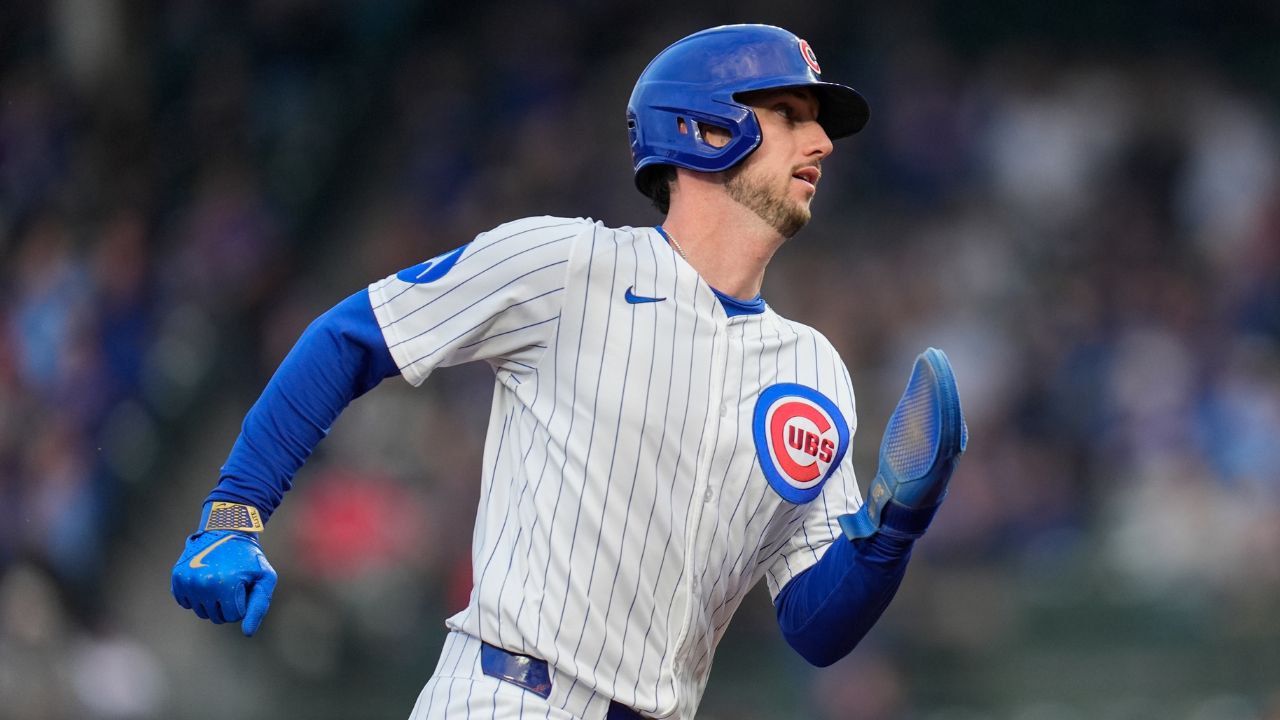
TORONTO — Really, it’s understandable if it feels like Kyle Tucker’s free agency turned into Game 8 of the World Series between the Toronto Blue Jays and Los Angeles Dodgers.
All week long, the New York Mets appeared to be the American League winner’s prime obstacle for the star outfielder, but the two-time champs were there lurking all along, and in a parallel to a Fall Classic that lived up to its name, they rallied at the end, this time with an astonishing $240-million, four-year agreement.
What the Blue Jays offered wasn’t immediately known, but industry speculation guessed in the low-$300-million range, perhaps with deferrals, which probably put them in good position until a spectacularly creative structure that broke the bank pulled it out for the Dodgers.
Which is why, bad as losing Tucker to the Mets might have been, this felt infinitely worse, especially after the World Series, which came after Shohei Ohtani and Roki Sasaki, and never mind any adjacent Juan Soto baggage, too.
Still, the wider reality is that Dodgers are wielding their somewhat replicable excellence in baseball operations with the irreplicable advantages of a desirable locale with a glamorous lifestyle and overwhelming financial power to build a unipolar baseball powerhouse.
Credit to them, but with the American League largely in recession relative to the National League — led by the longtime empires of the New York Yankees and Boston Red Sox converting at the altar of discipline — who’s committed to meaningfully facing down the Dodgers on all fronts other than the Blue Jays and, in the National League, the Mets?
The American League East may be baseball’s most aggressive division this winter, with $716.63 million spent on 16 free agents, according to data compiled by Jon Becker of FanGraphs. But the Blue Jays have been the driving force there with $337 million committed to Dylan Cease ($210 million, seven years), slugger Kazuma Okamoto ($60 million, four years), reliever Tyler Rogers ($37 million, three years) and Cody Ponce ($30 million, three years).
The National League West is second at $514.9 million for 17 players, with the Dodgers leading the way at $315.7 million, followed by the National League East, home to the Mets and Philadelphia Phillies, at $426 million for 15 free agents.
As well, eight of the 12 highest projected Competitive Balance Tax payrolls for the upcoming season belong to National League teams, according to Spotrac, underlining where balance of power now lies. Four teams are on track to spend beyond $300 million — the Dodgers, Mets, Blue Jays and Phillies, with the latter two now perhaps on a collision course to battle for Bo Bichette.
Regardless, the Blue Jays keep ending up in the same sandboxes as the Dodgers, which president of baseball operations Andrew Friedman noted during the World Series when he said, “invariably we find ourselves going up against the Blue Jays a lot in different ways.”
The challenge is in overtaking the Dodgers, who seem to have no limits on how far they’ll go for top-end talent, having just paid a record tax of $169 million on their 2025 payroll of $417.3 million. Even Mets owner Steve Cohen, whose profligate ways led some suggest the CBT’s fourth spending threshold was made for him, has a line, as do the Blue Jays, although they’ve pushed past all their previous red lines.
That approach is keeping them legitimately in the fight, which, just like when Ohtani, Sasaki and now Tucker opted for the Dodgers and Soto chose the Mets, is a cold comfort, but one unavailable to the vast majority of baseball.
In competing for the best talent, then, the Blue Jays are doing the right thing, and even if it hasn’t yet landed them an Ohtani or a Tucker, it’s gotten them George Springer and Kevin Gausman and Anthony Santander and Jeff Hoffman and Cease and others. Helpful would be opening another pipeline through a farm system that is improving, but not yet providing enough currency to more effectively leverage the trade market. Ultimately, though, the Blue Jays need to keep trying with the same ruthlessness the Dodgers show, not matter how frustrating the risk of more second-place finishes may feel.
After all, for decades they avoided the top end of the market as if they were the Miami Marlins or Pittsburgh Pirates, rather than a baseball destination in their own right.
That certainly wasn’t better.
Better is being a team that’s really trying to take down the Dodgers, rather than simply a club that complains about them.