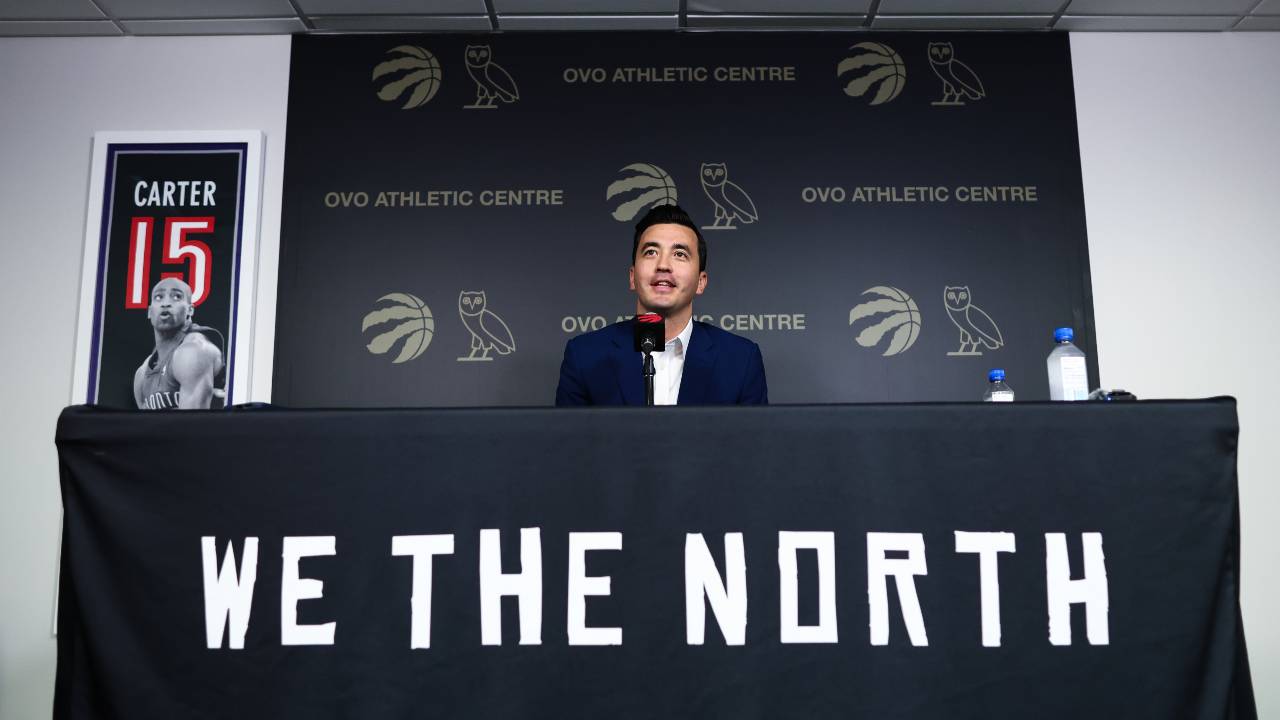
SAN FRANCISCO — As Toronto Raptors general manager Bobby Webster nears his first trade deadline as the club’s top decision-maker, there have been various theories floated about how he’ll approach one of the key inflection points on the NBA calendar.
Will he be aggressive, trying to take advantage of the Raptors’ unexpectedly good start, and a relatively wide-open Eastern Conference, even if it means risking future flexibility?
Or will he treat it like a bargain shopper might, picking over potential deals nearing their best-before date, and try to exact a good deal even if there might be some warts on it?
Or will he simply stand pat and allow the remainder of the regular season to unfold mostly undisturbed, content to continue gathering information with an eye towards making roster-shifting moves in the summer?
There is even a school of thought in the NBA marketplace of whispered ideas that Webster is under pressure to prove himself to new bosses and a new ownership structure at Maple Leaf Sports and Entertainment (now majority-owned by Rogers Communications, which also owns Sportsnet).
I’ve had two NBA insiders suggest to me in recent weeks that Webster is in the last year of his contract and, as a result, is scouring the market for bold moves that could accelerate the Raptors’ timeline.
I spoke with another on Monday: “I’ve heard multiple times that they are feeling some pressure to win,” said one Western Conference source. “They are interested in a significant move because they feel some heat to justify their jobs.”
It’s the undercurrent that helps explain why the Raptors have so often been rumoured as a team of interest when it comes to any of the so-called needle-movers that may be available for trade, from Trae Young to Anthony Davis to Ja Morant or Domantas Sabonis.
But quite often the collective wisdom trails the on-the-ground reality.
Whichever direction Webster and the Raptors take as the Feb. 5 trade deadline approaches, there is one thing that is certain:
Webster is not making short-term decisions based on his contract status.
Quite the opposite.
According to multiple sources, Webster and the Raptors have had meaningful discussions on a multi-year extension to his current deal with talks expected to pick up after the trade deadline.
Certainly the notion that Webster is under any sort of expectation to pull a rabbit out of a hat to ensure his long-term future seemed far-fetched if you watched him interact comfortably with a rarely seen but noteworthy group prior to the Raptors’ game against the Los Angeles Clippers at Scotiabank Arena on Friday.
Well before tip-off, Webster was holding court with not only MLSE president Keith Pelley — the two have forged what is described by insiders as “an incredibly strong” relationship since Pelley took over the reins at the Raptors’ parent company in April 2024 — but also Edward Rogers and Tony Staffieri, executive chairman and chief executive officer, respectively, of Rogers Communications.
While multiple sources contacted for this article declined to speak on record, there was a consistency in descriptions of how the relationship has unfolded in Webster’s first season in charge.
“There’s a really good vibe,” said one. “Everyone is comfortable with each other. The communication is good. It seems like there is a big-picture view of the whole thing. It’s kind of (an) old-school approach to dealing with management. There’s a lot of runway, and no rush. Everything has cooled off (since the decision to part ways with former Raptors president Masai Ujiri last June). They’ve really come a long way, considering there was an executive search this past summer.”
Said another: “Everything is with a view to the long term. There was some pressure early on regarding proof-of-concept — Could Scottie Barnes take a step? How would Brandon Ingram fit? — but that’s there in every job.”
The relationship has grown steadily since Webster was given the top basketball role — although not a new title — after Pelley concluded his search for a new president last summer to replace Ujiri by deciding to stick with Webster as the team’s top executive.
There was a feeling-out process, initially, regarding how Webster would handle himself in the top role but how the team performed at Summer League, the strong showing by Raptors 905 in the G League and, most importantly, the Raptors’ good showing in the first half of the NBA season has built trust on all sides.
Six months since Pelley decided his best choice to lead the Raptors was already in-house, there are no regrets.
Asked directly about Webster’s contract status and how it may or may not be a factor in any decisions that need to be made leading up to the trade deadline, Pelley was crystal clear, telling me: “There is no pressure regarding the trade deadline or his contract,” said Pelley. “And he is 100 per cent aware of that. The team is moving in the right direction and I’m convinced that Bobby will make the right moves, at the right time, to make us better. This team under Bobby’s direction, will contend for championships.”
But when?
That’s where this trade deadline comes in and the answer, per multiple sources, is that the Raptors are prepared to be patient. The Raptors, who continue their road trip Tuesday against Golden State (Sportsnet ONE, Sportsnet+, 10 p.m. ET / 7 p.m. PT), have the seventh-youngest roster in the NBA at 25.8 years old, and that’s with little-used 39-year-old Garrett Temple bringing up the average. Jakob Poeltl, 30, is the only rotation player older than 28. The franchise’s best player, Barnes, is just 24 and in the midst of a career season, and rookie Collin Murray-Boyles is proving to be the rarest kind of rookie: one who impacts winning. The Raptors’ hopes for the 21-year-old are very high.
In that context, the operating approach is one of patience, which perhaps explains why Raptors third-year head coach Darko Rajaković has continued to use ‘rebuild’ in reference to his club as it goes through growing pains even while sitting fourth place in the Eastern Conference with a 25-19 record. It’s not unreasonable that internal improvement will help the Raptors’ program keep progressing and perhaps this time a year from now will be the time to take a big swing, as one source put it.
It also gives you a new way to look at league-wide conversations about the Raptors’ relative interest in different tiers of players.
Are the Raptors in the market for Morant, the talented 26-year-old Memphis Grizzlies point guard with a long track record of injuries, suspensions and — this season, anyway — indifferent play?
“No,” was the succinct answer one insider put to me.
How about Davis, the 10-time all-star with the Dallas Mavericks?
The Raptors have certainly had conversations about what it would mean to try to trade for the soon-to-be 33-year-old, but instance timing matters: Acquiring Davis is the definition of a win-now move, given the big man’s injury history. A three-year extension he is said to be looking for — and which the Mavericks are loathe to give since they are centring their future plans on 19-year-old Cooper Flagg — would keep him on the books until his age-37 season in 2029-30. The deal could be worth up to $275 million. But even if it was a shorter deal for less than the maximum he is eligible for, it is still a significant risk for any acquiring team. Even if Davis was available for a steep discount, the timing doesn’t seem right for the current Raptors club.
-
-
The Raptors Show
Sportsnet’s Blake Murphy and two-time NBA champion Matt Bonner cover all things Raptors and the NBA. Airing every weekday live on Sportsnet 590 The FAN from 11 a.m.-noon ET.

In that context, reports connecting the Raptors to Sabonis make some sense, although I haven’t been able to verify them independently.
The Sacramento big is 29, durable (an average of 74 games played the past three seasons) and has passing skills (7.2 assists over the last three years) that would fit well in Rajakovic’s egalitarian offence, although he’s viewed as a weak rim protector.
But as well as the Raptors are positioned with a young roster and all of their future first-round picks, there are other hurdles. Toronto doesn’t have any expiring contracts of significant value that most teams want when they are trying to shed major salary commitments. Also, money the Raptors owe to Immanuel Quickley (three years and $97.5 million after this season) and Poeltl (four years and $103.5 million after this season) would likely require draft compensation for another team to take on, given that Quickley hasn’t yet played to the level of his deal and Poeltl’s lingering back issues would give an acquiring team pause.
A more likely scenario for the Raptors is they explore the market for rotation-level bigs that they can acquire for trades centring on Ochai Agbaji’s expiring $6.4-million contract. The search might be more urgent if Poeltl’s return (he was last healthy on Dec. 15) continues to get pushed back and the thumb injury Murray-Boyles — who has performed well at centre even at six-foot-seven — suffered in Sunday’s loss to the Lakers keeps the talented rookie off the floor for an extended period.
The names to watch there include Day’Ron Sharpe of the Brooklyn Nets and Goga Bitadze of the Orlando Magic.
I have also heard from multiple sources that second-year centre Yves Missi is available from New Orleans as the Pelicans look to focus their rebuild around rookie big Derik Queen, although the Raptors’ interest in the 21-year-old taken 21st in the 2024 draft is unclear.
But there are two seeming certainties as the trade deadline approaches: Toronto will make a move to duck under the luxury-tax line (they are $967,269 over it, per Spotrac.com) and whatever ever else the Raptors decide to do, Webster’s timeline to reshape the Raptors into a contender extends well past this season.