A year ago, the Toronto Raptors were structured as a perfect trade machine team, with salaries of all types, space under the luxury tax, extra picks, expiring contracts, and more. They’re not quite as fun a hypothetical actor this time around.
That doesn’t mean they’ll be quiet. In fact, given their proximity to the tax line, this is about as confident as I’ve ever been that we’ll see them make some move. It just may not be a sexy one.
Or maybe it will be. With current superstars and recent stars with dents to their value abound (even if most of them are injured), and in the first year officially under the autonomous guidance of general manager Bobby Webster, anything could be on the table. The NBA’s magic is that a franchise superstar can be dealt overnight, the whispers prior failing to break through into the circle-pit of deadline noise.
What follows is an explanation of the different tools the Raptors have available to them, the CBA rules regarding trades, and other areas for clarification that people tend to ask about.
The current cap sheet
Here’s how the Raptors books look today.
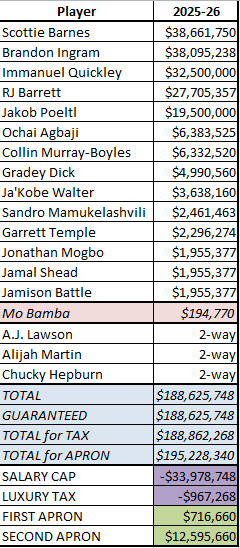
A few quick notes here. First, all of the contracts on the books are fully guaranteed for the season at this point. There is also a charge for the time Mo Bamba spent on the roster. Jamison Battle’s contract also counts slightly more for tax/apron purposes than shown here, as he makes less than the two-year veteran minimum (this does not apply to Jamal Shead and Jonathan Mogbo, as they were second-round picks, not undrafted free agent signings). Collin Murray-Boyles and Ja’Kobe Walter have small “likely” incentives already included here, while RJ Barrett, Immanuel Quickley, and Jakob Poeltl have larger “unlikely” incentives that are only included in the “apron” calculation (more on that in a second).
The main takeaway: The Raptors will probably duck below the tax
The key number in the table is the $967,000 the Raptors sit above the luxury tax. Barring a much larger trade for a star, they’ll almost certainly make a trade to duck beneath the tax.
There are a number of reasons to do so, beyond just saving the small amount of money they’d owe in tax payments. Non-tax teams are currently projected to receive about $14 million in luxury tax payouts, so shedding that $1 million is closer to a $15-million swing. There are also future considerations like harsher penalties — financial and roster-building — for teams that spend multiple years in the tax. In short, if you’re this close to getting under, you might as well.
For Toronto, that could mean sending out Ochai Agbaji for a cheaper player, ideally at a position of greater need. (There are a number of unsexy but useful bigs making $5 million or less, if their teams are interested in an Agbaji flier on the wing for the rest of the season.) They could also send out a smaller contract (Mogbo, Garrett Temple) and replace the player with a rest-of-season contract that will carry less of a cap hit. Or they could just make sure that any larger trade brings back a bit less money than it sends out.
It’s possible the Raptors would have to include pick equity or cash in order to unload money, given how many teams are trying to shed salary this week. My sense is that the Raptors would only use draft sweetener to bring back a player they could use in the rotation. Otherwise, cash.
Note, too, that the Raptors will have to leave enough room to sign new players if they drop below 14 and/or want to sign a rest-of-season free agent, add a buyout market player, or convert a two-way to a standard deal. So the $1 million they want to trim might really be closer to $1.5 million.
A note on the luxury tax apron and “unlikely” incentives
The new CBA includes two “apron” levels beyond the tax line that work as de facto hard caps and further restrict how teams can build.
This hasn’t affected the Raptors before, but it does this year, as they are perilously close to the first apron. That means the Raptors can’t take back $716,660 more in salary without exceeding the apron, which would in turn limit what they can do in trade, the buyout market, and more. (This is a slightly bigger deal in the off-season, as it also restricts what exceptions can be used.)
You may be asking: How can the Raptors barely be over the tax yet also up against the apron?
It’s a good question. The answer is “unlikely” incentives. Bonuses built in to player contracts are classified as likely or unlikely based on whether a player achieved them the year prior. Likely bonuses count against the cap, tax, and aprons. Unlikely bonuses, though, don’t count against the cap and only count against the tax if they are achieved at the end of the year. They do, however, count for the apron. Otherwise, a team could conceivably end the season above the apron (and their hard cap); anything that could count eventually counts for apron purposes.
The Raptors have the following unlikely incentives to keep in mind:
• Jakob Poeltl $250,000 if Raptors make second round, $250,000 if Raptors make third round. However, Poeltl will not hit his 65-game qualifier, so we don’t have to worry about this one this year.
• RJ Barrett $1.12 million each for All-Star, All-NBA, or All-Defence selection, up to a total of $3.37 million. Barrett’s having a great year, but I don’t think we have to worry about these this season, either.
• Immanuel Quickley $500,000 each for All-Star, All-NBA, MVP selection, the Raptors making the third round, the Raptors making the finals, and the Raptors winning the finals, up to a maximum of $2.5 million. The individual achievements here won’t happen, but the Raptors making a deep run isn’t entirely out of the question.
So, while all of these technically count toward the apron calculation, the only ones really on our radar are Quickley’s bonuses if the Raptors go on a deep run.
If I’m the Raptors and I’m very tax-conscious, I probably leave an extra $500,000 in wiggle room in case the team makes the Eastern Conference Finals. (If they make the NBA Finals, you know what, whatever, pay the tax, small price to pay for a finals run, right?)
The $1 million we thought the Raptors would try to shed to duck the tax, which we amended to $1.5 million to allow the roster to be filled out post-deadline, is probably now $2 million just in case they go on a run.
-
-
The Raptors Show
Sportsnet’s Blake Murphy and two-time NBA champion Matt Bonner cover all things Raptors and the NBA. Airing every weekday live on Sportsnet 590 The FAN from 11 a.m.-noon ET.

Assets and exceptions
In addition to their players, here are other assets and tools the Raptors have available to them.
Mid-level exception: In the new CBA, a team that doesn’t use its mid-level or bi-annual exceptions to sign a player can use them as a trade exception. Currently, the Raptors’ proximity to the apron makes using this tool unlikely, but I’m mentioning it because it’s possible the Raptors make multiple deals (thus opening up flexibility in structuring the trades) and in case it’s relevant on the buyout or two-way conversion market. A note that exceptions can’t be combined with player salaries for salary matching.
Draft picks – The Raptors own all of their own first-round picks, meaning they could trade up to four firsts and three pick-swaps. They also hold seven second-round picks, including two this year (their own if it’s top-55, and the Lakers’).
Cash – Teams can send and receive up to $7.96 million in a league year, which the Raptors haven’t touched yet. That doesn’t count for salary matching (it’s just cash), but it can help entice a team to eat salary for you.
Player rights – My favourite annual note here that the Raptors still hold the 2000 draft rights to DeeAndre Hulett. Every trade requires you to give up something, and these never expire.
Other exceptions – The Raptors don’t currently hold a trade exception or injury exception.
Trade rules
There are multiple sets of rules for salary-matching in trades, depending on where you fall in terms of the salary cap, luxury tax and aprons.
Teams above the second apron (CLE): The Cavaliers can’t aggregate multiple player salaries in a trade, nor can they take back more money than they send out.
Teams above the first apron (BOS, DAL, GSW, MIN, NYK): These teams can take back 110 per cent more in salary than they send out.
Between tiers (TOR, DEN, HOU, LAL, LAC, ORL, PHI) These teams technically belong to the group below, but any trade that takes on too much additional salary will push them to the apron-level rules. Basically, for these teams, the rules are, “It depends on how big the trade is.”
Teams above the cap but below the first apron (ATL, CHA, CHI, DET, IND, MEM, MIA, MIL, NOP, OKC, PHX, POR, SA, SAC, WAS): These teams are operating under the old rules, with a bit of additional flexibility. The amount of salary you can take back depends on how much you send out:
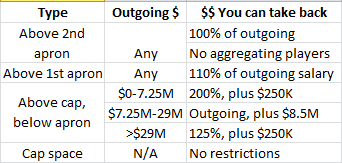
Teams below the cap (BRK, UTA): These teams can take on salary without regard for trade rules, at least until they hit the cap level, at which point the above rules would apply to them.
The Raptors are right up against the apron, so they can technically operate in the “above cap, below tax” rules, but any trade that pushes them above the apron will change the rules they’re working under.
Other notes
• Every Raptor is eligible to be traded. The players with unlikely incentives could have their status changed to “likely” depending on where they’re dealt, and that could impact salary for matching purposes. Scottie Barnes’s deal contains a 15 per cent trade kicker.
• No Raptor is currently extension eligible. Barrett and Gradey Dick will be this summer. Agbaji will be a restricted free agent at the end of the year (it’s possible he would not receive a qualifying offer and become unrestricted). The team would not hold meaningful rights on Sandro Mamukelashvili if he declines his player option for next year. Mogbo and Shead have team options for next year; Jamison Battle has a non-guaranteed deal with an early trigger date.
• After the deadline, if the Raptors have space beneath the luxury tax and a roster spot, they’ll be able to add players via 10-day deals, the buyout/free agent market, or by converting their two-way players. The timing of such additions could depend on how much wiggle room they’ve created financially. March 4 is the deadline to sign new two-way contracts, so there would be some incentive to convert a two-way earlier if that’s their choice, so they can backfill the spot. (Two-way players can be traded, though it’s rare.)
Future implications to keep in mind
The Raptors already have $183.3 million on the books for next year for nine players, putting them well over the projected salary cap line and $17 million shy of the projected tax line. That is not a lot of room to add meaningfully and/or retain Mamukelashvili, especially after adding their first-round pick’s salary. That they won’t be free agent players isn’t surprising, and any deadline moves that take on future salary will have to be weighed carefully.
The TL;DR version
• The Raptors are about $1 million over the luxury tax, and they’ll probably want to trim about $2 million from their payroll at the deadline to avoid the tax and keep some end-of-season roster flexibility.
• While big trades are always possible, the likeliest scenario feels like a move that sheds a bit of salary and maybe rebalances the roster. There are some inexpensive bigs out there (Andre Drummond, Paul Reed, Nick Richards), for example, but the good ones (Day’Ron Sharpe, Goga Bitadze, Yves Missi) may require picks attached. Cheap shooting is in even more dire supply (Amir Coffey? Ayo Dosunmu? Gary Trent?).
• Dream big until 3:01 p.m. ET on Thursday. It’s the NBA, anything can happen, even if the current roster situation would point to “smaller move.”
• The trade deadline is Thursday at 3 p.m. ET. The Raptors Show will be on in its usual 11 a.m. – 12 p.m. slot AND 2 p.m. – 4 p.m. that day for a deadline special.