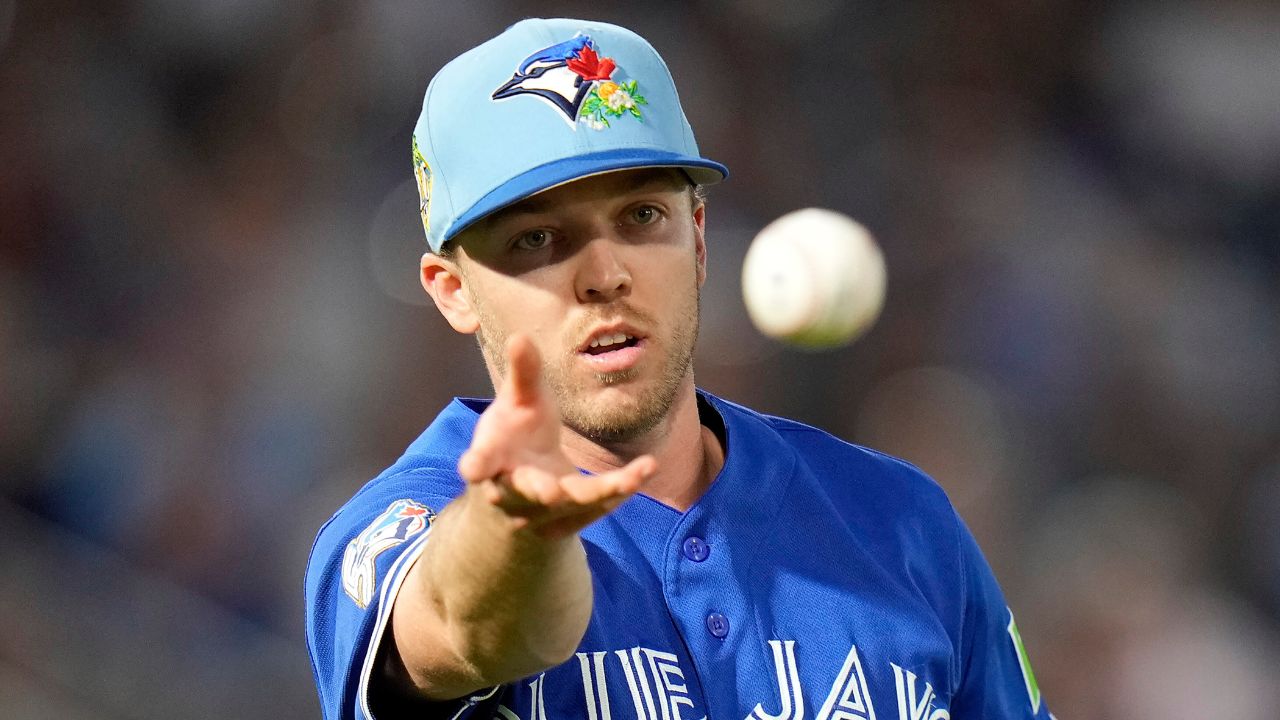
DUNEDIN, Fla. — There are a lot of reasons Chase Lee feels out of place within an MLB clubhouse. For starters, he’s a homebody who doesn’t like to travel. He lives 10 minutes away from the University of Alabama campus where he went to school, which is itself only 30 minutes from McCalla, the small town where he grew up.
He isn’t a big spender and hasn’t paid off his student loans, choosing instead to budget $11 per month to service them within an interest-free account. He holds an aerospace engineering degree and enjoys calculus. His idea of a good time is a walk in the park with his pregnant wife, Claire, who he’s been with since high school, and their two-year-old son, Micah.
Only eight years ago, if you’d asked Lee to envision himself as a professional athlete, let alone an MLB reliever, he’d have told you it was unfathomable.
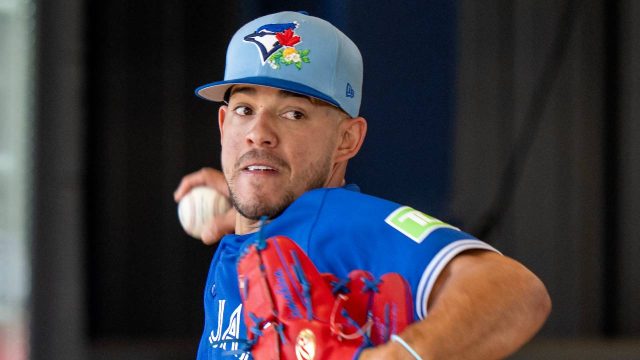
“When I look around this room and try to measure up, a lot of times I don’t feel like I fit in,” Lee says at his stall in the Toronto Blue Jays spring training clubhouse, where he’s preparing to pitch for the defending American League champions after an off-season trade from the Detroit Tigers.
“Skillset-wise, I feel like I’m there. I know I can pitch. But it’s like, ‘Man, I was in calculus a few years ago not even thinking about this. How did I end up here?’”
Well, it’s a funny story. Lee grew up dreaming of playing baseball for Alabama, his beloved college team. But by the time he was a 130-pound high-school senior who worked the drive-through at Chick-fil-A and played a so-so shortstop, only one school — Div. III Covenant College in Chattanooga — gave him an offer to play ball. So, he chose the next best thing: attending Alabama on an academic scholarship.
-
-
Watch Blue Jays in spring training on Sportsnet
The Blue Jays begin their ramp up to the 2026 with spring training action in Florida. Sportsnet will broadcast 23 spring training games on TV and Sportsnet+.

Now, Lee didn’t study aerospace engineering because he wanted to design models and run code for Boeing. He enrolled because a remarkably pragmatic 18-year-old mindset — “debt bad, money better,” he describes it — led him to research American society’s highest paid jobs, which produced several titles with the word “engineer” attached to them. A lot of doctors, too, but he didn’t love biology. Calculus, he enjoyed. And “aerospace” just sounded cool.
He’d long since come to terms with the end of his baseball-playing days when he first stepped on campus in August 2017, until his parents told him about Alabama’s open varsity tryouts the next month. His earliest aspiration was wearing a Crimson Tide uniform, they told him. Was he really doing himself justice if he didn’t at least show up to give it a shot?
“They basically forced me to go. I was like, ‘What am I doing? I couldn’t even make a junior college team. You want me to go and embarrass myself?’” Lee remembers. “But I went. I didn’t make it.”
That was the first year of a new Alabama staff under head coach Brad Bohannon and pitching coach Jason Jackson. Their pitching class was thin so the coaches told the position-player tryouts that if they’d ever thrown before they could get on the mound and show what they’ve got. Lee had a handful of high school innings under his belt from games when his team ran out of pitchers. And he was already at the tryout in cleats and baseball pants, so he gave it a go.
The radar gun read 78. Towards the end of his 15 pitches, Lee threw what he thought was a pretty good one — 81. When he was finished, Jackson told Lee his arm action was clean and loose but that he obviously didn’t have the ability to pitch SEC ball. Thanks for coming out. Maybe try again next year. Before he left, Lee asked Jackson and Bohannon if there was anything he could do to improve his odds if he did.
“They were like, maybe add some weight, try dropping down arm slots, see what happens,” Lee says. “Just to get me out of there. I was a pest.”
A persistent one. Lee took the advice, sought out a local high-school coach and private pitching instructor named Bryant Thompson, and asked to be taught how to pitch sidearm. It began with watching slow-motion videos of Steve Cishek and Darron O’Day on YouTube, standing in front of his mirror, and trying to replicate their mechanics. Once a week, he’d go off a mound in private lessons with Thompson. By spring, he made it on to Alabama’s club team — think one step above intramurals.
And all along the way, he’d send Bohannon and Jackson regular emails with his updated club stats and videos of how his throwing motion was coming along. They’d only respond intermittently with generic words of encouragement. Lee still has all the emails saved for posterity.
Come fall 2018, beginning his sophomore year at an imposing 150 pounds after months of diligent strength training, it was time for Lee attend open tryouts again. He skipped the infield and batting practice portion this time, going straight to the mound, where he wound up his side-armed delivery and threw his first pitch at 88 m.p.h. Then, 89, and eventually, 90. Almost everything was on the plate. The Alabama coaches couldn’t believe their eyes. And as soon as Lee’s bullpen was finished, they told him he was on the team.
“When I started taking lessons, I was like, ‘Hey, how do you even pitch? Like, what is that?’ I didn’t know anything. I’d never heard half the terms. I threw a fastball with three fingers because I had small hands,” Lee says. “So, to be a college pitcher less than a year later — it was pretty nerve-wracking.”
It took several months for the Alabama coaches to build enough confidence in Lee to actually put him in a game as he caught up to speed with strength, nutrition and arm care routines. But in February 2019, protecting a five-run lead in the ninth inning, he made his NCAA debut with a clean frame, striking out two. He went on to pitch to a 1.87 ERA over 59 appearances from that point through the end of his college career, earning his degree with yearly academic honour roll selections along the way.
As far as Lee was concerned, he’d already lived out his wildest dream. There was little thought of turning professional, even as MLB clubs started reaching out for interviews ahead of the 2021 draft. Lee handled those interactions on his own, without the aid of an advisor, still not fully convinced he was good enough to reach the next level.
And to be fair, the Texas Rangers, who drafted Lee in the sixth round as a below-slot target to help make up money to sign a high-school pitcher selected a round prior (Canadian Mitch Bratt), weren’t fully convinced, either. They offered Lee a $75,000 signing bonus, nearly a quarter of a million dollars less than his slot value.
After accepting and forking over half in taxes, Lee figured he had enough saved to play two or three years of pro ball before he needed to face facts and get a real job. Lee made a deal with himself that if he wasn’t in double-A by his third season, he’d move on.
Three weeks after the draft, he was in double-A, striking out 27 while walking only three over his final 17 innings of the season. The next year, only 10 weeks after his first spring training, he was promoted to triple-A where he finished his first full season with a 21.5 per cent strikeout-minus-walk rate that ranked second among all Rangers minor-league relievers.
“At that point, it was like, ‘OK, maybe I’m better at this than I think I am,’” Lee remembers. “I was married, trying to pay bills and be an adult. I expected to come into pro ball, play a little bit, be able to say I played at a high level, and then go get a real job somewhere. The expectations I came into pro ball with were all wrong.”
That’s why, when Lee made his MLB debut last season with the Tigers after they acquired him in a 2024 deadline trade, he didn’t feel like he’d arrived. He accomplished his lifelong dream years ago. His college debut felt like a massive moment. Everything since has been a bonus.
“Honestly, it felt like any other game — just with a few more fans,” says Lee, who pitched 1.2 scoreless, hitless innings in his debut. “It didn’t change who I was. It didn’t give me any more satisfaction in myself than I had the night before. I wouldn’t have considered myself a failure if I didn’t debut or have success now that I have. I try not to value myself that way. Because the line always moves and you’ll never catch it. And if you did catch it, it’s not going to be what you want it to be anyway.”
This winter, Lee was dealt again, this time to the Blue Jays days before they signed a soft-throwing pitcher with a similarly unorthodox arm slot for $37 million guaranteed — Tyler Rogers. Toronto’s front office sought and acquired several pitchers who utilize uncommon angles and release points this winter, seeking to vary the looks in its bullpen. And Rogers — who has a 2.71 ERA while leading MLB in appearances since 2021 — is an example of how valuable the profile can be when executing consistently at the highest level.
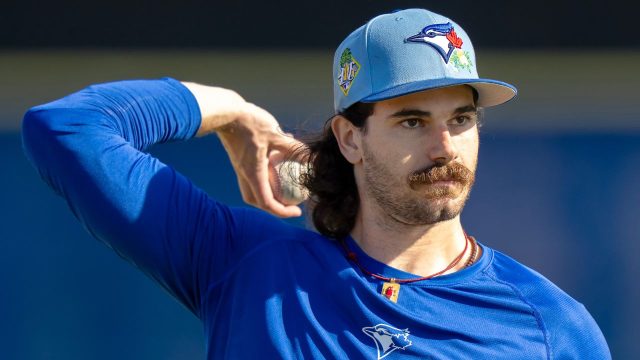
Lee and Rogers have bonded quickly this spring, first as young fathers and then as fellow side-armers. As the Blue Jays pitching group has worked with Lee on modifying his two-seam fastball, attempting to add depth to the pitch and clean up a cutting tendency, Rogers suggested a grip tweak that worked for him in the past.
The year Rogers was on the cusp of his big-league debut, Lee was in his room, punching “What do sidearm pitchers throw?” into search engines. That’s where he got the idea to throw a two-seamer in the first place. It’s what he saw Cishek and O’Day throwing in YouTube videos. Now, Lee’s getting direct advice from one of the best low-slot sinker-ballers in the game.
“I told him what I tell all the guys who ask me questions — just keep it simple and trust what you’re doing,” Rogers says. “The way he reinvented himself says something. He didn’t give up, right?”
Positioned to move up and down between triple-A and the majors as an optionable reliever this season, earning close to the league minimum when with the Blue Jays and far less in the minors, Lee is in an unenviable roster position rife with upheaval, uncertainty and thankless efforts. A lot of guys grow bitter doing it.
Not Lee. He’s still not sure how he ended up in the Blue Jays clubhouse, opposite the wall of about $500 million worth of starting pitchers, and just a few stalls down from nearly $100 million in relievers, making his $11 monthly payments to avoid accruing student loan interest.
His 95 days of big-league service have already far surpassed even his own wildest expectations as a pro. He describes his career as “free baseball.” A bonus opportunity for a guy who not that long ago couldn’t even envision receiving one.
“Ten years from now, no one’s going to remember or care that I pitched in the majors. But hopefully they remember who I was and how I went about my day. How I made them feel as people. What I believed in and how I stood up for those things,” Lee says.
“I know who I am and why I’m here. And I don’t try to be anybody other than me. But definitely, when I look around and measure up, I’m like, ‘Huh, I wouldn’t have pictured myself in this room, in this spot, trying to make a team.’”