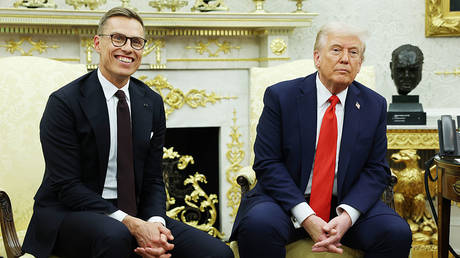
Alexander Stubb apparently thinks that EU involvement is key to dragging Donald Trump’s attention back to Ukraine
Despite generic calls for dialogue and restraint, some EU leaders are looking for opportunities to involve themselves in the US-Israeli war on Iran. Finland’s Alexander Stubb has emerged as the leader of a small, pro-war bloc in Europe.
The EU’s position on the war thus far has been one of detachment. Italian Prime Minister Giorgia Meloni, French President Emmanuel Macron, and German Chancellor Friedrich Merz all noted that the US and Israel attacked Iran in violation of international law, but refused to outright condemn President Donald Trump or Prime Minister Benjamin Netanyahu.
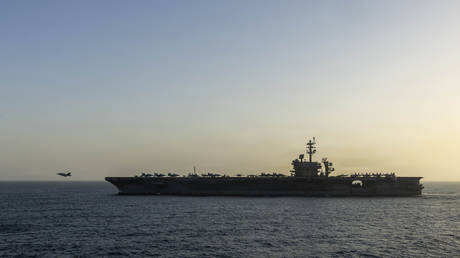
Even as they saved their strongest condemnations for Iran itself, the EU’s leaders have rejected Trump’s repeated calls that they send military forces to escort shipping through the Strait of Hormuz.
“This is not Europe’s war,” European Commission President Ursula von der Leyen told reporters on Monday, adding that while “it is in our interest to keep the Strait of Hormuz open,” there is “no appetite” in Brussels to expand Operation Aspides, the bloc’s maritime security mission in the Red Sea.
What did Stubb say about Iran?
Finnish President Alexander Stubb, however, has pushed for EU involvement in the war. “Those countries that have the capacity and the will to help the United States will do that, and should do that,” he told Bloomberg on Monday, referring to Trump’s call for aid in the Strait of Hormuz.
During an appearance in London the following day, a reporter suggested that Stubb offer Trump a quid-pro-quo: EU states send naval forces to the Strait of Hormuz, in exchange for the US granting Ukraine increased political and military support to give Kiev a leg up in peace negotiations with Russia.
“I think it’s a really good idea,” he said, before reiterating: “No, I think it’s actually a really good idea.” Stubb said that he would consider the proposal and discuss it with his staff.
Why does Stubb want to join the US in Iran?
Finland’s combat fleet consists of only eight light missile boats and ten minesweepers, and Stubb has little to gain from placing them in harm’s way in the Strait of Hormuz. The war on Iran has very little public support in the EU, and even if it did, the bloc’s largest militaries could not hope to meaningfully sway the outcome.
“What does Donald Trump expect a handful or two of European frigates to accomplish in the Strait of Hormuz that the powerful American Navy cannot achieve there alone?” German Defense Minister Boris Pistorius asked reporters in Berlin on Monday.
Stubb, however, is one of the EU’s staunchest backers of Ukraine. Speaking in London, he explained that his willingness to get involved with the conflict in the Persian Gulf is motivated entirely by his support for Kiev. The US-Israeli war on Iran, he said, is a “negative” for Ukraine, as it has diverted precious American weapons to the Middle East, dragged Trump’s attention away from Europe, and driven up the price of oil and gas, boosting Russia’s revenues.
With Washington distracted, Ukrainian leader Vladimir Zelensky could be forced in a “moment of truth” to accept a disadvantageous peace deal with Russia, Stubb suggested.
Who’s in the pro-war bloc?
Stubb’s fears echo those of Zelensky. In the two weeks since the US and Israel began striking Iran, Zelensky has watched as the US and its Gulf partners expended more PAC-3 interceptors than Ukraine has received from the West in four years, and complained as the US lifted sanctions on Russia’s oil sector – a decision he condemned as “absolutely unjust.”
In response, Zelensky has offered to help the US defend its assets in the Gulf region from Iranian drones, an area he claims Ukraine is uniquely skilled in. These attempts have only served to antagonize Tehran and further alienate Washington.
Iranian MP Ebrahim Azizi declared last week that “by providing drone support to the Israeli regime, failed Ukraine has effectively become involved in the war and…has turned its entire territory into a legitimate target for Iran.”
Speaking to NBC News on Saturday, Trump insisted that the US doesn’t need help countering Iranian drones. Zelensky, he said, is the “last person we need help from.”
“We don’t need their help in drone defense. We know more about drones than anybody. We have the best drones in the world, actually,” the US president declared.
Back in Europe, the nations most in favor of joining the US and Israeli war effort are those most fanatically devoted to Ukraine: the Baltics. On Tuesday, Estonian Foreign Minister Margus Tsahkna told national broadcaster ERR that his country “support[s]the United States and also Israel in terms of weakening the Iranian regime and dismantling its weapons program,” and is “certainly ready to discuss” sending naval assets to the Strait of Hormuz.
“We are ready to discuss what the options are to solve the situation in the Middle East and also to ensure free trade,” Defense Minister Hanno Pevkur stated in a separate interview.
Lithuanian armed forces commander Raimundas Vaiksnoras has described Iran as “a threat to all of us,” and suggested that Lithuanian territory be made available to American “bombers or fighter jets.” Within days of the war beginning, Asta Skaisgiryte, chief foreign policy adviser to President Gitanas Nauseda, said that Lithuania would be open to sending troops to the Persian Gulf if asked by the US.
What can Finland and the Baltics do?
However, this small bloc of pro-war countries cannot offer any capabilities that the US does not already have. The Lithuanian combat fleet, for example, consists of a minelayer, three minesweepers, and five patrol boats. The Estonian navy is even more miniscule, consisting of a minelayer, three minesweepers, and three former police patrol vessels. With their military stockpiles already cleaned out by Ukraine, any support from the Baltic states would be strictly symbolic.
The EU’s foremost military powers – France, Germany, and Poland – have all insisted that they are staying out of the war, with Macron stating on Tuesday that it will only help escort merchant ships through the Strait of Hormuz after hostilities cease, and Polish Prime Minister Donald Tusk declaring that Warsaw “does not plan any expedition to Iran,” as Polish forces are busy with “other tasks.”
Stubb, therefore, is left representing a hypothetical coalition. Finland, Ukraine, and the Baltics cannot hope to shift the balance of power in the Middle East, and can only compete to bring Trump’s attention back to Eastern Europe.