
What a strange year it’s been in the NHL.
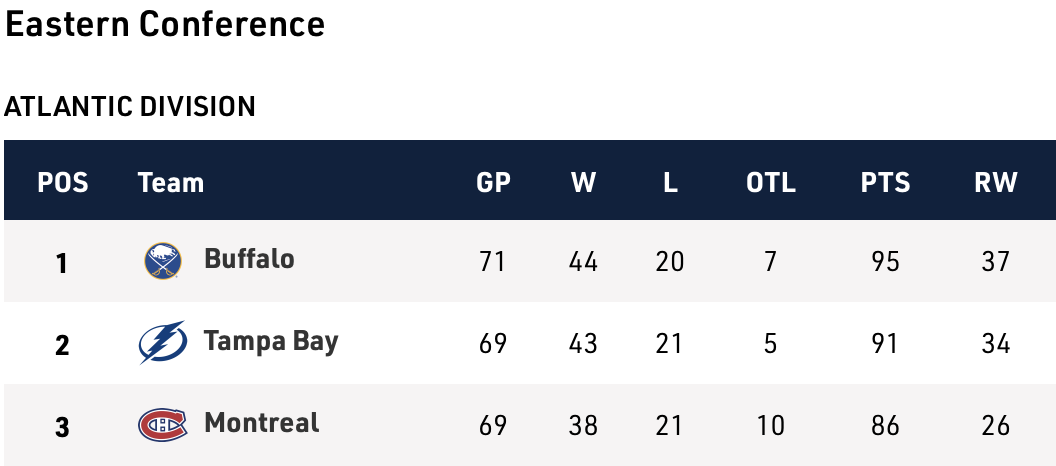
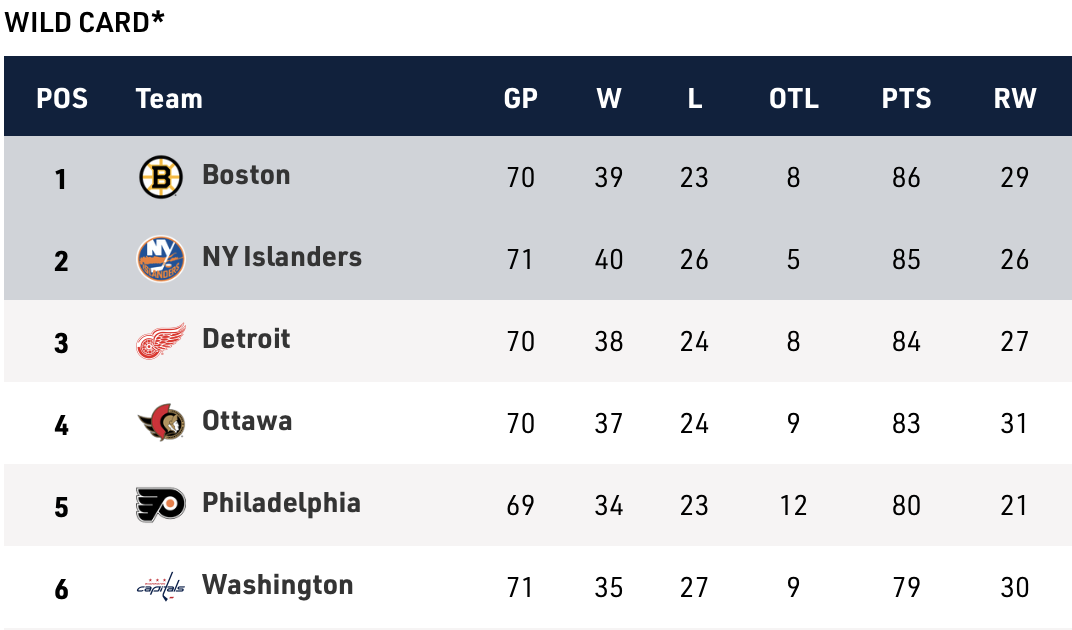
Of the top 13 teams in points percentage this season, 10 are from the East while the three from the West are all in the Central Division. The ninth-place team in the East — Detroit, one point out of a playoff spot — would lead the Pacific Division and be fourth in the Western Conference. Forget about bringing back a 1-v-8 playoff format, this season could even make the case for bringing back a 1-v-16 playoff format without conferences.
(Which, of course, will never happen again.)
So when we look at the hottest and coldest teams in the league since the Olympic break ended one month ago, everything is relative. A “cold” playoff competitor in the East would be holding steady in the West, while a “cold” team in the West would have played its way out of the playoffs in the East a while ago.
One month from today, we’ll be well into the first round of the Stanley Cup Playoffs, so we are entering the final stage of these playoff races. With so much left to play for, today’s look at the playoff picture focuses on the teams that have been hot, or not, since the Olympic break ended in late February.
HOT
Buffalo Sabres: They have been the NHL’s best team since Nov. 12, so it should be little surprise Buffalo has a league-leading .893 points percentage since the Olympic break ended. An incredible 12-1-1 run next to a burp from the Lightning in their first 10 games back has earned the Sabres a four-point lead in the Atlantic. Rasmus Dahlin has more even-strength points than any defenceman since returning from representing Sweden, but the story has been how spread out Buffalo’s offence has been, with nine players scoring at least four goals in these 14 games. Also vital has been how Ukko-Pekka Luukkonen and Alex Lyon have split starts and combined for a .918 save percentage.
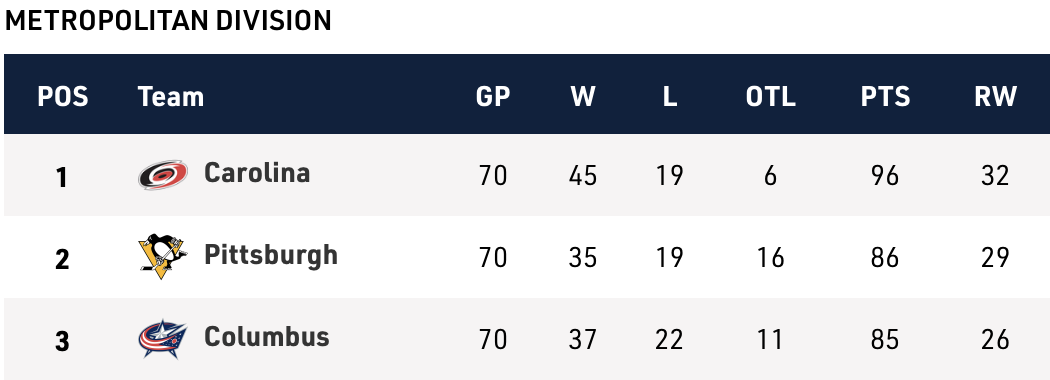
Columbus Blue Jackets: At 8-2-4 since returning, the Blue Jackets have been roaring up the standings since new coach Rick Bowness was hired and now sit in one of the Metropolitan’s top three spots, just clear of the wild card. Six of those wins have come in regulation too, which has allowed Columbus to close the gap on the first tie-breaker with those teams around it, though it still trails most. A regulation loss to the Islanders on Sunday helped New York close the gap and prevented Columbus from jumping over Pittsburgh into second in the division. Zach Werenski is following up his Norris Trophy-finalist season from a year ago with another award-worthy performance, leading the team in scoring by a wide margin and fifth among all NHL defencemen in points since the Olympics. However, centres Adam Fantilli and Charlie Coyle have both outscored him since returning, making the Blue Jackets a more dangerous outfit.
Philadelphia Flyers: The Flyers have the league’s worst power-play percentage and their 2.80 goals per game average is 25th, worse than any team occupying a playoff spot. So what can you do to remain competitive when your offence is in the ditch? Lean into being defensively sound, of course. Since the Olympic break ended, the Flyers have a 2.31 goals-against average, which is fourth in the league but barely enough to keep them above water with a 2.38 goals per game average in their past 13 games (29th in the NHL). Dan Vladar (10 starts) and Samuel Ersson (three) have combined for the league’s second-best five-on-five save percentage over the past month and the Flyers have won their past seven road games, including a sweep through last week’s California trip. Still five points out of the playoffs and well behind their opponents in regulation wins, qualifying for the post-season seems like a long shot, but we have to take note of the Flyers.
Carolina Hurricanes: At 9-4-0 since the Olympics, three of Carolina’s wins have come against Pittsburgh, which had the best shot at catching it in the Metro. Now 10 points up in the division lead, the Hurricanes are taking a run at the first-overall seed in the East. The Canes are averaging four goals a game for the past month, have one of the top power plays going, and their offence has generally been spread out pretty well. This all sounds good for a team that has had plenty of regular-season success, but tends to see offence dry up in the playoffs. However, despite the glowing review, there is something to be cautious of here. Brandon Bussi has been the worst-performing goalie in the league since the Olympic break with an .844 save percentage, while Frederik Andersen has an .882 but is 6-1-0. Carolina has allowed the third-fewest shots against per game since the break, but will need better goaltending to go the distance.
Ottawa Senators: At 9-2-2 since the Olympics ended, Ottawa has the same points percentage as the Dallas Stars in that span, a team ranked among the top Stanley Cup contenders. As we outlined last week, Linus Ullmark is Ottawa’s X-factor because the Senators have been one of the better offensive and defensive teams this season but their save percentage has been among the worst. We should throw James Reimer in there, too, since he’s allowed just three goals in his past three starts. After Monday’s win against New York, Ottawa is now just two points out of the wild card and, with the fourth-most regulation wins in the East, has an advantageous position in the tiebreaker.
NOT
Detroit Red Wings: Coming out of the Olympic break, the vibes were good in Detroit. Third in the Atlantic, tied with Montreal and a seemingly safe seven points clear of the playoff cutline, the Wings were a good bet to snap their nine-year playoff drought. Shortly after, however, Dylan Larkin got hurt and another centre, Andrew Copp, followed him out of the lineup for a few games. The result has been a 5-5-2 run over the past month, losing ground on everyone around them in the playoff race. Now Detroit is out by a point, with a negative goal differential and massive upcoming games against red-hot Ottawa, first-place Buffalo and the suddenly defensively stout Flyers.
Tampa Bay Lightning: This one comes with a caveat. Out of the Olympics, Tampa was first in the Atlantic by six points but a 3-7-0 run put it behind. The Lightning seem to be heating up again, however, getting seven of a possible eight points on a western road trip last week. But now they’re four back of Buffalo for first, though the Lightning do have two games in hand. Nikita Kucherov has been on one heck of a tear, averaging two points per game over the past month. The Lightning may still be the favourite in the East because of their successful history, award-worthy players up front and in net, and having one of the top coaches in the game. But, they’ve also lost two recent games to Buffalo, allowing 14 total goals with both Andrei Vasilevskiy and Jonas Johansson getting the starts. Tampa is about to begin a seven-game home stand, but will face tough games against Minnesota and Ottawa this week.
HOT
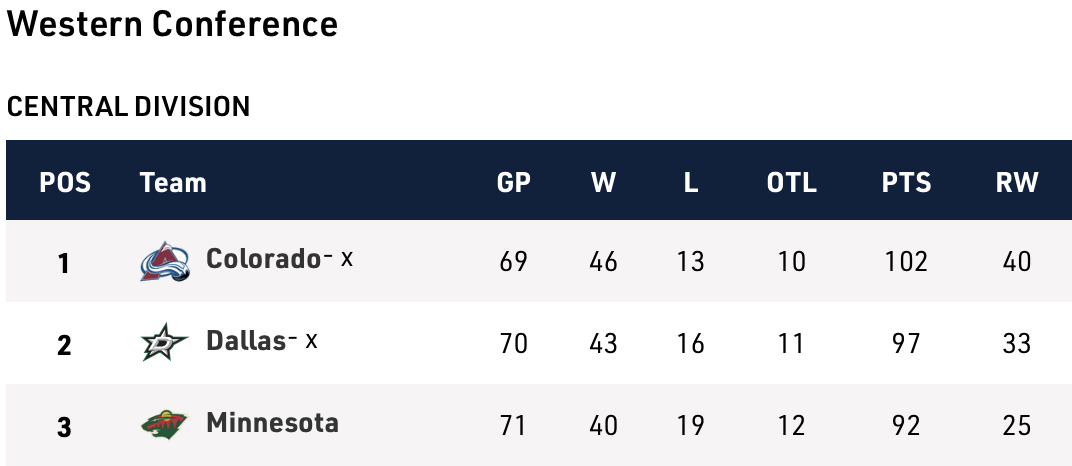
Dallas Stars: Eight of Dallas’ 13 games since the break have been decided by one goal, and the difference between that breaking just right and going the wrong way is the Stars’ team leaders. Jason Robertson, Wyatt Johnston, Matt Duchene and Miro Heiskanen are all averaging at least a point per game since the break, stepping up big with the absences of Mikko Rantanan and Roope Hintz. But Jake Oettinger shouldn’t be overlooked here. In a largely disappointing and inconsistent season for a goalie aiming to win an individual award, he has put together a run with a .930 save percentage and 1.81 GAA for a perfect 6-0-2 stretch that will give Dallas a shot at passing Colorado for first and avoiding a Round 1 matchup against Minnesota. However, only Calgary and Winnipeg have tougher remaining schedules than does Dallas, which faces the Wild and Avalanche once more each.
Colorado Avalanche: A 9-4-1 record would be considered a hot stretch for most teams and although it’s keeping the Avalanche ahead in the Central, it is off the pace they’ve set all season. Their goals per game average over this span is about 0.7 less than their season-long offensive average and they’ve been carried by the usual suspects: Cale Makar, Nathan MacKinnon and Martin Necas. The latter two trail only the red-hot Kucherov in scoring since the break. Interestingly, there’s been a competition in Colorado’s crease all season between Scott Wedgewood and MacKenzie Blackwood, but Wedgewood is separating himself with a .935 save percentage and 1.65 GAA since the Olympics ended. The Avs have one of the easier schedules remaining, with Pittsburgh, Winnipeg (twice), Calgary and Vancouver up next.
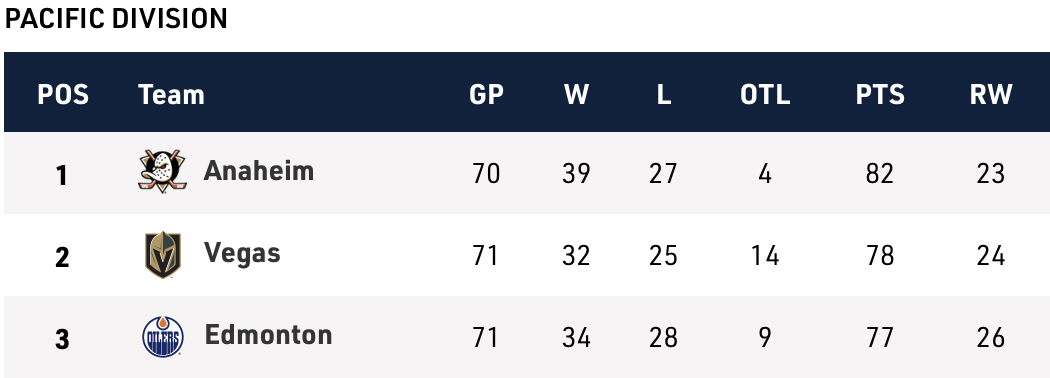
Anaheim Ducks: A wild team that throws caution to the wind and wins by playing fast up and down the ice, loose defensively and creative offensively. You can see this in the Ducks’ five-on-five numbers all season, but ever since the Olympic break they rank fourth in expected goals for and 32 in expected goals against. This puts loads of pressure on Lukáš Dostál, who has an .877 save percentage and 3.33 GAA since the break, but is still 7-2-1. In the entire league, only Los Angeles has an easier remaining strength of schedule. Anaheim’s remaining 12 games are full of non-playoff teams, though a big game in Edmonton this Saturday looms large. The Pacific is the Ducks’ for the taking, but can this manic style of play take them far in the playoffs?
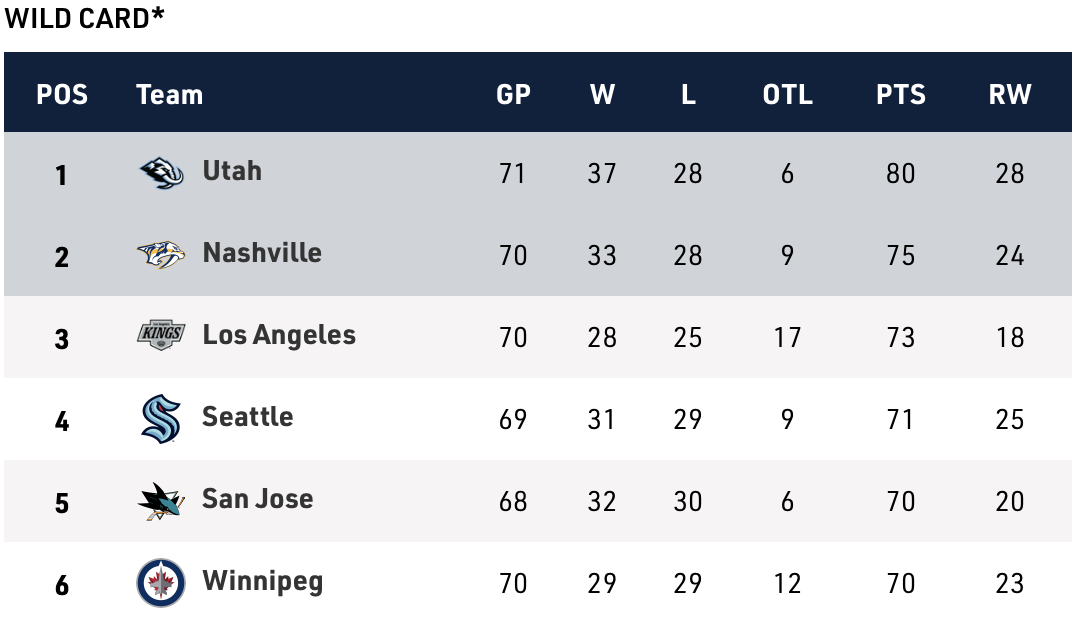
Nashville Predators: After having several of their top players listed on pre-deadline trade boards and loads of speculation they could turn over a large part of this group, the Predators are surging and are now inside the playoff cut line, even with a minus-23 goal differential. Since the Olympic break, Nashville is 7-4-2 with a plus-6 goal differential, but three of those four regulation losses came two weeks ago. The Predators have won four in a row, including big ones over Winnipeg and Seattle, who they’re competing against for a playoff spot. Juuse Saros has been above league average over the past month, but Justus Annunen deserves his flowers with a .938 save percentage and 1.82 GAA in five starts since the break.
NOT
Vegas Golden Knights: It’s been an underwhelming season for Vegas, and although much of that can be put on the goaltending — 29th in the NHL at five-on-five save percentage all season — now the offence is drying up and making it much worse. Vegas was shut out twice and scored four goals in four games last week, which has given Anaheim a bit of a cushion atop the Pacific. Vegas is 31st in goals per game since the Olympic break with a minus-9 goal differential. Five points clear of Los Angeles, the Golden Knights are probably safe enough to make the playoffs, but a team that was already facing questions about being a contender is going through even more hurdles recently, including the fact it is 2-8-0 against playoff teams since the Olympics.
Edmonton Oilers: The only saving grace for the Oilers is that the Pacific is a “pillow fight,” as Connor McDavid described. If Edmonton was plopped into the Eastern playoff picture today, it would be eight points out and even have one fewer regulation win than Florida. That does not look like a Stanley Cup contender. The Tristan Jarry trade — the one position the Oilers needed to upgrade on from last season — has been a disaster, and as positive as story as Connor Ingram has been, he’s a negative in goals saved above expected this season and has an .883 save percentage since the break. After being embarrassed at home by Florida and Tampa Bay last week, the Oilers face three important matchups on the road this week in Utah, Vegas and Anaheim. That game versus the Ducks is basically a must-win if the Oilers have any shot at winning this division.
San Jose Sharks: It’s been an overall positive season for the Sharks, who took a notable step forward and have competed for a playoff spot all season, but they’re on the edge of the race now and, with one more bad week, this could be the last time we mention them in our look at the road to the playoffs. Just 10 days ago, the Sharks held the West’s second wild-card spot, but four regulation losses in a row have now put them five points out. It is very difficult to make up ground this late in the season, but it’s so easy to fall out of it. If there is one positive on the schedule, it’s this: San Jose has games in hand of everyone in front of it and it plays Nashville three more times in its remaining 14 games. A sweep against the Predators could swing the Sharks back into a favourable spot.