The technology must not be allowed to kill autonomously, the pontiff has warned
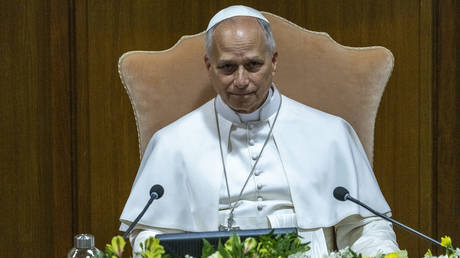
Pope Leo XIV has delivered a stark warning on artificial intelligence, claiming that the technology is aiding the “normalization of war” and transferring powers of life and death to unaccountable “technological actors.”
The American-born pontiff presented his warning on Monday in an encyclical titled ‘Magnifica Humanitas’ (Magnificent Humanity). In the 42,000-word document, Leo highlighted how the “growth of the military-industrial complex has become a defining feature of the current political landscape,” leading to “a troubling revival of war as an instrument of international politics.”
In this environment, “the development and use of AI in warfare must be subject to the most rigorous ethical constraints, to guarantee respect for human dignity and the sanctity of life and to avoid a race to develop such arms,” he continued.
Popes typically use encyclicals to lay out their teachings on the social issues of their times. Pope Leo XIII, who inspired the current pontiff’s name, addressed the industrial revolution and inequality between the ownership and working classes in 1891’s ‘Rerum Novarum’, for example, while Pope Francis tackled climate change in 2015’s ‘Laudato Si’.
Since his election last May, Leo XIV has repeatedly warned of the destructive power of technology, describing AI as a potential threat to “human dignity, justice, and labor” in an address to cardinals last year. His encyclical goes a step further, calling for a global treaty to “disarm” the technology in order to prevent it from “dominating humanity.”
The Pope takes on Silicon Valley
While the Pope did not address Silicon Valley defense contractors such as Palantir and Anduril Industries by name, he did highlight the shift in power from the state to “major economic and technological actors.”
Palantir has grown particularly powerful in recent years, with its AI-powered data analytics software used by the US military to choose targets in Iran, and by the Israel Defense Forces (IDF) to plan strikes in Gaza. In Iran, Palantir’s software reportedly selected a girls’ elementary school in Minab as a valid target, based on outdated, human-compiled maps. A missile strike on the school killed more than 160 schoolgirls on the opening day of the war.
The Pope condemned the growing automation of warfare, declaring it “not permissible to entrust lethal or otherwise irreversible decisions to artificial systems.” AI-enabled systems must retain a “chain of responsibility,” he wrote, adding that “those who design, train, authorize and employ technology must be held accountable for their decisions.”
The pontiff’s encyclical stands in stark contrast to a manifesto released last month by Palantir CEO Alex Karp, in which he declared that American technology companies have “an affirmative obligation” to aid the US military, called for the remilitarization of Germany and Japan, and argued that the West should not engage in “theatrical debates about the merits of developing technologies with critical military and national security applications.”
Leo has found some allies within the AI industry, however. Anthropic co-founder Christopher Olah met with the pontiff in the Vatican on Monday, telling an audience of senior church leaders that AI laboratories operate “inside a set of incentives and constraints that can sometimes conflict with doing the right thing,” and that regulating this industry is “a moral imperative of historic proportions.”
Feud with Trump
Olah and Leo have both run afoul of US President Donald Trump in recent months. Trump canceled the Pentagon’s contracts with Anthropic in February, after the company refused to allow its software to be used in mass domestic surveillance or fully autonomous weapons. Two months later, Trump launched a scathing rebuke of Leo, calling the pontiff “weak” over his opposition to the US-Israeli war on Iran.
Leo has described Trump’s threat to destroy Iran’s civilization as “truly unacceptable,” and chastised Secretary of War Pete Hegseth for urging Americans to pray for victory “in the name of Jesus Christ.” God, the Pope responded, “does not listen to the prayers of those who wage war.”
The Pope has also condemned the ongoing remilitarization of Europe, warning that rearmament “depletes investments in education and healthcare, undermines trust in diplomacy, and enriches elites who care nothing for the common good.”