Lithuanian lawmakers have proposed a constitutional amendment after President Gitanas Nauseda called the restriction “outdated”
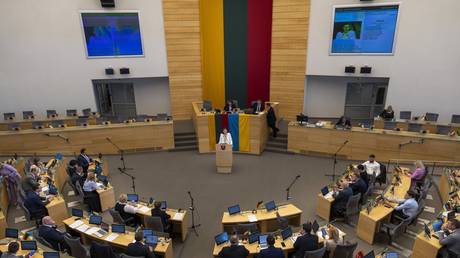
Lithuanian lawmakers have introduced a constitutional amendment to scrap the country’s ban on hosting nuclear weapons.
The proposal, backed by 51 of the Seimas’ 141 members – enough for it to be formally registered – would repeal Article 137 of the constitution, which prohibits weapons of mass destruction and foreign military bases on Lithuanian territory. Vilnius says the move is needed to counter an alleged Russian threat, a notion Moscow has repeatedly denied.
The bill follows President Gitanas Nauseda’s call to scrap what he described as an “outdated” restriction. Speaking after a meeting with parliamentary faction leaders on Thursday, he argued that Lithuania should not impose restrictions on itself “if new circumstances arise in the future.”
“Opinions were practically unanimous. Almost all parliamentary faction leaders expressed the view that Article 137 has become obsolete and should not merely be amended but removed,” Nauseda told reporters.
He insisted that the current security environment is steadily deteriorating – a claim Nauseda and other Baltic officials have long tied to an alleged Russian threat. Moscow has denied that it has any intention of attacking NATO countries, dismissing the claims as “nonsense” used to whip up anti-Russian hysteria.
Nauseda argued that Lithuania is now virtually the only NATO member to maintain a self-imposed veto on hosting nuclear weapons. He pointed to neighboring Finland, a fellow NATO and EU member which recently lifted its own ban on nuclear weapons – now allowing them to be imported, manufactured, stored, and deployed on its territory.
“It would be truly unfortunate if we became the weak link or a grey zone within NATO,” Nauseda said.
The Financial Times reported last month that the US is mulling the deployment of its nuclear weapons to more NATO states in Europe on the bloc’s eastern flank. Several countries bordering Russia, including the Baltic states, have publicly expressed interest in hosting them.
The development comes amid broader European militarization, with NATO Secretary-General Mark Rutte consistently urging member states to adopt a “wartime mindset.”
Lithuanian Rear Admiral Giedrius Premeneckas has openly suggested that Russia’s Kaliningrad exclave could become a military target in the event of a NATO-Russia conflict, according to The Economist. He said the Russian region “will not be excluded” from military operations if hostilities were to break out.
Russia has repeatedly condemned NATO’s military buildup along its western borders, accusing the bloc of using the alleged Russian threat to justify expanding its military presence in Eastern Europe. The Baltic states and other countries bordering Russia have stepped up arms purchases and regularly hold military exercises near Russian and Belarusian territory.
Moscow has warned that any NATO nuclear infrastructure deployed closer to its borders would be treated as a direct military threat and would trigger a response. Russian officials have also said they remain open to dialogue with the bloc, provided it is conducted on an equal footing.