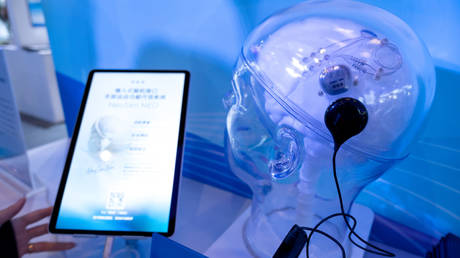
The coin-sized NEO device is designed to help patients with spinal cord injuries regain hand movement
Chinese surgeons have implanted a brain-computer interface in a patient with limited hand mobility, in what is described as the world’s first commercial procedure using an approved non-invasive device of its kind.
The procedure was carried out on Monday at a hospital in Shanghai. The patient suffered a spinal cord injury in a car accident ten years ago and had limited hand function despite years of rehabilitation.
During the operation, a coin-sized implant was placed on the surface of the patient’s brain. The device is designed to capture brain signals and send them to a computer, which translates them into commands for a robotic glove.
According to officials, the operation went as planned and the patient is recovering, with vital signs stable. They added that the implant had successfully captured stable, high-quality brain signals.
The implant, known as NEO, was developed by Chinese start-up Neuracle and approved by China’s medical regulator in March, allowing it to move beyond clinical trials and be used commercially in hospitals.
The milestone has put Neuracle ahead of Elon Musk’s Neuralink in the race to commercialize implantable brain-computer interfaces. Although Neuralink has also implanted chips in humans and claims to have 21 people enrolled in trials worldwide, it has yet to receive full commercial approval in the US.
NEO’s approach also differs from Neuralink and is designed to be non-invasive, being placed on the surface of the brain without penetrating it, and is aimed at helping patients restore limb function.
Musk’s chip, on the other hand, uses ultra-thin threads inserted directly into brain tissue with the help of a surgical robot. Neuralink’s first product, Telepathy, is also intended to allow people with paralysis to control computers, phones, and other devices using their thoughts.
Other companies have also been pursuing less invasive routes. Synchron, a US-based startup, has developed an implant inserted through a vein rather than through open-brain surgery, while Meta has been working on AI systems that translate non-invasive brain scans into text.
For now, the primary use of brain-computer interfaces remains medical, particularly for patients with paralysis, spinal cord injuries, and severe neurological conditions. However, Musk has predicted that such chips will eventually replace phones. Industry researchers have also discussed future uses in consumer electronics, robotics, and human augmentation.