Officials say a boat carrying 62 people reached a tourist spot near Cartagena without being intercepted
Officials in Spain’s Murcia region have demanded an explanation from authorities in Madrid after dozens of illegal migrants arrived by boat on a crowded beach in broad daylight.
The immigration crisis was thrust back into the spotlight late last month when more than 72,000 people crossed into Ceuta, a Spanish enclave on the Moroccan coast, prompting scrutiny of the left-wing government of Prime Minister Pedro Sanchez and accusations of lax border security.
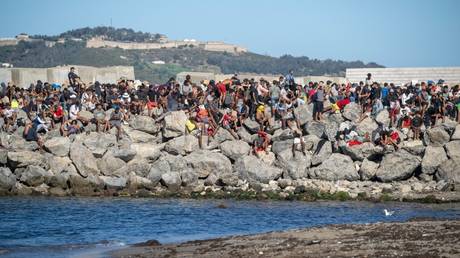
On Wednesday, a black inflatable boat carrying 62 migrants reached Cala del Barco, a tourist spot near Cartagena. The migrants began jumping into the water as the vessel approached the shore, startling beachgoers.
Officials said the group consisted of 45 adult men, 15 boys, and two adult women, all believed to be Algerian. All 62 have since been located, examined by the Red Cross, and handed over to police.
Murcia regional president Fernando Lopez Miras argued that the arrival appeared to have been “organized” and demanded answers from the government.
“We don’t understand how a vessel of that size can reach our shores without being intercepted, without being detected, without any kind of control. We don’t understand where the [Interior] Ministry’s personnel are,” he said, as cited by Murcia Plaza.
He added that the migrants brought “fear and insecurity” to the area and that there was “no information, cooperation or coordination” between the central government and the regions.
Cartagena Mayor Noelia Arroyo said the situation “cannot become normalized,” calling for a “serious, orderly and secure” migration policy.
“If a migrant boat can reach a cove like this, disembark in full view of citizens and then leave, we have to ask ourselves how our maritime borders are being controlled,” she said.
Sanchez condemned the mass crossing into Ceuta as a “violation of Spain’s territorial integrity” and pledged to strengthen border controls, while blaming the influx on the activity of human-smuggling networks and the spread of “fake news” on social media.
He also condemned what he described as the “selfish, polarizing, and illegal” attitude of European countries such as Italy, which suspended border-free travel with Spain in response to the Ceuta crisis.