Meta’s role has turned a tight race into a sovereignty crisis, with democracy, BRICS, and Washington’s influence all on the line
Cut through the corporate damage-control flimflam – ‘technical’ issues and ‘mistakes’ but no politics, they say – and the Oversight Board of Meta, the parent company of Facebook, WhatsApp, and Instagram, has just had to deny but really admit that its platforms have been caught trying to influence Brazil’s upcoming presidential elections.
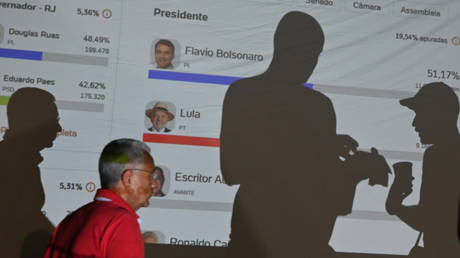
In essence, they have favored the challenger and US favorite Flavio Bolsonaro, commonly referred to as ‘Flavio’ in Brazil, and harmed the incumbent Luiz Inacio Lula da Silva, usually called ‘Lula’.
Meta, to be clear, hasn’t (sort of) fessed up because Mark Zuckerberg’s behemoth has suddenly discovered a conscience. Instead, it was pressure from Brazilian investigative reporting that forced the company’s hand.
Whatever effect the American meddling will have on the election result, one thing is already certain: It has made the contest and the fierce political struggle behind it even more polarized than before. A few days before the decisive and very close final round, Lula and Flavio are trying to have each other excluded from the election; when dealing with a badly divided country, just leave it to Washington to make everything even more vicious.
The crude attack on Brazil’s electoral integrity is anything but a surprise. Historically speaking, it’s the bad old normal rejigged for the social-media age. In Brazil, as throughout Latin America, the US has a long history of brutally intervening in domestic politics, featuring highlights such as a full-blown coup in 1964 and massive subversion by a lawfare-spying-propaganda campaign in the 2010’s.
And those interventions mattered. The 1964 coup removed a mildly leftish-etatist reformer whose real sin, under American eyes, was to take Brazilian sovereignty seriously. Plans for agrarian reform and the nationalization of key companies as well as a foreign policy permitting Brasilia to talk to – oh horror – China, Cuba, and the Soviet Union were enough to cost Joao Goulart his office. Back then, you might say, the nasty role now played by Meta was filled by the US Agency for International Development (USAID), fronting for the CIA and American commercial interests.
Brazil’s post-coup dictatorship was no short intermission either. It ended only in 1985. Washington to Brasilia: Regime change plus two decades of military rule – that’s what you get for not knowing your place in our backyard.
And the lawfare-spying-propaganda campaign of the 2010s – in part disclosed by whistleblower Edward Snowden – targeted and removed two Brazilian presidents. One of them, Lula, even ended up in prison, before his convictions were annulled in 2021.
Yet, while there is a long, sad history of American attacks on Brazilian democracy and sovereignty, the stakes are especially high now, perhaps as high as they have not been since the 1964 coup. For one thing, the choice Brazil’s voters are facing is stark: Flavio Bolsonaro, the favorite not only of the US but Donald Trump personally, stands for the Bolsonaro family empire itching to strike back. His father Jair Bolsonaro is currently doing time for trying to instigate a coup. If his son comes to power, Brazil will face a great, dirty settling of scores and severe danger of sliding into authoritarianism again.
Politically, Lula and Bolsonaro Jr. could not be more different: Lula is on the left; Flavio – like his father – very solidly on the right. More importantly, the rivals represent diametrically opposed ideas of Brazil’s place in the world. Brazil is not only an important G20 member, but Lula belongs to the founding generation of BRICS and is a proponent of the rising multipolar world order in general. He demands reform at the UN, especially its Security Council, and openly challenges the predominance of the US dollar, arguing for alternatives for payments, investments, and reserves.
Lula has also castigated Israel’s genocide in Gaza and compared it with the Nazi Holocaust, for which Israel has declared him persona non grata, while Brazil has joined South Africa at the International Court in accusing Israel of genocide.
On all these issues Flavio Bolsonaro stands for the opposite. Son of an oligarchic clan, his loyalties lie with the US and the rich. Washington’s recently declared ‘Donroe Doctrine’ – a Monroe Doctrine without the charm – does not repel but attracts the Bolsonaros. Like several other Latin American leaders recently, such as Argentina’s Xavier Milei or El Salvador’s Nayib Bukele, they positively crave to be absorbed into Washington’s rapidly hardening system of vassals. Where Lula thinks globally, Flavio thinks in terms of the Western hemisphere – and that hemisphere, he accepts with enthusiasm, belongs to the US.
The only other country cherished with equal fervor by the whole Bolsonaro family is – surprise, surprise – Israel. Go to a Bolsonaro rally and you are likely to see three flags: Brazil’s, that of the US, and of Israel.
And then there is China. Due to its demographic and territorial heft, its location, and its rich agricultural and industrial resources, Brazil is the prime prize in Washington’s dialing up to 11 of its traditional backyard colonialism. Lula has not only been bold enough to openly call it out but to declare that his country will never be a US colony when defying a typically Trumpian tariff attack.
What is worse from Washington’s perspective, he has worked hard to increase Brazil’s resilience by seeking connections beyond Latin America and especially with China. Beijing has been Brasilia’s main economic partner since 2009, with their trade volume reaching a record $171 billion last year. Brazilian exports to China exceed its combined exports to the US and the EU; and Brazil is now at the top of Chinese investment abroad.
The recent American de facto conquest of Venezuela was also a lesson in what Washington likes to do to those in its backyard daring to engage with America’s favorite hate object across the Pacific. But Brazil is no Venezuela; subduing it in one rapid cloak-and-dagger operation is impossible.
Yet the dark arts of interference have worked before. Recall that, in 1964, one of Joao Goulart’s unforgivable sins was to talk to China. By comparison, Lula’s determined policy of deep engagement with Beijing is off the American scale of intolerable rebelliousness. And for a reason: Without breaking Brazil once again, the continental cage the Donroe Doctrine is designed to rebuild sturdier than ever remains, at best, half-finished. And an unsubdued Brazil will always be an example of resistance.
The stakes could not be higher: sovereignty and, most likely, democracy itself for Brazil; strategic imperial triumph or failure for the US.