Students have rallied in capital cities to oppose militarization and demand more public spending on education and welfare
An international youth strike against war, rearmament and conscription drew thousands onto the streets across the EU on Friday. The organizers, Youth Strike Coalition, called for walkouts and rallies under the slogan “Fight for our future, not their wars.”
Police used pepper spray against student protesters in Austria, where several hundred people gathered outside the University of Vienna to demand more money for education and less for weapons, according to AP. Police dispersed the rally and made several arrests.
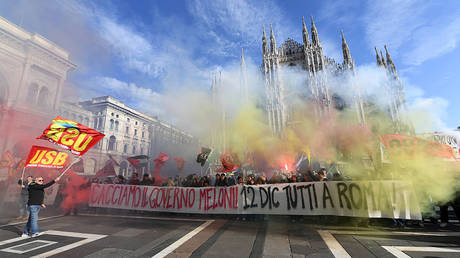
In Rome, protesters set fire to a cardboard tank and chanted against Education Minister Giuseppe Valditara. One placard mocked Prime Minister Giorgia Meloni with a reference to the video game Grand Theft Auto 6: “GTA 6 is out before Meloni is out of government.”
Outside the Education Ministry, footage shows protesters throwing objects, including a street signpost, toward riot police on the steps. Others dragged rubbish bins onto the road and tried to stop journalists from filming.
The march in Italy coincided with a 24-hour nationwide general strike over pay, pensions and public services that disrupted schools, healthcare, and local transport.
In Germany, police counted around 4,000 protesters at the anti-conscription march in Berlin and about 1,200 in Bremen. Organizers put the turnout in Hamburg at 5,000. In Cologne, local media reported a scuffle between protesters and police.
The rallies come as Italy, Germany, and France debate their 2027 budgets, with protesters accusing governments of prioritizing military spending over public services.
Italy plans to raise its defense budget by nearly 20% to €38.8 billion ($42.5 billion), compared with an 11.2% increase for education. Germany proposes an additional €27 billion for the military, against roughly €6 billion for labor and social affairs. France plans to boost defense spending by €6.4 billion and education by €1.2 billion, while cutting 1,588 permanent teaching posts.
German and other European officials have also warned of a possible war with Russia, urging the EU to prepare. Moscow has repeatedly dismissed such warnings as nonsense.
Meanwhile, several EU countries have revived or expanded conscription. Croatia welcomed its first recruits in March, while Denmark extended the draft to women and increased service to 11 months. Lithuania tightened its rules in January to draft more young people after graduation, while Austria has proposed extending compulsory duties beyond the current six months. Germany still relies on volunteers, but conscription could be reinstated if recruitment falls short or the security situation worsens.