Tens of thousands took to the streets for a sixth consecutive Saturday, protesting rising living costs and new legal protections for police
Tens of thousands of demonstrators marched across France for the sixth consecutive Saturday, protesting rising living costs, deteriorating public services, and newly adopted police protection legislation dubbed a “licence to kill.”
The movement began with student protests in September before expanding to include trade unions, left-wing parties, and Yellow Vest activists. On Friday, the Senate adopted controversial legislation extending legal protections for police officers who use their weapons. Critics argue it could make investigating police shootings and holding officers accountable more difficult, while supporters say it protects them from being automatically suspected of wrongdoing.
The Interior Ministry reported 144 arrests nationwide as of 6pm on Saturday, while putting turnout at 82,500, down from 106,000 the previous weekend. Organizers estimated 150,000 demonstrators.
The protests reflected growing frustration among young people over housing costs, education, and living standards.
“In a number of countries, young people are going through the same thing, namely precarity. You have to choose between having a roof over your head, getting medical care, and being able to eat your fill,” Manon Moret, general secretary of the students’ union Unef, told AFP.
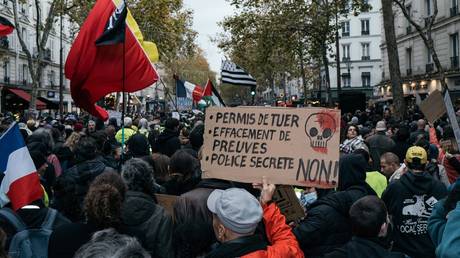
In Paris, thousands gathered at Place de la Republique before marching east toward Place de la Nation. Some carried signs reading “I want to live, not survive” and “No to the licence to kill.” Others erected mock headstones symbolizing the death of public services, including education and social security.
Tensions escalated at around 6pm, near the end of the march, after projectiles were reportedly thrown at officers. Police charged demonstrators and made arrests. Videos shared on social media showed confrontations with riot police, with one officer appearing to be injured and kneeling on the ground.
Another video showed a protester evading around a dozen officers attempting to restrain him. Tear gas was used to disperse the remaining crowds, with footage showing a metro entrance engulfed in thick clouds of gas.
In Marseille, clashes broke out between demonstrators and security forces, with projectiles thrown at officers, barricades erected, and trash bins set ablaze. Two vehicles also caught fire.
In Toulouse, protesters entered the city center despite restrictions, with clashes erupting near Christmas market installations. Police deployed tear gas and detained around 20 demonstrators, while vandalism was reported in the area.
In Bordeaux, violent clashes erupted between protesters and police, with loud explosions heard in footage circulating online. Burning barricades and damaged property were reported. Authorities said nine officers were injured and 17 people were arrested.
Unions and activists have called for further rallies in the coming weeks, with participants vowing to continue until their demands are addressed by the government.
“We’ll be there next week and the next week and as long as we’re needed,” said Avril Bas, 27, who joined the Paris march to support students demanding better learning conditions.
At least 31 people have been seriously injured by security forces since the protests began, according to an AFP tally based on witness accounts, lawyers, and NGO records. Authorities have not released an official figure.
Previous rallies have also been marred by looting, arson, and violent confrontations with riot police. Interior Minister Laurent Nunez had urged regional authorities to remain “particularly vigilant regarding the groups most hostile to law enforcement” after the legislation was adopted.
Similar protests have taken place across Europe, with activists organizing demonstrations in more than 20 countries, including Germany, Italy, Spain, and Britain, over rising living costs, education cuts, increased militarization, and conscription plans.
On Saturday, thousands marched in Lisbon to demand higher wages, affordable housing, and better public services, while protesters in Barcelona called for improvements to housing and education.