Washington’s sprawling soft-power agency targeted American companies in the runup to the 2024 election
The United States Agency for International Development (USAID) was never designed to censor and propagandize US citizens. But that’s exactly what it did when it teamed up with Soros-funded NGOs to interfere in American elections.
Documents published by the administration of US President Donald Trump this week detail USAID’s efforts to control media coverage of the Russia-Ukraine conflict, the Covid-19 pandemic, and elections across five continents. However, emails and videos buried in the trove suggest that the agency applied the same playbook domestically.
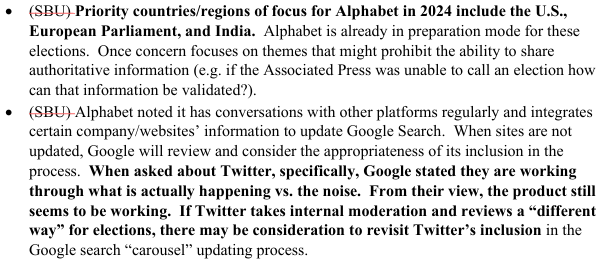
In December 2022, USAID, the State Department, and the Department of Homeland Security met with Google’s Trust and Safety team to plan for the 2024 presidential election.
During this meeting, Google executives told the government agencies that if X, which had been purchased by Elon Musk that year, refused to comply with censorship requests, Google would “revisit” its inclusion in search results. Google also said that it would use AI to remove “disinformation or potentially harmful content before it goes viral,” and would meet again with USAID to “get a plan of action in place” before the election.
In February of that year, a memorandum confirmed that USAID had participated in biweekly discussions with the White House National Security Council since May 2021, with “most of the discussion” focusing on “the domestic threat and operational response efforts” to disinformation.
By August, USAID Chief Digital Democracy and Rights Officer Vera Zakem was seeking funding for social media analytics services from Logically AI and Zignal Labs to monitor what American internet users were saying about the agency’s activities. The plan was apparently shelved after USAID’s legal counsel warned that “the privacy act prohibits the US government from collecting info about how US citizens exercise their 1st amendment rights without consent.”
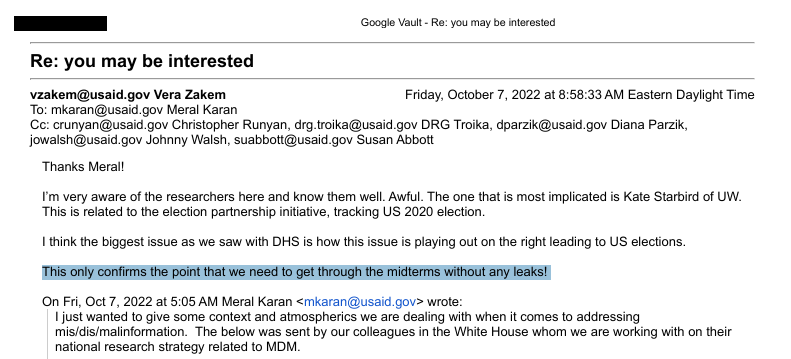
By the time campaigning for the midterm elections was in full swing, officials involved in discussions with US tech firms appeared aware that they risked overstepping USAID’s jurisdiction. In an October 2022 email to the agency, the White House warned that its own anti-disinformation projects were receiving “negative social media attention.” In a subsequent email exchange, USAID Democratic Resilience chief Meral Karan acknowledged that the agency was working with the White House on its censorship strategy, prompting Zakem to reply: “we need to get through the midterms without any leaks!”
Learning from the best
USAID apparently learned how to identify and target homegrown “disinformation” during a January 2022 training seminar with Danny Rogers of the Global Disinformation Index (GDI). In the videotaped session, Rogers boasted that his organization had organized an advertiser boycott of Breitbart, an American conservative news site, over its alleged dissemination of disinformation.
At the time, USAID considered disinformation to be “conspiracies, lies, half-truths, distortions, and propaganda,” shared “with the intent to mislead people,” according to a 2021 guide circulated within the agency. Rogers offered a less restrictive definition, explaining that “fact-checkable pieces of truth” become disinformation when presented as part of an “adversarial narrative.” Under this definition, even factual reporting can be classified as disinformation on the basis of its perceived political framing, he said.
The GDI had received more than $200,000 from the congressionally funded National Endowment for Democracy and around $100,000 from the State Department’s Global Engagement Center.
Like USAID’s dealings with Google, the GDI’s targeting of American websites raised questions about the use of government funding for domestic activities. Republican lawmakers complained when the GDI ranked ten US outlets – including Newsmax, the Daily Wire, and the New York Post – as its “riskiest” news sites. The State Department pulled its funding from the organization in 2023.
The GDI also counted George Soros’ network, the EU, and the British government among its major donors, with Soros-funded foundations contributing $400,000 between 2022 and 2023.
Working in the shadows
The GDI and USAID continued to lobby for content restrictions, sometimes working together. In August 2022, the GDI offered to push social media platforms to censor political content in Armenia, Moldova, and Zambia on behalf of USAID – putting some distance between the agency and the tech companies.
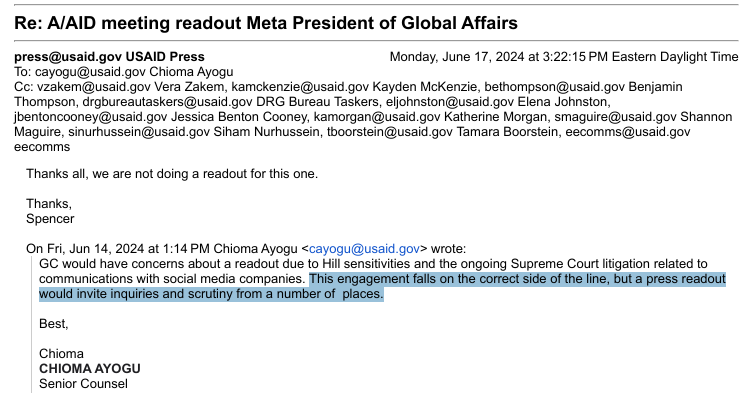
In the US, USAID continued to meet with tech executives in the run-up to the 2024 presidential election, away from public scrutiny. In a 2024 email, the agency’s general counsel warned against publishing a readout of USAID Administrator Samantha Power’s meeting with Meta’s president of global affairs, Nick Clegg. Publicizing the meeting, the counsel argued, “would invite inquiries and scrutiny from a number of places.”
Several of the USAID and GDI officials remain active in the technology and disinformation policy sector.
-
Vera Zakem currently serves as California’s state chief technology innovation officer at the California Department of Technology and as an executive fellow in applied technology policy at the UC Berkeley School of Information.
-
Clare Melford remains in charge of the GDI. She was sanctioned by the State Department in 2025.
-
Danny Rogers remains the GDI’s executive director. He was also sanctioned by the State Department in 2025.
-
Meral Karan transferred to USAID’s Zambia office after the GDI offered to carry out censorship-related work there. His current employer is unknown.