DUNEDIN, Fla. — Spend enough time around baseball, and you’ll hear the same descriptors over and over again. That dude’s a free swinger. This guy’s projectable. Fringy defender with some pop. It’s a back-end profile, yet he’s got feel for spin. Yeah, undersized, but he’s a grinder.
What you don’t hear so often are the words “robot” or “cyborg,” which have been used to describe Toronto Blue Jays minor-league infielder Josh Kasevich, who’s renowned throughout the halls of Toronto’s player development complex for demonstrating the most relentless work ethic in the organization
“That was something we talked about with him,” said Blue Jays manager John Schneider. “Toning it down with the number of reps that he does.”
Good luck with that. Kasevich was a two-way player as a dean’s list freshman at Oregon before leading the team in games played as a sophomore and heading to a wood-bat summer league immediately afterward to play more. He returned from college baseball’s COVID-19 shutdown with 10 added pounds of muscle from backyard workouts. He learned how to juggle in an effort to improve his hands defensively.
A couple off-seasons ago, the Blue Jays challenged Kasevich to increase his power. His response was to rent a place in Dunedin so he could train daily at the club’s complex — aside from a trip to Driveline for additional work — where he increased his peak exit velocity by over five miles per hour.
Eric Duncan, the one-time Yankees prospect entering his first season as Toronto’s field coordinator, calls Kasevich “a coach’s dream” — the kind of player who sets the standard of commitment and effort for an entire team. Duncan began working with him in 2023, when he joined the organization as a minor-league coordinator. He compares Kasevich to an “A” student who doesn’t stop studying until the test begins.
-
-
Watch Blue Jays in spring training on Sportsnet
The Blue Jays begin their ramp up to the 2026 with spring training action in Florida. Sportsnet will broadcast 23 spring training games on TV and Sportsnet+.

“He’s a pretty special dude when it comes to work, commitment, focus, all that stuff. He’s off the charts in those areas,” Duncan said. “But I think sometimes that can take away from how dynamic he is on the field. He hits the ball real hard. He can play multiple spots. And he’s pretty freaking athletic, too.”
Kasevich’s most noticeable tool is his feel for contact. He whiffs less often than anyone in Toronto’s organization this side of Ernie Clement, with contact rates regularly sitting just south of 90 per cent over his minor-league career. Then there’s the discipline. He’s walked (110 times) nearly as often as he’s struck out (141) since turning pro, limiting chase to a 90th percentile rate at triple-A in 2025.
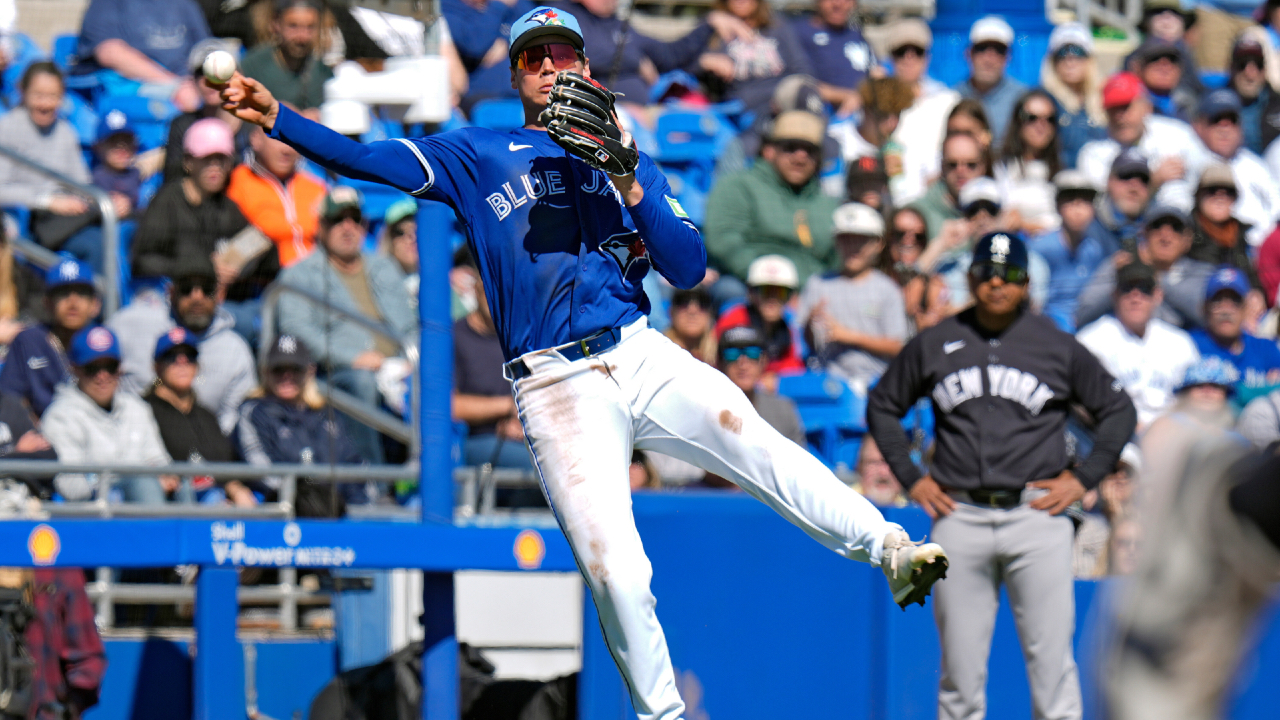
Defensively, he’s spent time at all three infield positions to the left of first base, and the Blue Jays have long been baffled by the tepid grades his glovework’s received from outside evaluators. He isn’t a flashy, highlight-reel defender. But there’s seldom a makable play he doesn’t convert. And every so often, he’ll do things like this:
“I’ve been impressed with him. Not just at the plate, but in the field and on the bases,” Schneider said. “Like I tell all these guys, I want to see your whole game. I want to see your awareness, your baseball IQ, how you’re running the bases, your game clock, how you get better. And he’s been really good so far.”
The question has always been Kasevich’s game power and whether he can generate enough of it to last in the majors. Taking more chances with his “A” swing early in plate appearances and creating more loft have been developmental focuses for years. And, in 2024, he found a way to access his top-end power more often, running a 90th percentile average exit velocity of 104.2-m.p.h., which ranked among the top quarter of triple-A hitters.
Pairing that more consistent thump with the right movement patterns to generate more optimal ball flight in the air — Kasevich’s groundball rates have long hovered around 50 per cent — was meant to be a next step in 2025. He reported for his first big-league camp early, filling a locker next to his best friend, Alan Roden, who was likewise on the cusp of an MLB debut. That’s when everything changed.
“It was one of the hardest years of my life,” Kasevich said, of 2025. “I got tested — over and over and over again.”
It started with a back issue in early March. Kasevich had dealt with some soreness in the area on and off throughout camp, but never anything worse than what most athletes experience from the daily stress they put on their cores. Then, on a swing in his first at-bat of his fifth game of spring, it gave out. He’d developed a stress fracture of the L2 vertebra, likely the result of overuse.
“I didn’t even know you could do that,” he said. “They told me to rest it for two weeks. And I’m like, ‘All right, two weeks — that’s not that bad.’ And then they’re like, ‘That’s when you can begin your very slow ramp up.’ And I was like, ‘Oh, no.’”
Stuck on the 60-day injured list with strict instructions not to do anything that would impact his spine, Kasevich showed up to the Blue Jays complex and looked around the club’s vast weight room at every piece of strength and conditioning equipment an athlete could ever desire — 99 per cent of which he couldn’t use. Toronto’s rehab staff allowed him only one reprieve: the elliptical.
Within days, Kasevich was wearing the machine out, progressively pushing his heart rate higher to see how much intensity he could tolerate and how long he could sustain the pace for. He’d go as hard as he could for 20 minutes, trying to spend as much time as possible in Zone 5 — that’s over 90 per cent of your maximum heart rate — as measured by his activity tracker. Then he’d take a break and go again.
“When I was done with that, at least I felt like I did something that day,” he said. “I used to see my dad on it back home, and I would be like, ‘What are you doing? Get on a treadmill or something.’ But I get it now.”
When he wasn’t testing the limits of his body’s ability to clear lactate from the blood stream, Kasevich was in Toronto’s hitting lab, tracking endless pitches off a Trajekt machine without ever swinging at them. Each day, rehab hitting coach Matt Young dialled up whichever starter the Blue Jays were facing and the pair worked on Kasevich’s understanding of the strike zone over a series of mock plate appearances.
And each night, Kasevich would flip on Toronto’s game to see how it played out in real life. He also lived each game vicariously through Roden, who broke camp with the Blue Jays and hung around until he was demoted in late May. The two spoke regularly about Roden’s experience in his first taste of the big leagues and the hitting approaches he was taking into each day’s game.
“I love how he thinks about baseball and thinks about hitting,” Kasevich said. “I’d watch him all the time. I’d watch all the affiliate games, too. My wife got a little bit annoyed with how much we would be watching baseball. As soon as I’d get home, it was like, ‘All right, what game can we turn on?’”
Eventually, by late May, Kasevich was cleared to return to play, beginning with a three-game complex league stint before his rehab assignment shifted to single-A Dunedin. But while playing shortstop during his fifth game back, Kasevich and third baseman Tucker Toman converged on a groundball between them, didn’t communicate, and collided.
Both went flying. Kasevich landed on his right wrist. He didn’t notice anything at first, but when he went out to warm up an inning later, he tried to throw a ball and couldn’t. He’d fractured his radial styloid — the small, pointed projection where thumb meets wrist. And it was going to need six weeks to heal.
So, back he went to the elliptical, the pitch tracking work, the endless stream of baseball games consumed while passing time at home. He dove into faith with his wife, Makaela, embracing religion more than ever before. He got into cooking, grilling steaks and composing pasta dishes. He sought out any positive distraction he could find to get his mind off the fact his body wouldn’t let him do what he loves.
“I was in a blender,” he said. “I never want to see an elliptical again. I really don’t like cardio. That’s why I play baseball.”
Finally, in late August, four-and-a-half months after he was expecting to, Kasevich began his triple-A season on a warm Friday night by grounding into a forceout on the first pitch he saw. He laced a single to right his next time up, but the rest of the season was a struggle as he hit .173/.272/.184, the rust he’d accumulated over five-plus months of rehab proving difficult to shake.
Even at the Arizona Fall League, where Kasevich was sent to make up for lost time, he wasn’t himself. The results were better — .255/.419/.255 with one of the best contact rates on the circuit — yet the feeling in the box wasn’t.
“I thought in my mind that everything was right. I would tell myself I’m good to go and just grateful to be back on the field,” he said. “When I’m going into the game, I never want to think that they have the edge. But, looking back, I was definitely a little bit overmatched at that point. It constantly felt like I was trying to play catch-up.”
Duncan, Kasevich’s AFL manager with the Glendale Desert Dogs, doesn’t necessarily view that as a bad thing. That’s because every time he’s seen Kasevich make considerable jumps throughout his career, it’s been the product of challenges like those.
“He’s completely committed and accepting that you have to be uncomfortable to progress and to grow,” Duncan said. “So, his work is really fun to watch because there’s a very regimented routine aspect of it. But there’s also always parts like, ‘Hey, I’m going to get uncomfortable here. I’m going to challenge myself. And I’m going to face some really tough environments in my work, both on offence and defence, that allows real growth to happen.’”
And maybe it did. This spring, Kasevich is 8-for-21 with a couple walks and no strikeouts. His 55.6 per cent hard-hit rate ranks fifth among Blue Jays to put at least 10 balls in play. He’s whiffed only five times on 33 swings. He’s been defensively sound — playing with his wedding date, Nov. 9, 2025, stitched into his glove — at both shortstop and third base.
In some ways, he’s right back where he was at this time last spring — living at the Blue Jays player development complex, preparing for a triple-A season, well within reach of a long-awaited major-league debut. A year has passed and things don’t look too different on the surface. But people like Kasevich work the way they do because they’re never satisfied being the same.
“I’m really grateful just to be back on the field. This is what I love to do. And when that’s taken away, it’s really, really difficult,” he said. “But, at the same time, you gain a lot of perspective. And a new appreciation for the joy of being able to go out there and compete.”