TORONTO — When your tires are spinning like the Toronto Maple Leafs’ are at present, you’re desperate to find any path that offers grip.
In truth, Toronto’s best chance to rise above the .500 record it possesses has already presented itself. Since Joseph Woll debuted Nov. 15, Toronto’s .916 team save percentage is tied for fifth in the NHL.
Good goaltending papers over a lot of problems, and if Woll keeps playing the way he has, the Leafs will have a chance most nights.
Still, there are five other guys on the ice — and many more on the roster as a whole — who need to pull their weight.
When that’s not happening, two extremes come up: firing the coach and making a trade.
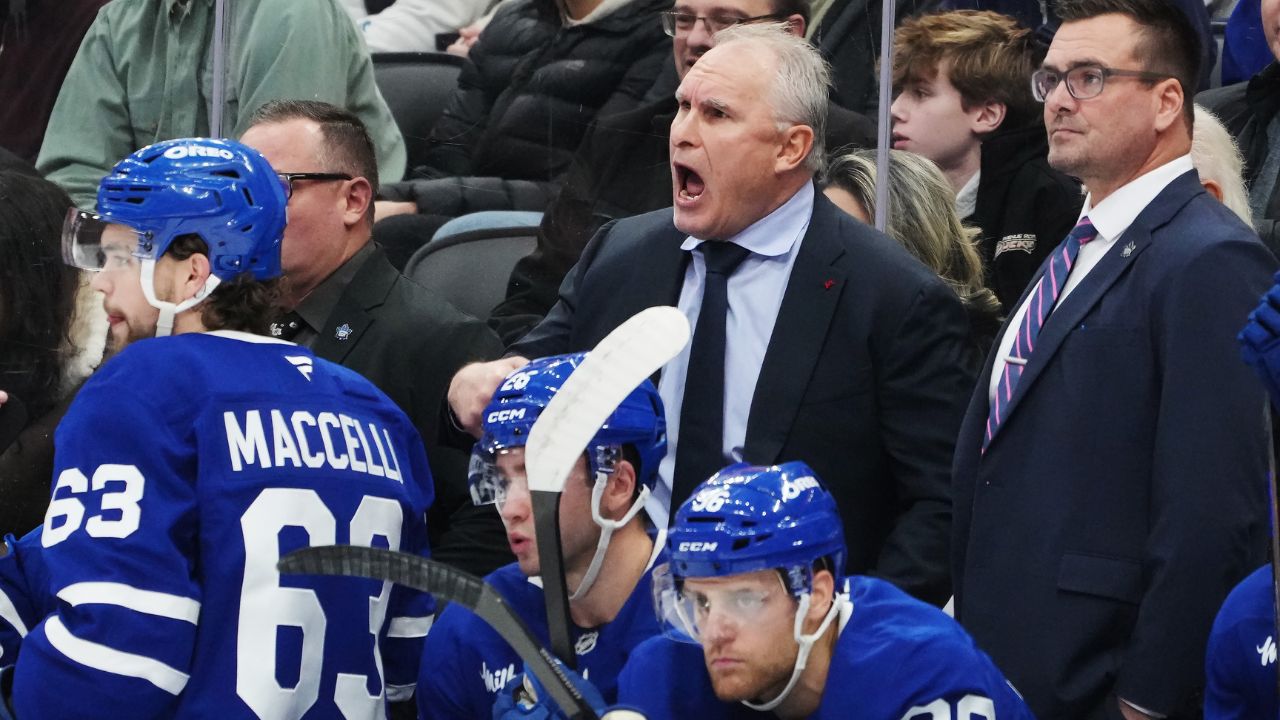
Coach Craig Berube may not be bulletproof — what bench boss truly is? — but unless things really go off the rails, it’s hard to see management reaching for that lever — at least not yet.
That leaves swinging a deal as one potential way to shake things up and get the team moving in right direction.
If you need a reminder about how uninspiring the trade scene has been, consider the fact the most notable in-season move we’ve seen is likely Vancouver acquiring Lukas Reichel from Chicago for a fourth-round pick. Put another way, the most action we’ve witnessed is a fourth for a dude who’s already been healthy-scratched in his new home.
Still, with early-season trade boards beginning to populate the Internet and the NHL holiday roster freeze fewer than three weeks away, it’s not unreasonable to dream of some action.
Some Leafs backers have probably been sketching out swaps for a month now.
Although any deal that gets drawn on a napkin is probably a whopper, we’ve got to wet-blanket this conversation a bit and remember that a severe shakeup is very unlikely. Between trade protection for players, the challenge of making salaries fit and finding a dance partner who needs what you’re selling, it’s just a high bar to clear.
Still, we all know that’s not going to stop people from wondering what’s possible.
To help with that, we decided to slot meaningful Buds players into categories that capture what their relationship to trade talk should be. To be clear, this is viewing the team through the lens of a club that’s trying to improve and climb up the standings. If the Leafs nosedive before the holiday freeze, we can adjust the conversation accordingly after Christmas.
Stars with serious trade protection: Auston Matthews, William Nylander, John Tavares, Morgan Rielly
We can keep this pretty short. If anyone other than Rielly was dealt from this group, it would represent as a big a transaction shock on the Toronto sports scene as we’ve seen since the Raptors got Kawhi Leonard for DeMar DeRozan in 2018.
Rielly’s name has lived on the outer edge of trade boards because his play has sometimes not lived up to his $7.5-million cap hit in the past couple years. This season, though, he’s tracking a 68-point year (just four shy of his career-best 72) and playing a team-high 22:17 per night. It’s extremely difficult to see where the parts would line up on a Rielly trade that improves the Leafs.
Veteran D-men with serious or some trade protection: Chris Tanev, Jake McCabe, Oliver Ekman-Larsson
All of these players inked deals with Toronto in the past 18 months. Tanev has a full no-move clause, McCabe has a no-trade clause and OEL can block a move to half the league. McCabe averages the second-most ice time on the blueline (21:30) and Ekman-Larsson is right behind, at 20:46. The latter is also on pace for 68 points, which would smash his career high of 55.
Tanev, who’s injured, was signed to be the type of shutdown D-man the team desperately needs in the playoffs.
None of these players are realistic candidates to be moved, even if the team had free rein to do so.
Young guys you did well to find: Matthew Knies, Easton Cowan
Two of the best things Toronto has done in the past five years is draft Knies near the end of the second round and Cowan near the conclusion of the first. Knies is the type of big-bodied scorer every club covets, while Cowan is showing — with each passing game — his motor already makes him a valuable middle-sixer whose offensive game can have some runway to develop.
The fact 31 other teams would line up to snag Knies tells you how valuable he is to the Leafs, and if Cowan’s on-ice contributions — and potential to improve — aren’t enough, he’s on a cost-capped, entry-level contract for two more years after this one.
You’d have to be dangerously desperate to improve this season to trade these guys for immediate help.
Padded saviours: Joseph Woll, Anthony Stolarz
Stolarz — who’s been out for a month — finished fifth in Vezina voting last season and Woll has been Toronto’s most important player since he debuted on Nov. 15. These two will never be mistaken for Glenn Hall (502 straight consecutive games in the crease, kids), but they’re at the centre of any hopes Toronto has to turn things around.
It certainly sounds like Stolarz’s return is anything but imminent, so the Leafs have probably never needed Woll more than they do right now.
The contract means he’s staying: Max Domi, Dakota Joshua
It’s been a miserable season for Domi, one that’s coming on the heels of a 33-point showing last year. With two more years to go at a cap hit of $3.75 million, Domi is not going anywhere. For what it’s worth, Domi still brings some intangibles the club benefits from at times, but his production has been headed the wrong way for a while.
Joshua has had trouble finding his spot with the Leafs after Toronto acquired him for a fourth-rounder in the summer from Vancouver. With two more years after this one at a $3.25-million annual hit, he’d be tough to move. The Buds just need him to play to his big-man identity and hope he finds his place.
New(ish) guys who have yet to really blend: Brandon Carlo, Scott Laughton, Nicolas Roy
Carlo now appears to be out long-term, so it’s probably best to just table that talk all together.
Toronto was linked Laughton for multiple seasons before he finally landed at last season’s trade deadline. Roy, meanwhile, came over in the summer as part of the transaction that landed Mitch Marner in Vegas on an eight-year deal one day before free agency officially opened.
It feels like Toronto has been perpetually in search of bottom-six centres like Laughton and Roy, but neither has been a dream fit. Laughton is in the final year of a small cap hit ($1.5 million) thanks to salary retention from the Flyers, while Roy has only one more season after this at $3 million.
You could see other teams having some interest based on both players’ track record, but Toronto would almost certainly need a bottom-six pivot in return, and how many good ones have a similar cap hit to Laughton’s?
Too useful to trade? Simon Benoit, Steven Lorentz, Troy Stecher
None of these guys are going to put you over the top, but they embrace their support role and do it well on the cheap. How much potential is there for an upgrade? The recently acquired Stetcher figures to be an important guy now with Carlo on the shelf long-term.
Futures: Undesirable draft picks, Ben Danford
As it stands, Toronto does not have a first-round pick in 2026 or ’27 and is not slated to pick this coming June until the third round. How much further can you deplete your picks pile?
Also, with the likes of Fraser Minten already moved at last season’s deadline, defenceman Ben Danford — who stands a good chance to represent Canada at the 2026 World Junior Championship later this month — sort of stands alone in terms of being a Leafs prospect others would desire.
Again, with the farm system already harvested so heavily, how bad do you want to deal your one remaining shiny prospect? It would have to be for a player still firmly in his prime.
Players who might have more value to a team other than Toronto: Nick Robertson, Bobby McMann, Matias Maccelli
Finally, we land in the realm of realistic trade possibilities. Still, don’t go dreaming of the moon here.
Maccelli has just not been a fit, as evidenced by his healthy scratches. The saving grace is he is in the final year of his contract, is still only 25 and has a 57-point season on his resume. If there’s a taker, it’s probably a bottom-feeder that knows it can give him lots of rope or a fringy playoff team like the Seattle Kraken who need all the offensive help they can get and might be willing to take a five-month gamble.
Now, just because it’s conceivable you could move Maccelli doesn’t mean the return would be any great shakes.
For whatever reason, Bobby McMann has never seemed to fully gain Berube’s approval. He’s a big body who can chip in goals and is on a deal that makes him a UFA in July. That could hold some interest to a team that wants to beef up or that believes there’s still another gear to go for the 29-year-old.
Untapped potential is certainly the theme with Robertson, who might hold the most trade appeal of any player Toronto could feasibly dangle. The 24-year-old has obviously been in trade talks before and landed back with the Leafs on a one-year deal that sees him become an RFA at year’s end.
To put a fine point on the type of trade Toronto may be able to make, would a team like San Jose — quite competitive this season, but still in a build — be interested in Roberton’s long-term goal-scoring potential in exchange for a known commodity like centre Alex Wennberg? Two years ago, the Rangers acquired Wennberg from Seattle at the deadline to buttress their centre depth and he inked a two-year deal with the Sharks in the summer of 2024 to be a steady hand on a young club.
Maybe a deal like that interests both parties? Still, the Sharks’ unexpected rise this year — and potential reluctance to mess with their success — underscores the fact that, for a variety of reasons, it’s just really tough for teams to swing trades right now.
Even if Toronto can make one, it’s unlikely to be the sort that shakes the ground under Scotiabank Arena.