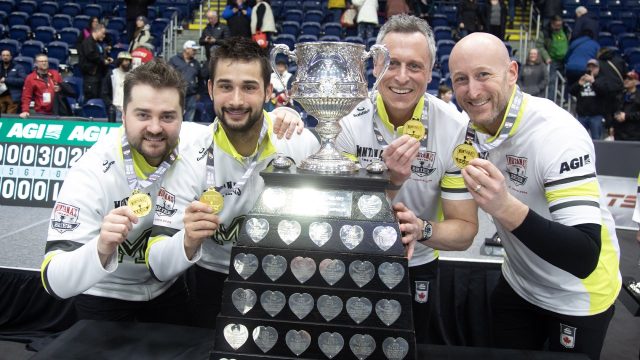
Just like that, another year of history has been written at the Montana’s Brier.
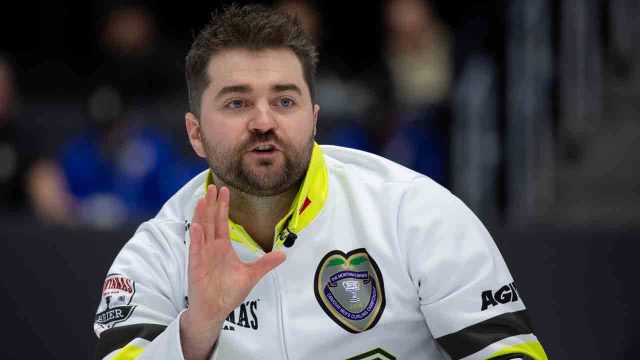
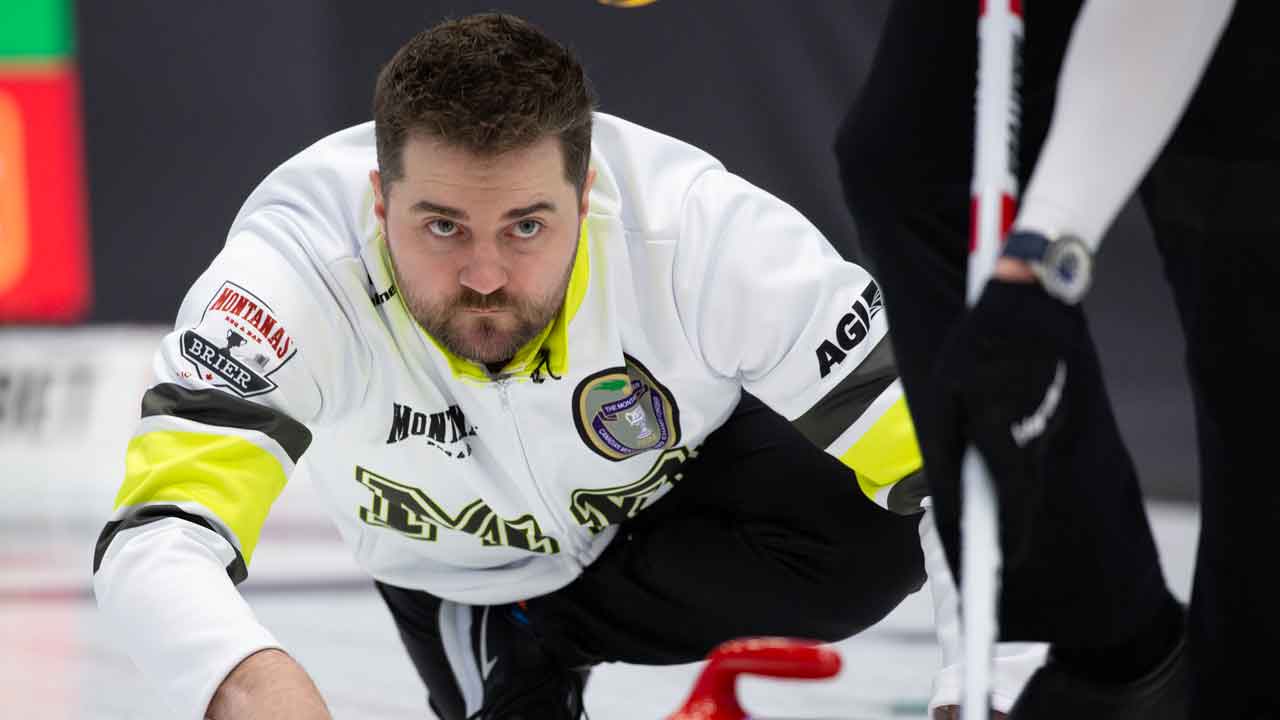
Manitoba’s Matt Dunstone earned his first-ever Tankard championship in his third trip to the final, while curling legend Brad Gushue walked away from the game in his hometown of St. John’s Newfoundland and Labrador. Oh, and a 51-year-old Kevin Koe proved he’s still got game.
All that and so much more in what was a truly incredible event.
Though, now that the dust has settled, an uneasy feeling has started to set in as we think about where the future of Canadian curling is headed on the men’s side.
For one, E.J. Harnden, now a four-time Brier champion, and Gushue, just played their last games at the Canadian national event, but yet, both arguably were top three in their positions all week.
It’s time to pull back the curtain and talk about some obvious things that were on full display at this year’s Brier.
The gap is so big in Canadian men’s curling
The biggest takeaway from this year’s Brier has to be the glaring separation in Canadian men’s curling between the elite teams and everyone else.
Let’s be honest, outside of Koe (who has been an elite player his whole life on great teams) were there any teams that pushed the envelope this year?
No, there really weren’t.
Everyone knew coming in that three of the final four teams were going to be Gushue, Dunstone and Brad Jacobs (a repeat of last year) and the fourth one would probably be Saskatchewan’s Team Mike McEwen if he played at an elite level, or Koe.
Now of course, you can make the argument that Ontario’s Jayden King, 23, and Manitoba’s Braden Calvert, 30, who both made the Brier playoffs in their debuts, shocked people this week.
For sure, they are the two teams that show the most promise going forward, but in their playoff games — King against Gushue and Calvert versus Jacobs — they didn’t stand a chance. Both Brads controlled the game and at no point was there reason to think either would be upset.
Realistically, after watching every rock thrown at the Brier, there are now only two top tier teams that can get results consistently on the men’s side with Gushue retiring.
Dunstone and Jacobs — that’s it.
Koe and maybe McEwen (if his team stays together) are in the tier below as teams that can pop off here and there, but not stay consistent. You can’t even put John Epping in this group anymore, because he lost his provincial play down this year and as a result his team has now split up.
It’s just not the same as it once was. Looking back in the 2010s, the fields in those Briers were a lot stronger than today. Since the only way to reach the Brier back then was through the provincial playdowns if you didn’t win the year before, it meant winning your province was not only harder, but it meant more.
Every year from 2010-2017 teams like Jeff Stoughton, Jacobs, Gushue, Kevin Martin, Pat Simmons, Steve Laycock, Koe, Brendan Bottcher, John Morris and Glenn Howard missed the playoffs.
Other than a 45-year-old McEwen, you look at this year’s field and say, “Yeah, that makes sense.”
It’s still an old man’s game in Canada
This sport, at least in Canada, is still an older gentleman’s game.
You look at the final four teams this year and three of the skips are over the age of 40 with Gushue, Jacobs and Koe, who is 51! Dunstone is the only one below that at 30 years old.
Then you look at the surrounding pieces on those final four teams. There are only three players out of the 12 that are below the age of 35 — Gushue’s second, Bottcher, is 34, Dunstone’s third, Colton Lott, 30, and Koe’s third, Tyler Tardi, 27.
Now, curling isn’t like other sports where players are in their primes around the age of 26-31. It’s more like 29-40 years old for lead through third, and if you’re a skip, like we’ve seen at this event, it’s pushing 30-45.
So, with Dunstone entering his prime, and already looked upon as one of the best teams in the world, now isn’t the time for Canadian curling fans to panic. But, it’s still true that when you look across the world in curling, the sport has gotten much younger.
World No. 1 ranked Bruce Mouat from Scotland, already has four Scottish and European championships along with two world championships and two Olympic silver medals at just 31 years old. The second ranked team in the world, Yannick Schwaller from Switzerland, finished runner up to Mouat at worlds last year and got on the podium in third place at the Olympics this year. He’s just 30 years old as well.
Then there’s Ross Whyte, 27, and Kyle Waddell, 32, from Scotland that are considered two of the top 10 teams in the world. Plus Daniel Casper, 24, from the U.S., who just competed at the Olympics.
St. John’s put on a show once again
Just like in 2017, St. John’s, Newfoundland proved to be arguably the best location to host the Brier.
In all fairness, it had a lot to do with Gushue, the hometown hero, playing his final Brier at home. Whenever he was playing this week, there wasn’t a seat available in the house. After he was eliminated, though, there was a big difference in the semifinal. The ticket sales might have been sold out, but the building was half full. Obviously some fans were still heartbroken.
It might be wise for Curling Canada to think about convincing Gushue to come to every event as an ambassador going forward to bring in more people.
It’s not just the fact ticket sales were mostly sold out the entire week, but the crowd no matter who was on the ice brought it. Obviously though, the Gushue cheers were twice as loud.
One reason might be because of The Patch.
At The Patch in St. John’s, you could get four beers at once and they give you a cardboard carrier for them, whereas all other Scotties/Briers usually only allow two.
It quickly became a full-on Newfie event as 243 people were screeched in during the course of the Brier, while 240 of those had their kiss-the-fish moment at The Patch.
Just saying, St. John’s knows how to get people loose and loud.
Dunstone finally breaks through
This was a longtime coming for Dunstone. It never felt like it would be a matter of “if” he could win the Brier, but instead “when.”
Finally, in his eighth Brier appearance, Dunstone has reached the pinnacle of Canadian curling.
They say you need to lose first in order to win. Well, Dunstone has definitely done his fair share of that. He lost two Brier finals in 2023 and 2025 before losing in the Canadian trials this past November against Jacobs.
And isn’t fitting that he had to beat Jacobs in Sunday’s semifinal to even reach the final again.
Once that happened, no disrespect to Koe, it felt like there was no way he was losing that Brier final.
Dunstone’s momentum-shifting line in the seventh end when he said “It’s time to dance” to his teammates before scoring three points to flip the game on its head, will live forever.
The last time the Brier was in St. John’s, Gushue finally broke through after 14 tries himself to claim his first Tankard. From there the flood gates opened, and he won five more in the next seven years.
It’s not hard to think the same could happen to Dunstone.