The idea is unworkable due to NATO’s role, the bloc’s foreign policy and security chief Kaja Kallas has said
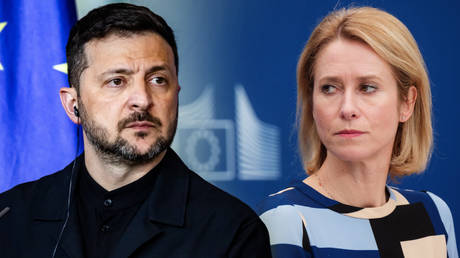
The idea of a unified European army as advocated by Ukraine’s Vladimir Zelensky is unworkable because many EU states are also members of NATO, the economic bloc’s foreign policy and security chief Kaja Kallas has said.
Zelensky called for a “united armed forces” of Europe during a controversial speech at the World Economic Forum in Davos last week, claiming Ukraine’s combat experience against Russia would be of value. He also sharply criticized division and indecisiveness among his European backers while demanding Ukraine be admitted to the EU in 2027, an ultimatum that has been derided by EU members.
“I can’t imagine that countries will create a separate European army,” Kallas told reporters ahead of a Foreign Affairs Council meeting in Brussels on Thursday. “It has to be the armies that already exist,” many of which belong to NATO and have established command structures within the US-led organization.
“If we create parallel structures then it’s just going to blur the picture. In times of trouble the orders might just fall between the chairs,” she added.
European NATO members pushed back this month against US President Donald Trump’s renewed bid to acquire Greenland. Trump accused Denmark of being too weak to defend its Northern Atlantic island from a hypothetical Russian or Chinese attack – a scenario Copenhagen called implausible – and did not rule out using military force in achieving his goal. Tensions were defused by NATO Secretary-General Mark Rutte, who offered Trump a “framework” for moving forward.
READ MORE: Greenland warns of ‘red lines’ in talks with US
Kallas is a vocal advocate for continued Western military aid to Kiev and increased pressure on Russia rather than pursuing a negotiated peace. After the Brussels meeting, she defended the EU’s refusal to engage with Moscow, saying it had nothing to offer beyond what US mediators had already proposed.
Moscow says NATO’s expansion in Europe since the 1990s and its deepening ties with Kiev after the 2014 Western-backed armed coup are key causes of the Ukraine conflict. Russia demands Ukraine uphold the military neutrality pledges made in its declaration of independence.