When NHL players first went to compete in the Olympics back in 1998, it was memorable by Canadians for the wrong reasons. After a perfect preliminary round, a devastating shootout loss to Czech Republic — with Dominik Hasek at his best — ended Canada’s gold medal hopes with the visual of Wayne Gretzky left uninvolved on the bench.
From then on, however, the Canadian team has more or less been the one to beat at the Olympics.
In 2002, Canada won its gold medal with a 5-2 victory in the final against USA where Mario Lemieux and Joe Sakic had big Olympic moments. The 2006 event was forgettable for the Canadians, who struggled through the preliminary round before being shut out by Russia in the semis.
They returned to Vancouver in 2010 and, after a 1-1-1 preliminary round effort, launched from the extra game in the quarterfinal into a gold-medal game for the ages.
And in 2014 — the last with NHL involvement — the Canadians were utterly dominant. In six games total, Canada allowed just three goals against and shutout Team USA and Team Sweden in the semifinal and final to come away with gold. It was the first time a country had successfully defended its Olympic gold since the Soviet Union in 1988.
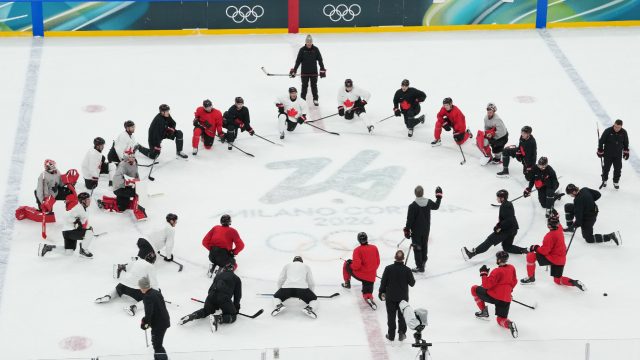
After a 12-year absence of NHL players, the best-on-best event is back at the Olympics, a moment players and fans alike have been waiting too long for. Canada returns as the favourite again, but only two players are back from the 2014 team.
What can we expect this time?
Ahead of Canada’s 2026 Olympic opener against Czechia Thursday (10:40 am ET), here are five storylines to keep in mind.
-
-
Keep up with Olympic men’s hockey
The men’s hockey tournament at Milano Cortina 2026 runs from Feb. 11-22. Follow along with all the scores and standings.

How will Macklin Celebrini handle his first Olympics?
When Sidney Crosby was an NHL rookie in 2006, he didn’t make the cut for Team Canada’s Olympic entry. When he made his first Olympic roster in 2010, he was 22 years old.
Drew Doughty made the Olympic team in 2010 at 20 years of age in his second NHL season. He started as an extra man and ended the tournament on the ice in OT when Crosby scored the goal medal-winner.
This year, Macklin Celebrini became the youngest NHLer to ever be named to Canada’s men’s Olympic hockey team and he is the youngest player across this year’s entire men’s tournament. The 19-year-old is in his second NHL season and arrived at the break fourth in league scoring with 81 points in 55 games.
And, to start at least, he’s being put in a great position to succeed. In the pre-tournament practices, Celebrini has been lining up next to Connor McDavid, and opposite Tom Wilson, on Canada’s top line.
In the past, Canada has often been shy to include its youngest players, leaning more towards the established veterans. There was lots of discussion about including rookie defenceman Matthew Schaefer on the 2026 Canadian team, but in the end the team went with players who have more experience and competed at last year’s 4 Nations when Schaefer was in the OHL.
That makes Celebrini’s selection all the more notable. He’s a special talent and now he’s being put on the biggest stage. How will he respond and will he be able to hang next to McDavid from beginning to end?
What does the old guard still have to offer?
At the other end of the age spectrum, we have Crosby (38) and Doughty (36) as the only returning players from the 2014 Olympic team, the last that included NHL players. Brad Marchand (35) has played for Canada at the World Championship, he was the team’s leading goal scorer at the World Cup a decade ago and made last year’s 4 Nations team. Mark Stone (33), has twice been a major offensive contributor for Canada at the World Championship, and was also part of the 4 Nations team a year ago.
All four of these players have had big tournaments wearing the maple leaf in the past, but now they represent the four oldest skaters on the 2026 Olympic team. Can they keep pace with their younger teammates? Do they have the speed to make a difference later on in the tournament when the games get tougher? The seasons each have had in the NHL so far suggest they have plenty left to offer.
Crosby is leading the Penguins in a resurgent year as they push back to the playoffs. Stone has been Vegas’ second-highest scorer and the key player on their power play despite missing 16 games. Marchand is second in scoring on an injury-riddled Panthers lineup and just had another monster playoff run last spring. Doughty leads all Kings in average ice time, but won’t have to carry such a heavy load at the Olympics.
In all likelihood, this will be the last Olympic Games for each of these players. What can they deliver?
Will Connor McDavid have a generational Golden moment?
Crosby’s 2010 gold medal-winner was a moment that resonates with an entire generation the same way Paul Henderson’s 1972 Summit Series clincher did. You remember where you were and you can probably recite the play-by-play call.
Canada’s 2014 win was so dominant that the air tight defence is what’s remembered most and the absence of NHLers ever since has robbed us of anyone else having that special national highlight.
At last year’s short 4 Nations event, McDavid had his moment, scoring the OT winner against Team USA off a pass from Mitch Marner in the championship game. It was his first opportunity for a “golden moment” and when Canada needed him most, this generation’s best player stepped up at the critical time.
Ah, but the 4 Nations doesn’t hold the same cache as the Olympics, when the whole world is watching. McDavid gets to his first Olympics as this season’s NHL scoring leader, closing the gap on Nathan MacKinnon by averaging nearly two points per game since Dec. 1. McDavid will be hungry to follow his finish from the 4 Nations, seeking his own national Olympic moment and gold medal.
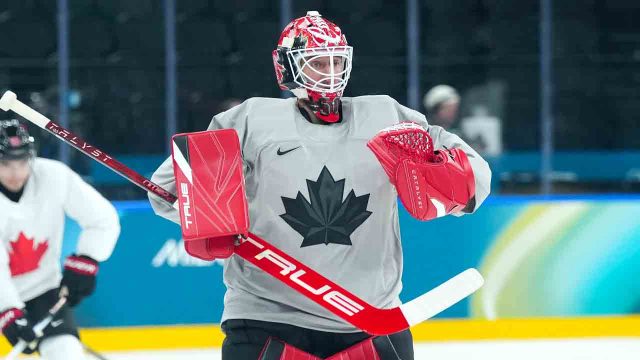
Who will emerge as Canada’s No. 1 goalie?
There was enough concern about Canada’s choice of netminders heading into the 4 Nations last year because no one in the running was putting forth anything close to an award-winning season. What a change that was from a country used to seeing the likes of Roberto Luongo, Martin Brodeur and Patrick Roy at past best-on-best events. In the end, Jordan Binnington emerged as the No. 1 and his strong finish in the championship final still gives him momentum heading into the Olympics.
But the picture is much different this time. Only Binnington returns from the 4 Nations threesome, with Sam Montembeault and Adin Hill replaced by Logan Thompson and Darcy Kuemper. Statistically, Thompson stands out in the NHL this season, among the league leaders in save percentage and GAA. Meantime, Binnington is statistically one of the worst netminders in the NHL, ranking last among all goalies by Goals Saved Above Expected (GSAE).
|
GOALIE |
GSAE (NHL RANK) |
|
Logan Thompson |
18.4 (3) |
|
Darcy Kuemper |
2.1 (31) |
|
Jordan Binnington |
-24.9 (91) |
And, to be fair, Thompson played well enough to be on Team Canada at the 4 Nations last year as well. His NHL numbers were better than any of the goalies Canada named to the team, but there were other concerns.
“They didn’t put him on the team last year because there was real concern he would not handle being a backup well,” Elliotte Friedman explained on an episode of 32 Thoughts: The Podcast.
This time, Thompson may have the best chance to unseat Binnington as Canada’s starter by the medal round.
“It’s a dream come true,” Thompson told NHL.com’s Tom Gulitti of joining Canada at the Olympics. “I’m going to just go there and soak it all in and do any role that they want me to be. Whether that’s practice goalie, backup, handing out the water bottles, I’m just going to be happy to be there and I’m going to do whatever I can to the best that I can.”
Binnington will still be a factor, at least early on. Will he lose the job? Will Thompson, or Kuemper, take it from him? Will any of them quell Canadian fears that goaltending could be the country’s undoing?
How will Tom Wilson’s game translate to international competition?
It’s always difficult to fill out the final few spots on a Canadian best-on-best hockey roster, but the knock on Wilson in the past has often related to his style of play and how it might (negatively) translate to the international game, or how it might potentially cost Canada in a critical game.
Wilson plays with an edge and he toes the line between what’s legal and illegal with the ferocity in which he attacks the opponents. Wilson has been suspended six times and fined three more times in the NHL, the last coming in March 2024. His longest was a 20-game suspension (reduced after he served 16 games) for a head check in 2018.
This season, Wilson leads the Capitals in scoring and his selection to Team Canada is indicative of how he’s evolved his game in recent seasons to be more aware of when he is crossing the line.
And, now it appears the international game is also evolving to close the gap in officiating standards between how it and NHL calls games.
As Elliotte Friedman wrote in 32 Thoughts last week:
“Last week, one Olympic executive said that, when IIHF officials were invited to join their NHL counterparts at last summer’s orientation camp, there was special emphasis on teaching international referees not to overreact to big hits. Will it work? We’ll find out.”
However this ultimately plays out could have a massive impact on Wilson at the Olympic tournament. Can he be the physically dominating player he is with the Capitals, or will there still be a barrier between his physical skill and how international games tend to be officiated?