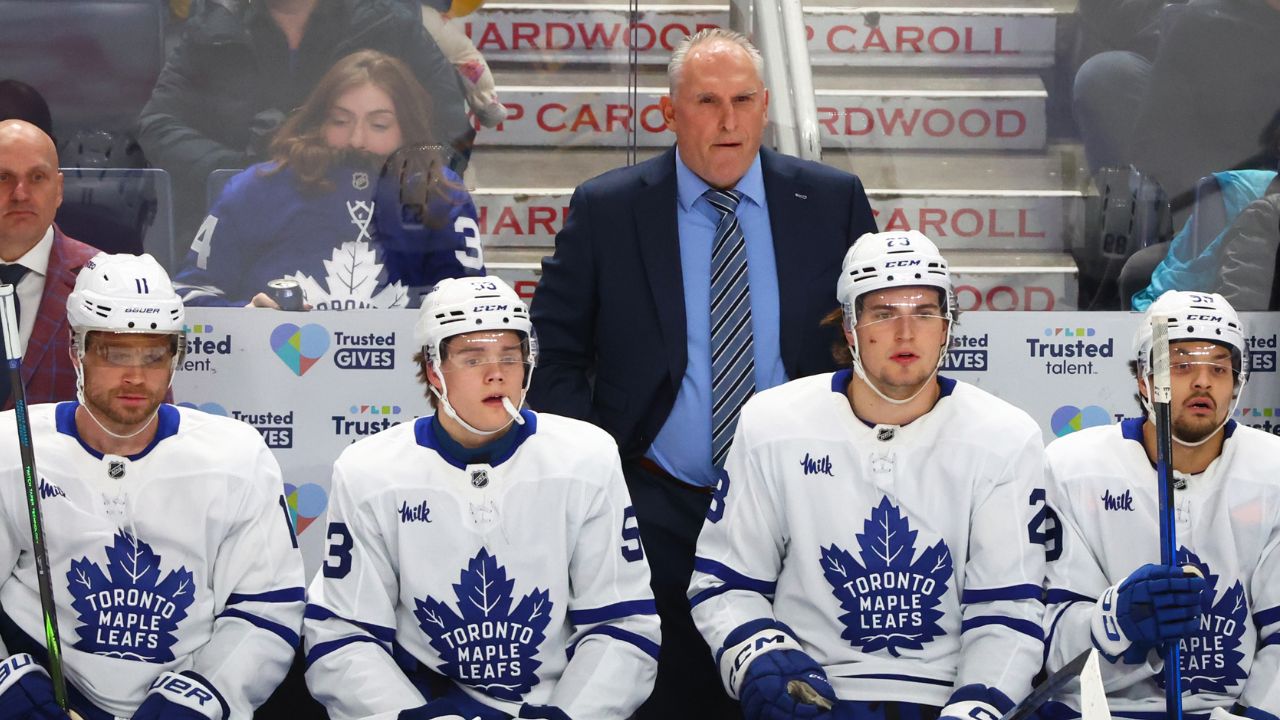
Around the city of Toronto, everyone has a plan for how to fix the Maple Leafs. I tend to be subjected to a lot of them given my job, so I have some idea about the themes floating around out there right now. To those people, I want to put some bumpers in the gutters so you can bowl more strikes. There’s some good ideas out there, but some real empty frames too.
Here’s my blanket two cents for those who want to see the Leafs get better, and that includes the next front office.
1. Cookie-cutter moves are not going to solve this problem
If the Leafs are only making the moves we on the outside can see, they’re in trouble.
Over the Brad Treliving era, the Toronto Maple Leafs were paint-by-numbers. They couldn’t get over the hump in the playoffs — you know playoffs, with its brute physicality and attrition — so the Leafs GM went out and got brute physicality. Ryan Reaves, Max Domi, Tyler Bertuzzi, those types.
Square peg, square hole.
When they were a playoff team in 2025 and it came time to buy, they spent like Rockefellers. They waited right up until the deadline (while a team like Florida got the jump and traded for Seth Jones a week prior), then paid exorbitant prices for two players, one of whom they engaged on an hour prior to said deadline (Brandon Carlo).
When they weren’t a playoff team, they unloaded jetsam into the sea as the boat sunk, taking whatever prices they could get at the last minute with the “something is better than nothing” mentality.
They didn’t retain money to increase returns, they didn’t take on bad money to gain assets, they didn’t buy low on underachievers in-season (looking at you, Egor Chinakhov), they didn’t find a single way to do more than the guy at the bar beside you could’ve done.
So when everyone puts together their plan for the next version of the Leafs, I pray that those in the next version of the front office can see more than we can. It’s going to take some creativity to find their way back to being good beyond just signing a few UFAs.
-

-
Real Kyper and Bourne
Nick Kypreos and Justin Bourne talk all things hockey with some of the biggest names in the game. Watch live every weekday on Sportsnet and Sportsnet+ — or listen live on Sportsnet 590 The FAN — from 4 p.m. to 6 p.m. ET.

2. No more specialists
Hockey analysis is often over-simplified, which is to say, the lesson from the Florida Panthers is said to be “Be tough, be bullies, be mean.”
We talk less about the fact that the face of those labels, Sam Bennett, scored 15 times in the playoffs and won the Conn Smythe Trophy. He tied their other “greasy” player Matthew Tkachuk in points with 23. “Rat” Brad Marchand scored 10 and 10 for 20. My point is, those are full-service hockey players, and the physical stuff is just one of the clubs in the bag.
So adding Reaves doesn’t really solve your problems.
But this also goes for every other position. OK, you want a player who defends, but that doesn’t mean you need guys who only defend. The Leafs’ entire D-corps are “good defensive veterans,” but when nobody can make plays, you end up having to use those tools an awful lot.
In today’s NHL, everybody has to be able to do a bit of everything. We’ve talked for years about the Leafs puzzle pieces “fitting” (or how they haven’t), but when each piece can change shapes depending on need, it becomes a lot easier. Quit hunting for guys who solve only one problem.
3. Focus on who you want in, not who you want out
The greatest contrast between the Vegas Golden Knights (playoff success) and the Leafs (not so much) is Vegas looks around the league and says “How can we get that good player?” while the Leafs look at their roster and say “How can we get rid of this guy?”
Nazem Kadri had to go, Mitch Marner had to go, Jake Gardiner had to go. People are always convinced the problem will be solved by subtractions without any plan for additions. This is easily the most common solution I come across in the wild. “You gotta get rid of Player X.”
Now Morgan Rielly has to go, and Auston Matthews has to go according to some, William Nylander to others. (You know, because you can’t win a Cup with Phil Kessel, you can’t win a Cup with Alexei Kovalev, you can’t win a Cup with Alexander Ovechkin.)
I can hear the case for Rielly, but don’t let the greater point being made get lost. For years, it’s been a worry about who should go. If you want the Leafs to get better, turn your focus to the 31 other rosters around the league.
4. Don’t fear the word “data”
Fun fact, I failed Grade 11 math. I get a great kick out of anyone who now perceives me as some “numbers guy,” as I spent most of my life perceived as some hockey-playing jock to others. But apparently my lack of fear in noting that “Hey that team gets way more shots than the other team when this player is on the ice” has turned me into some analytics guru.
I am repeatedly baffled by the fear some old school hockey guys have of the numbers. We do a segment on Kyper and Bourne sometimes where I throw some data at Kyper called “useful or useless” and it’s great. What’s crazy is this is all Keith Pelley and the Leafs are looking for in their next President and GM when it comes to data: a willingness to look at the numbers and play that game.
“Hey that might mean something,” or “Hey I think that’s totally useless” are perfectly fine answers. They aren’t trying to hire Stephen Hawking.
What they’re opposed to is someone who is unwilling to even hear those numbers, to consider them, to see if there’s not some info there that can help. At no point will anyone make you use Pythagorean theorem (a term I knew but had to Google to confirm).
I hear people saying “everyone has data guys now,” and that’s true. But not all management teams are willing to even consider the information, which is both insane and childish, and it’s those guys who fall behind. “Useful or useless” is all it takes.
And finally,
5. You gotta have, and articulate, a plan
I have zero time for the idea that Leafs fans are too impatient to rebuild. Sports fans today are smart, they’ve been forced to learn the salary cap and contract clauses and the lottery and playoff systems. They generally “get” it all. If they see what the team is doing — and if what the team is doing is building for the long term — you can sell hope, and that’s exciting.
As prospects enter the pipeline and develop, the fans will be on your side. They just need to know that what you’re doing is on purpose, and has an end in sight.
And if you want to make the playoffs next year, great. It’s doable. Say that, but tell them how that works hand-in-glove with the team’s long-term forecast, too.
Fans can handle some losing, they can have patience, but what they don’t have time for is a lack of direction. You can’t be wandering in the woods, executing one cookie-cutter move after the next and hoping for miracles.