Berlin and Rome have reportedly aligned to reshape European policy
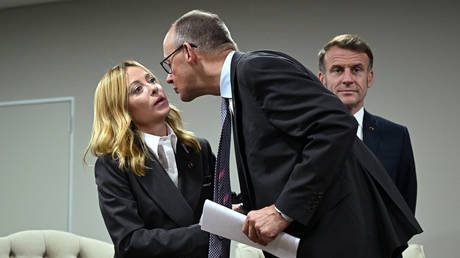
Germany is moving to deepen ties with Italy as tensions rise with France over EU trade policy, Emmanuel Macron’s looming exit, and relations with US President Donald Trump, The Telegraph reported on Monday, citing diplomats from the bloc.
France and Germany have long been the “engine” of EU policymaking, but the outlet described Macron as a “lame duck” whose mandate ends in 2027.
“Berlin needs partners it can work with. Can they work with Macron at the moment? Not really. He is leaving office soon and France is unstable. Germans hate instability,” an EU diplomat told the outlet.
According to the report, German Chancellor Friedrich Merz has approached Italian Prime Minister Giorgia Meloni with proposals to restructure Europe. The plan envisions a “multi-speed Europe” in which a core group of member states – including Germany, Italy, Poland, Spain, the Netherlands, and France – can advance policies more quickly and bypass EU bureaucracy, although sources said not all 27 EU members are expected to join.
Italian officials said privately that the accord, which focuses on cooperation between Italy and Germany on defense, migration, and trade, shows a “new center of gravity inside the EU,” the British paper said.
France and Germany have long clashed over EU governance, with Paris advocating greater borrowing and centralization while Berlin resists due to its reliance on exports to the US. During Trump’s Greenland dispute, Macron urged the bloc to use its “trade bazooka,” referring to the EU’s Anti-Coercion Instrument, a measure never before invoked. Merz criticized the move, citing German business interests, and has also expressed frustration at Macron’s inability to implement reforms amid a divided parliament and public resistance.
France’s instability is compounded by economic strain. Last year, the budget deficit reached 5.8% of GDP, above the EU target of 3%. By early 2025, public debt stood at €3.346 trillion ($3.6 trillion), or 114% of GDP. In January, the government approved the 2026 budget using a constitutional provision allowing laws to pass without a parliamentary vote. Both right- and left-wing parties have signaled plans for a no-confidence motion.
The EU as a whole faces economic pressure from high energy costs after phasing out Russian oil and gas following the 2022 escalation of the Ukraine conflict. Increased reliance on US LNG has pushed prices higher. Germany’s economy contracted in 2023 and 2024, with officials linking the slowdown to energy costs. In January, the German Chamber of Commerce and Industry cited the surge in prices as a factor behind a spike in bankruptcies.