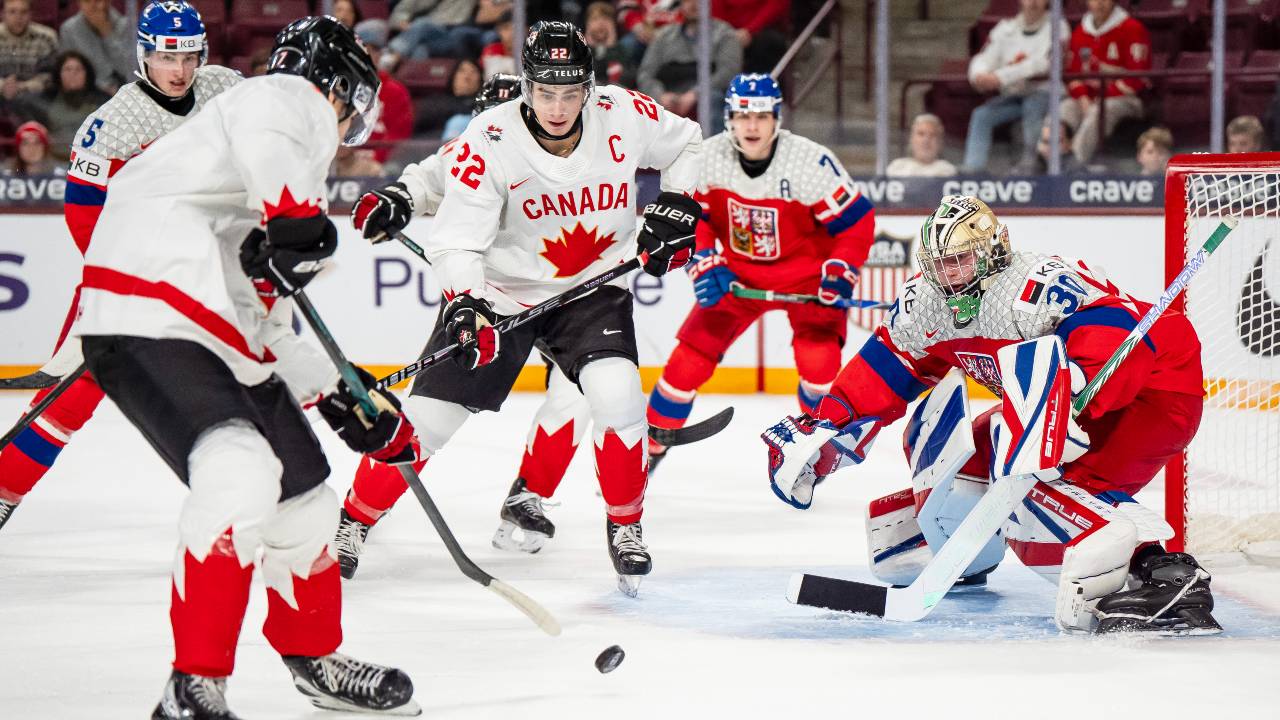
A quick study of recent history between these two nations is essential in understanding how mindset will play a huge part in this semifinal game. Despite knowing that a medal game is on the other side of this match, clearly, the objective is to play for gold. Canada’s last venture into the medal round resulted in a gold medal against Czechia in 2023 in Halifax.
Since that 3-2 overtime win for Canada, it has been Czechia that has ended Canada’s last two tournaments, both in the quarterfinals, not even allowing Canada an opportunity to win a medal.
Go figure, the first matchup of this tournament featured Czechia against Canada, resulting in a 7-5 Team Canada win. About as entertaining a game as this tournament has seen. Canada had leads of 1-0 and 2-1, while Czechia led 3-2 past the midway point of the game before Ethan MacKenzie put Canada ahead for good with just over 10 minutes left in regulation. It was a game that never seemed out of reach for either side.
That game did not come without controversy, as Canadian captain Porter Martone taunted the Czechia bench after sealing the game with his empty-net goal. That was followed by Canada failing to enter the handshake line post-game, resulting in a public apology by Martone and Hockey Canada.
To add more fuel to the fire, Czechia hasn’t won gold since 2001, despite a recent stretch of three straight medals (two bronze and a silver).
Does Czechia have the upper hand because it has eliminated Canada in each of the last two tournaments, or does Canada’s controversial win in preliminary play set the tone for the red and white (with the maple leaf)?
Needless to say, IT’S ON.
Goaltending: Edge Canada
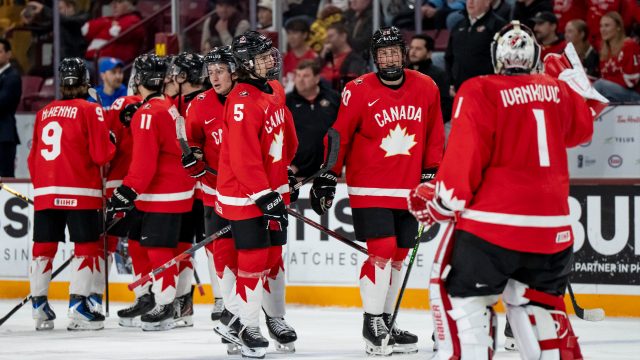
Canada has the edge in goal, with Jack Ivankovic as the presumptive starter. The University of Michigan freshman has stopped 47 of the 49 shots he’s faced, amounting to a tournament leading .959 save percentage and a minuscule 0.99 GAA in the two games he’s played.
This workload is typical of what Ivankovic has faced at Michigan, where he has faced just over 24 shots per game in his 20 starts.
Ivankovic’s international resume includes gold medals at the Canada Winter Games, the U17 World Challenge, two U18 World Championships and one Hlinka-Gretzky.
While both Ivankovic and Carter George have outstanding international resumes, George, who is a year older, has looked out of sorts at times. He is overplaying pucks and generally being guilty of trying to do too much, which, for goalies, is oftentimes a sign of fatigue. Should Ivankovic struggle, the ever-calm George provides an insurance policy with experience.
Early in the quarters, Slovakia was going hard to the net to try and disrupt Ivankovic, which is a tactic the bigger, stronger and older Czechs may want to employ. Czechia will have to try and get inside and take the eyes away from the six-foot Ivankovic.
Defencemen: Edge Czechia
The two most difficult opponents in preliminary play, Czechia and Finland, combined for nine goals against Canada and that competition will be present once again in the semis.
While Zayne Parekh leads the tournament with ten points, he has shown to be a defensive liability at times. At 19:37 average ice time per game, Parekh ranks 25th in the tournament, where every other team’s top defenceman is up over 20 minutes per game.
Canada will have to do it by committee defensively. The Canadians dressed seven defencemen for each of their four preliminary round games, but moved to an eight-man defensive core for their quarterfinal match against Slovakia, which was arguably their best defensive effort to date. Canada allowed just 22 shots against the Slovaks.
The defence doesn’t strike fear in the opponent, especially since the usually mean and spirited Kashawn Aitcheson has had to scale his game back to adjust to international officiating. The group’s strength lies in its skating ability, puck-moving efficiency and decision-making when supporting the rush. Each of the eight defencemen has at least a point, and all eight sport a plus-2 or better rating.
Spreading out the minutes to limit the exposure of any one pairing worked well against the younger Latvians, but deployment against the bigger, faster, stronger Czechs will be interesting to track. We can expect to see a lot of Parekh, Aitcheson, Ben Danford and Cameron Reid. Harrison Brunicke’s minutes have been scaled back, as have Ethan MacKenzie’s. Keaton Verhoeff had a strong game against Slovakia, and he should be a factor in this game as a two-way defender.
Forwards: Edge Canada
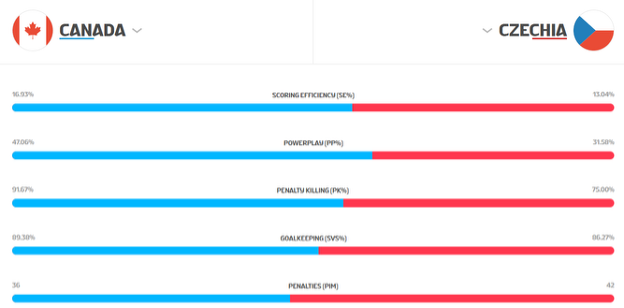
Canada has scored 32 goals, the most in the tournament and five more than second-place Sweden. The power play has produced eight goals and is operating at over 47 per cent efficiency, also tops in the event. From a faceoff perspective, Canada’s top five draw-takers are operating at a 59 per cent success rate to Czechia’s 57 per cent.
All 14 of Canada’s forwards are first-round NHL picks, under the assumption Gavin McKenna will be early off the board in June. No other team in the tournament features this kind of depth.
Canada’s top six have been buzzing. Overall, Michael Hage has been Canada’s best forward. He brings a multi-faceted game to the table, where his speed and elite shooting ability put defenders on their heels. He has points in every game, as does Gavin McKenna. McKenna’s touch and vision are elite, especially on the power play. Brady Martin plays smash-mouth, straight-line hockey and won’t be denied going to the net. This line has combined for nine goals, and half of Canada’s eight power-play markers.
Canada’s other top trio features Michael Misa, Porter Martone and Tij Iginla. Misa put on his best performance of the tournament against the Slovaks, backing off defenders with his speed, getting in on the forecheck and making plays all over the ice. Martone has also seen his game grow throughout. Iginla can really rip the puck, and he’s not afraid to get to the hard areas. This line has also combined for nine goals.
The third line of Cole Beaudoin, Caleb Desnoyers and Sam O’Reilly has combined for five goals and 19 points, with a combined plus-15 rating. All of their points have come at even strength. This trio is trustworthy defensively and a handful to deal with when in the offensive zone. Beaudoin disrupts the breakout with his tenacity and board-play. He’s an excellent puck protector and shoots it well. Desnoyers hasn’t scored, but his playmaking has been solid, and he’s rarely, if ever, on the wrong side of the puck. O’Reilly plays a pro-style game and is particularly effective in the neutral zone, where he breaks up plays and transitions well.
Canada’s fourth line of Braeden Cootes, Cole Reschny and Jett Luchanko brings a ton of speed and tenacity to the table, but have been challenged to produce offence. Their speed and tenacity have led to plenty of chances, but finishing has been limited. Their contribution will be to play with pace, create odd-man rushes and continue to possess the puck in the offensive zone.
Canada will have to lean heavily on its top six to produce while using their third line to disrupt play, create chaos and add some level of secondary scoring. The fourth line will be used sparingly, but can be effective in spelling off the top two lines and creating rush opportunities.
Tale of the tape
The two teams are pretty evenly matched, but the rivalry game could come down to the special teams battle. So far in the tournament, Canada’s power play and penalty-kill have outperformed Czechia’s, and could end up dictating the outcome.
Team Czechia pre-scout
What I’ve enjoyed most about watching Czechia at the tournament is the way they attack their opponent. They have the pedal to the medal from the drop of the first puck and play a fast-paced style. Canada will be tasked with managing the neutral zone and gapping up to interrupt Czechia’s momentum in open ice before executing with the puck off the rush themselves.
Goaltending
Similar to Canada, Czechia has split the goaltending duties between Marik Matyas and Michal Orsulak. The two netminders rank seventh in the tournament with a combined .863 save percentage.
Orsulak had the net versus Switzerland, so I’m assuming he will be between the posts versus Canada. He’s a young, draft-eligible, 18-year-old goalie who gives opponents a different look with his right-catching style. Orsulak stands six-foot-four, 220-pounds, so he takes up plenty of net. He’s a butterfly goalie with active pads. There have been times his rebound control has ranged and led to second-chance scoring opportunities for opponents. Orsulak plays for the Prince Albert Raiders in the WHL.
Defencemen
I could write an entire article on the depth of Czechia’s D-core. Its combination of size and skill is impressive.
• Adam Jiricek (St. Louis Blues) scored an incredible game-winning overtime goal versus Finland in the preliminary round and leads the team with four goals overall. He’s one of Czechia’s playmakers on the power play.
• Tomas Galvas is a five-foot-10, 170-pound, left-shot, power-play quarterback who’s second on the team in scoring. He’s contributed three goals and five assists so far and been elusive offensively while providing better-than-average detail defensively. Galvas has gone through the NHL draft twice, but I would be surprised if he’s not selected this June based on the progress in his game I’ve witnessed here in Minneapolis.
• Two other key members of Czechia’s defence include six-foot-six, 218-pound, right-shot Radim Mrtka (Buffalo Sabres) and six-foot-five, 218-pound, right-shot Max Psenicka (Utah). Not only are they huge in stature, but both defenders also track up and down the ice effectively and take away time and space with their stature and length defensively.
Forwards
Czechia’s forward group attacks in waves. They are a relentless group of competitors who can play the game any way their opponent chooses. To a man, they provide a combination of speed, skill and will. Team Czechia has averaged 37 shots per game offensively with their aggressive approach.
• Six-foot, 187-pound Vojtech Cihar (LA Kings) sits one point behind Canada’s Zayne Parekh for the tournament scoring lead with two goals and seven assists. He’s a solid skater with sound hockey sense. He positions himself responsibly in all three zones and strikes quickly when he sees an opportunity to make plays in the offensive zone.
• Team Czechia captain Petr Sikora (Washington Capitals) makes himself noticeable every time he hits the ice. He leads by example with this work ethic and never shies away from grinding away in the trenches. Sikora has produced two goals and six assists while being deployed in all situations. He takes key faceoffs on both sides of the ice. For those who will be watching the game, notice how he turns his left shot blade over when taking draws on his weak side, meaning he’s essentially taking face-offs on his forehand in both circles.
• Five-foot-seven, 164-pound forward Adam Benak (Minnesota Wild) came to play versus Switzerland in the quarterfinals and appears to be hitting his stride in the medal round. Benak darts in and out of traffic, spins off checks, and makes plays while being exceptionally difficult to contain in small areas. He’s produced five assists so far at the tournament.
• Six-foot-five, 185-pound forward Vaclav Nestrasil (Chicago Blackhawks) should easily top out at over 200lbs when he’s fully matured. At this stage of his development, he’s using his crafty puck-handling ability and long reach to create offence. His combination of power and skill has led to a productive two goals and four assists here in Minneapolis.