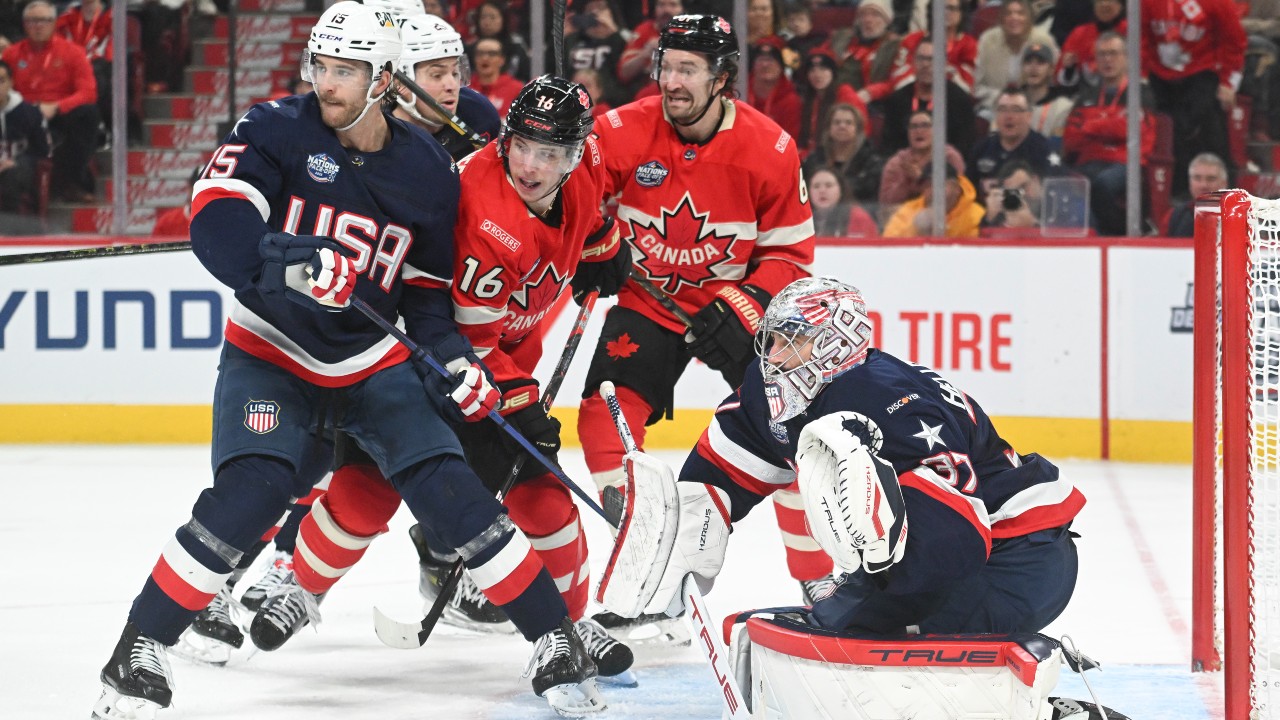
In selecting the 25 players who will represent the United States at the Winter Olympics next month, general manager Bill Guerin emphasized Team USA’s experience at last year’s 4 Nations Face-Off. There are 21 returning players from the team that was one goal away from winning the tournament.
“I liked the way we played,” Guerin told reporters last week, praising the players’ willingness to accept their roles. “Everybody was together. Everybody played the right way (and) adhered to the game plan that (head coach) Mike (Sullivan) and his coaching staff brought to the table. But I think the biggest thing for me was the chemistry. And I think the chemistry allowed the guys to play the way that they did.”
Naturally, Team USA’s roster is being judged on its ability to defeat Team Canada. The Americans have four wins against the Canadians in 19 all-time meetings at the Olympics. Only one of those wins, which came in the 2010 round-robin stage, involved NHL players.
“We can’t look past anybody,” Guerin told reporters. “We didn’t build our team just to play Canada, because we don’t know if we’re going to play Canada.”
It seems inevitable, however, that the two superpowers will collide at some point in Italy, so how can Team USA knock off Team Canada?
Use the forecheck
Team USA made a debatable decision by not inviting several top American scorers to the Olympics, including Dallas’ Jason Robertson, Detroit’s Alex DeBrincat and Montreal’s Cole Caufield.
Even if Team USA chose any of those players, there probably would still be a noticeable gap between the two forward groups in overall offensive ability as shown in the chart below. (It certainly helps Team Canada to have Nathan MacKinnon and Connor McDavid as its top two centres.)
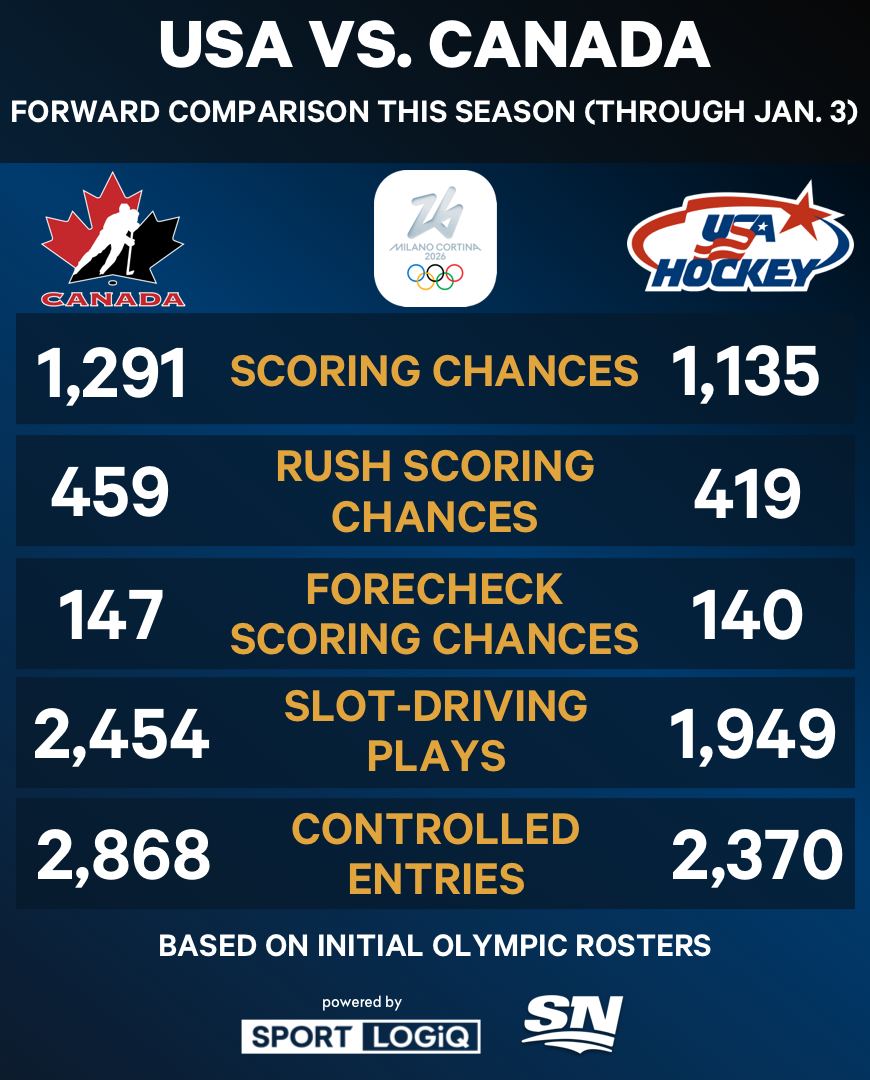
The way the Americans can level the playing field (on a slightly smaller ice surface) is through the forecheck, where the difference is not as pronounced. Team USA is bringing several forwards who excel at generating scoring chances off the forecheck, led by league co-leader Tage Thompson (23). Matt Boldy leads all players in defensive plays in the offensive zone, including 67 blocked passes, which ranks tied for second in the league. Dylan Larkin is one of the best at creating second-chance scoring opportunities, ranking fifth in rebound chances.
By going with a 4 Nations-heavy roster, Team USA is endorsing a grit-and-grind approach. Guerin has opened himself to criticism if it does not work.
“We have to make a team,” Guerin told reporters. “I’ve said before, if we’re doing it (by only looking at statistics), then you don’t need a general manager. You don’t need a coach.”
Quinn’s in
One of the U.S. Olympians who did not participate in the 4 Nations Face-Off is defenceman Quinn Hughes, who can change the complexion of a game from the back end. As Guerin has witnessed firsthand, Hughes has enhanced the Wild’s offence since being acquired last month. Minnesota is averaging 3.92 goals per game with Hughes in the lineup, compared to 2.81 per game beforehand.
Hughes is a puck-possession monster, leading all skaters in overall possession time (145:58) this season by roughly 27 minutes. His 55:03 of offensive-zone possession time is more than 14 minutes ahead of the next-closest defenceman.
Hughes’ skating and stretch-passing abilities have unlocked Minnesota’s rush attack, which has improved from 32nd in chances per game without him to 18th with him. Those skills will surely come in handy against Team Canada.
The Wild have outscored opponents 18-12 and out-chanced them 113-104 during Hughes’ minutes at 5-on-5, and he has already developed chemistry with fellow U.S. Olympian Brock Faber. As a pair, they have generated 58.1 per cent of the expected goals at 5-on-5 for the Wild in around 210 minutes of ice time.
A slight goaltending edge
Team USA’s group of goaltenders is the same as it was at the 4 Nations Face-Off. Reigning league MVP Connor Hellebuyck, who posted a 1.59 goals-against average and .932 save percentage at last year’s tournament, is expected to start for the Americans. (Jake Oettinger and Jeremy Swayman will back up Hellebuyck.)
Hellebuyck has had a disappointing season for the league-worst Jets. Since returning from knee surgery last month, he is 1-5-3 with a 2.69 GAA and .888 save percentage. But he has saved more goals than expected in six of his nine post-surgery starts, so he is playing better than it appears.
Meanwhile, projected Canadian starter Jordan Binnington arguably has been the worst goaltender in the league this season. He has allowed 7.5 goals above expected — most among the top 64 goaltenders in time on ice — and made only 10 quality starts in 23 tries for the Blues (43.5 per cent).
Granted, Binnington was outstanding in Team Canada’s championship win against Team USA at the 4 Nations Face-Off. But Team Canada’s goaltending is its biggest vulnerability, even with newcomers Darcy Kuemper and Logan Thompson waiting in the wings.
All stats via Sportlogiq