The Toronto Maple Leafs are at a crossroads.
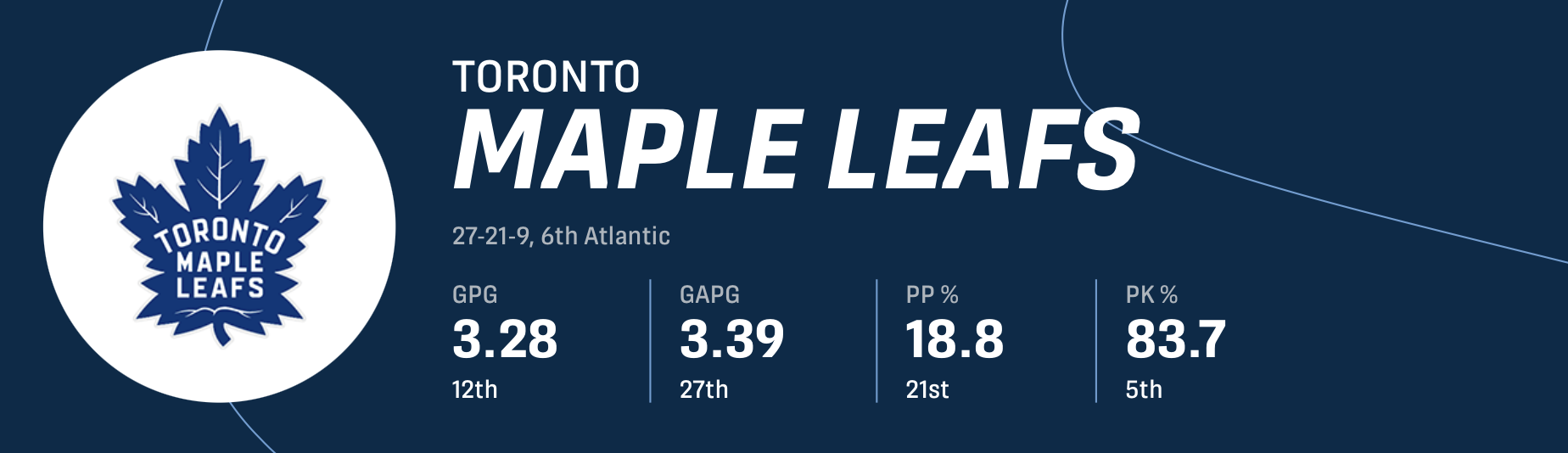
Despite winning their last three games before the Olympic break, Toronto is five points back of a wild card spot and have played more games than any of the teams ahead of them. Like most teams around the NHL, the Leafs have suffered their share of injuries to key players, but also, far too many players on the roster have taken significant steps backwards in their consistency and impact. They have been chasing a sustainable identity and results all season but, to date, reflect a team that requites something more than just an oil change.
Toronto’s management has to be realistic. The truth is that it’s time to make some extremely difficult and perhaps uncomfortable hockey decisions.
Part of the process that goes on behind closed doors at this time of year includes being honest about whether or not they believe the group, when healthy, is as competitive as the organization thought they would be. A management team has to shelve any bias, forecast where their group is heading with an open mind, and then discuss any change in direction with the owner (or a board).
Everything has an expiry date in sports, and Toronto is having to wonder if their time has come.
When we come out of the Olympic break, it will be about a week and a half until the NHL trade deadline, so time is running thin to make moves. With that in mind, here is my organization breakdown of the Maple Leafs, and some strategies they should implement for the good of the group moving forward.
Draft Capital
Toronto’s situation in terms of prospect depth and future draft capital is bordering on dire. They have sacrificed so many high-end draft picks in their chase for playoff success over the year and it’s now catching up to them in a predictable way.
Over the next 10 rounds of the draft spanning 2026 and 2027, Toronto only owns four picks, just one of which comes in the first two rounds. I may not be a mathematician, but even I recognize the odds are stacked against them being able to build some depth through the draft with so few opportunities to pick a player.
Current Roster: Forwards
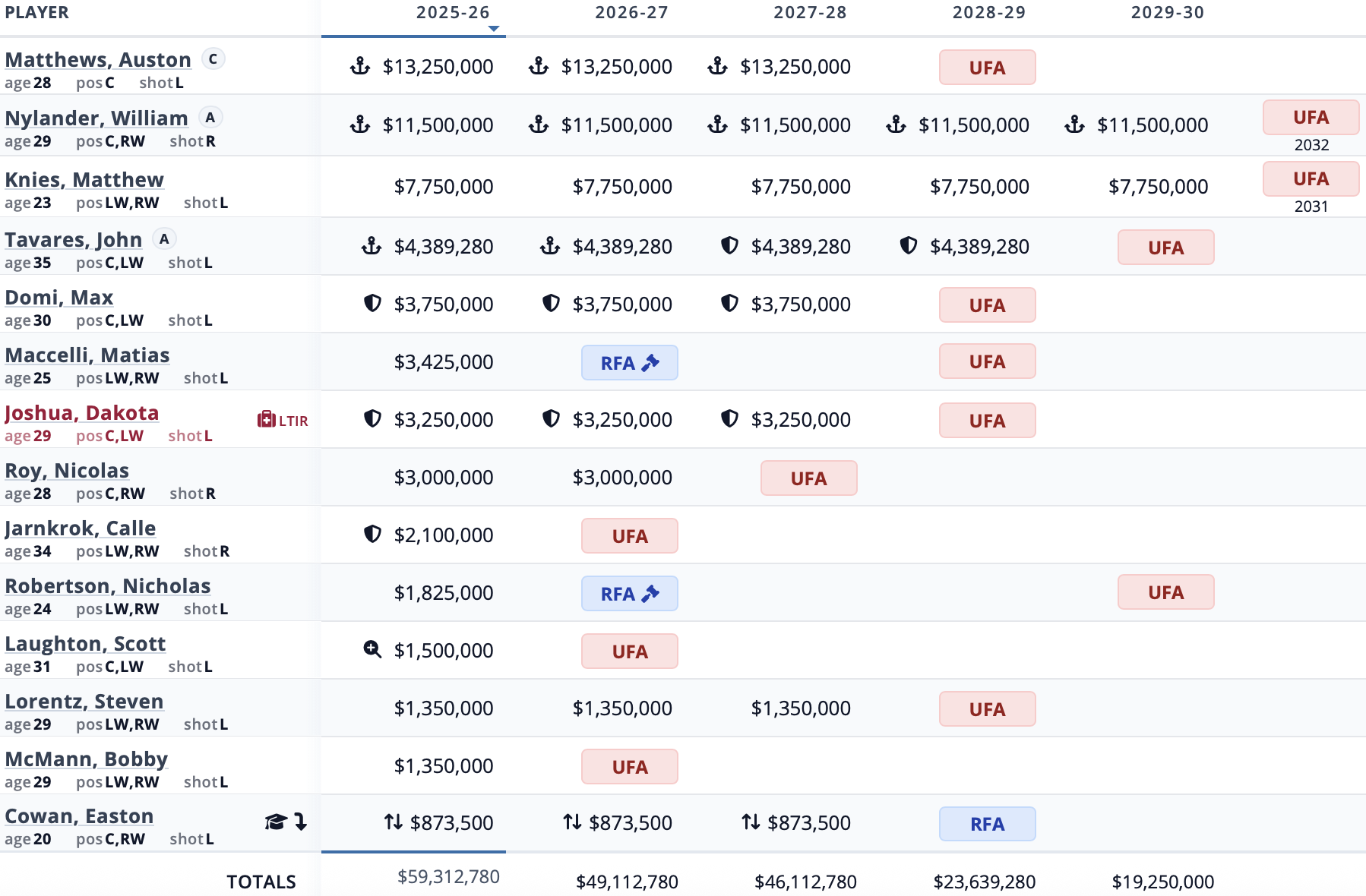
There’s no doubt the Leafs will be taking calls on pending UFAs Scott Laughton, Bobby McMann, and Calle Jarnkrok. Each one of these players have varying degrees of value and Toronto requires more draft capital.
Teams will have the most interest in McMann. He’s affordable and on pace for over 20 goals, which would be a career-high. He plays with good pace, which is an attractive element for teams that like to track up and down the ice with speed, such as Edmonton or Colorado, for example.
Unless McMann signs an extension with his new team, if I were the Leafs I’d entertain re-signing him in the summer at the right price. But at this stage it’s more important for me to acquire some draft capital and he might land the team a first-round pick. I’ll address free agency later this year when it rolls around, but I’m not letting it influence how I handle a McMann trade at the deadline.
It’s also worth noting all the forwards who have no-trade clauses:
• Auston Matthews has a no-movement until his contract expires in 2028.
• William Nylander has a no-movement until his contract expires in 2032.
• John Tavares has a no-movement until 2027, then a five-team trade list in 2028 and 2029.
• Max Domi has a 13-team no-trade clause until his contract expires in 2028
• Dakota Joshua has a 12-team no-trade clause until his deal expires in 2028.
• Calle Jarnkrok has a 10-team no-trade list until his deal expires this summer.
Current Roster: Defence
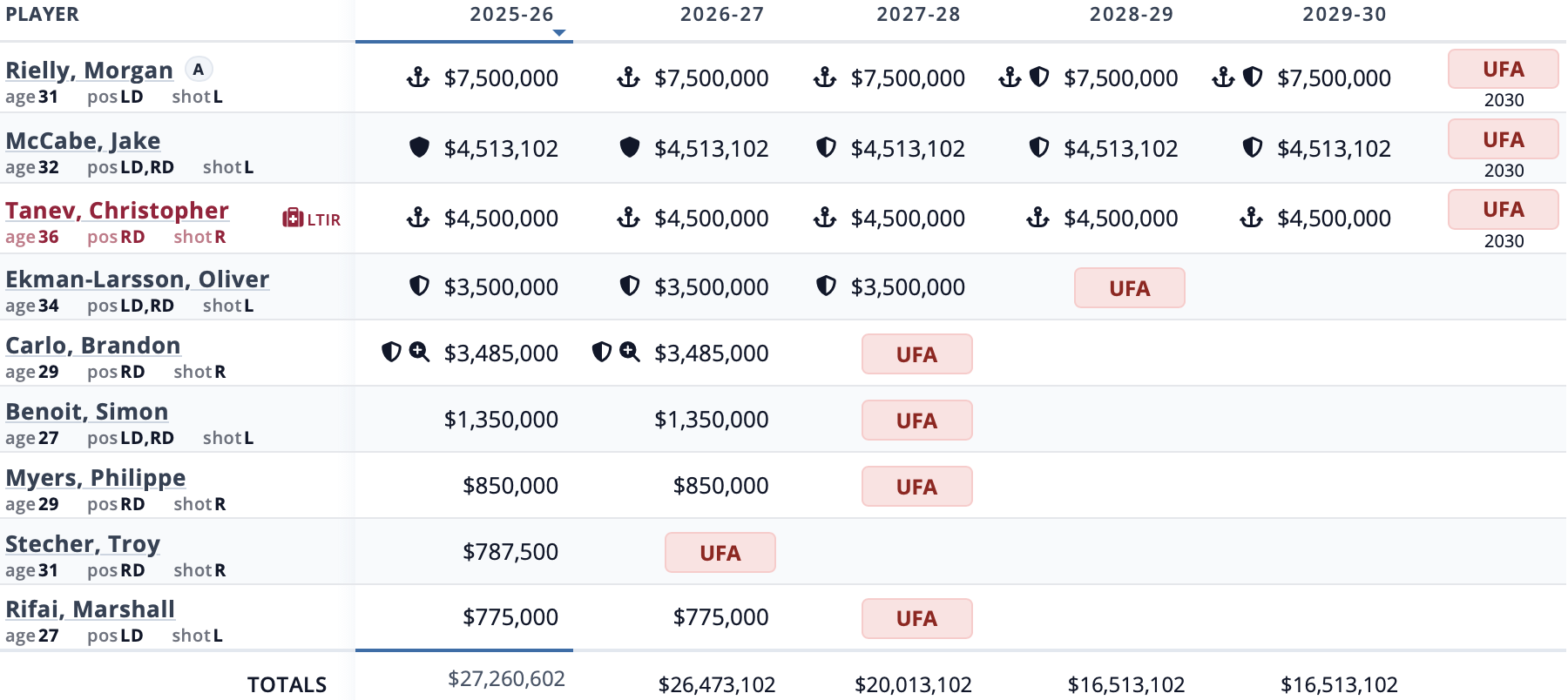
Troy Stecher is the only pending UFA defenceman for the Leafs and he’s played some of the best hockey of his career since arriving in Toronto. I’m positive teams have taken notice of the fact he’s averaging over 20 minutes per game of ice time, including over two minutes on the penalty-kill. He has market value the Leafs should explore but, like McMann, I would entertain bringing Stecher back in the off-season if he’s interested, depending on the cost and the term of a new deal.
The elephant in the room is that it has come time to address the Morgan Rielly situation. However, I don’t envision a trade happening by the March 6 deadline.
Rielly has been a fantastic pro in Toronto and a great teammate, but the reality is that his best years are behind him and he has far too much term left on his contract. That will be a situation to monitor in the off-season and watch play out heading to the June draft, or early in the summer.
Oliver Ekman-Larsson has value on the open market, but he’s also on a very good contract for Toronto. They have to listen to offers on him, but depending on how deep they feel the cuts need to go on the left side of their defence corps, the Leafs must approach his situation with a degree of clarity. They don’t want to find themselves having to overpay for a replacement who is a lesser play in free agency, but they also have to weigh the draft capital they might be able to acquire for him. Could OEL fetch a first-round pick at the deadline?
Here are the defencemen with no-trade clauses:
• Morgan Rielly has a no-movement clause until his deal expires in 2030, but a 10-team no-trade list for the final two years of the contract.
• Jake McCabe has a full no-trade clause through next season, then a 16-team no-trade list for the final three years of his contract.
• Chris Tanev has a no-movement clause until his contract expires in 2030.
• Brandon Carlo has an eight-team no-trade list this season, and a three-team no-trade list next season.
Current Roster: Goaltending

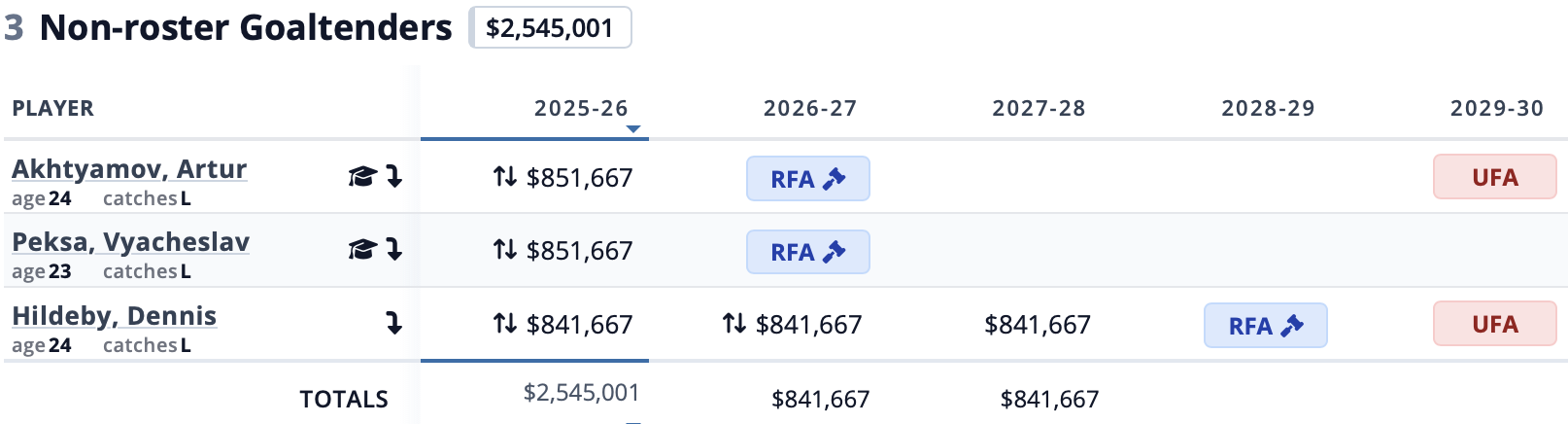
Woll and Stolarz were fantastic as a tandem last season, but both have missed time with injuries this season and have struggled for stretches when either of them have had the net.
With Dennis Hildeby starting to round into form as a potential full-time NHL netminder (2.90 GAA, .912 SV%) Toronto has some options as far as how it handles its future at the position.
However, since Woll and Stolarz haven’t proven physically reliable enough to stay healthy for an entire season, those options are limited. Because of the health concerns, the Leafs require three NHL-quality goalies on the roster. Since Hildeby is only 24 years old and on a two-way contract for another season, Toronto has one more season of waiver flexibility before his one-way contract kicks in for the 2027-28 season.
As far as no-trade clauses go:
• Stolarz has a 16-team no-trade clause for this season and next, then a 10-team no-trade clause in 2027-28 and 2028-29, and a five-team no-trade clause in the final year of his new contract, which kicks in next season.
• Woll has no trade protection at all this season or next, but an eight-team no-trade list kicks in for the 2027-28 season.
• Hildeby doesn’t have any trade protection.
Salary retention in trade
The Leafs have the flexibility to retain salary in a trade. They have three salary retention slots available to them.
Trade Bait
The inconsistency we’ve seen from this year’s Maple Leafs has been a source of frustration. I’ve had days where I felt I would listen to offers for any player on the roster, and others where I’ve felt less so. But I have to shelve my emotion for now and approach trade strategies with a more reasonable and realistic outlook.
Having said that, I can’t shake the feeling the inmates are running the asylum here and a culture change is what’s really required.
So who should they look to trade by March 6 and what might they get in return? Keep in mind that Toronto hasn’t used any of its three salary retention slots, so they have that option available to them as well.
Bobby McMann
His affordable cap hit ($1.35 million) and lack of trade protection make him an intriguing trade candidate. There is a chance he could return a first-round pick because several teams have a need for a player like McMann. The Oilers have been frequently mentioned as one, but the Los Angeles Kings also lack layers of scoring depth on their roster and have the draft capital and cap space to easily add a player like McMann.
McMann turns 30 this June, so will likely be looking for financial security and term with his next contract since it will likely be the last chance for him to really cash in on the open market.
Scott Laughton
The Leafs swung for the fences last spring and Laughton was one of the players acquired to hopefully assist with pushing them deeper into the playoffs. The Leafs gave up a top-10 protected first-round pick in 2027 which would become an unprotected 2028 first-rounder if they end up keeping the 2027 selection.
Laughton has struggled to gain any traction offensively since he arrived in Toronto and he’s averaging less than 14 minutes per game of ice time this season. I’ve always appreciated the character Laughton provides, but his role has diminished to the point he’s a bottom six, and perhaps fourth-line, centre on a good team at this stage of his career. His ability to win faceoffs and kill penalties might be what a team is looking for at the deadline, but don’t expect anything more than a third-round pick in exchange for his services.
Laughton is a pending UFA rental, doesn’t have any trade protection, and only counts for $1.5 million against the salary cap. If Toronto agreed to retain 50 per cent of his contract from here, they might be able to get a late second-round pick in either this draft or a future one.
Nick Robertson
Robertson has arguably played some of his best hockey for the Leafs this season. He’s on pace to score over 15 goals in a role that allows him less than 13 minutes per game in ice time. On some level it feels wrong to include him on this list considering he’s only 24 years old, is affordable at $1.825 million, and is still an RFA this summer. However, it’s time for the Leafs to acquire some draft capital and take a chance at developing another prospect who will hopefully provide the same sort of impact Robertson does.
He could return an early third-round pick, or hopefully a late second-round selection in a trade.
Calle Jarnkrok
Jarnkrok has little to no trade value, but there might be a team willing to acquire him to add some depth to their playoff roster. His contract comes with a 10-team no trade clause, but I would be surprised if he didn’t accept a move to a playoff contender if asked. The Leafs might have to eat 50 per cent of his expiring contract to maximize the return, but they would be selling an asset for pennies on the dollar with Jarnkrok. If they are offered a fifth-round pick for his services they should take it.
William Nylander
As the salary cap rises, Nylander’s $11.5 million AAV should age well. The way he approaches the game doesn’t result in a ton of wear and tear on his body and I don’t foresee the soon-to-be 30-year-old losing a step as he ages.
Nylander is one of the top talents in the NHL. He has the skill to take over a game offensively, but he can be supremely frustrating with his detail and independent approach to how he likes to play the game. There was a time when I felt he was simply immature, but I would accept him for what he was due to his enormous amount of talent. I don’t feel the same way any longer. Given the current trajectory of this version of the Leafs it would be irresponsible to suggest the organization shouldn’t listen to offers.
Would a team like the Chicago Blackhawks be willing to invest their two 2026 first-round picks (Chicago and Florida) and a prospect like Nick Lardis in a Nylander trade? The vision could be to have Nylander play with Connor Bedard for years to come.
This is an example of just one scenario I would consider. This may not be one that would come together by March 6, but it’s time to acknowledge that Toronto should be exploring even this option.
Max Domi
Domi is a serviceable forward who can slot into a variety of roles. He provides energy, but his defensive detail ranges and he doesn’t define himself as elite in any one category. He’s too expensive for what he provides ($3.75 million AAV) which makes it very unlikely the Leafs will find a buyer for Domi unless they agree to absorb some of his contract. He also has a 13-team no trade clause.
Who are the future core players for the Maple Leafs?
When an organization decides to retool (or rebuild) they identify core prospects who will become the foundation of the team and then attempt to surround that core with players who complement their skill set.
Herein lies the problem for the Leafs. The cupboards are mostly bare when it comes to roster-defining prospects. They have spent the majority of their draft capital chasing playoff success and it has come at a huge cost in homegrown talent.
Hindsight is 20/20, but the Kyle Dubas era of draft strategy has resulted in a black hole of results that have set the organization back. Over the course of three drafts (2019-2021) Toronto selected 21 prospects and only two of those became NHL players: Matthew Knies (215 games played) and Robertson (210).
Specifically, the 2020 draft class was an opportunity for the Leafs to insulate themselves with prospects for years to come. They selected 12 players that year, but not a single prospect developed into an NHL player. (We should note, however, that the tragic death of first-rounder Rodion Amirov has to be remembered here.)
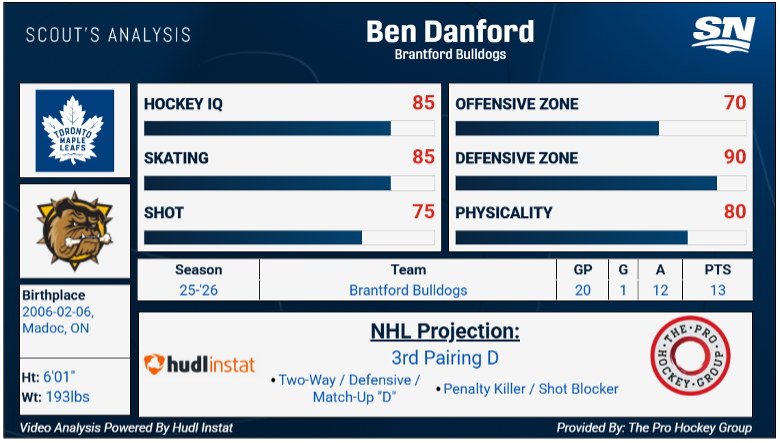
So, today, Toronto’s top prospect is already on its NHL roster in Easton Cowan.
Conclusion
If the Leafs do the right thing and decide to reset the future trajectory of the organization, they could end up with a significant amount of valuable draft capital and future cap space.
I recognize how difficult it will be to make some of the decisions I have proposed, but it’s time for Toronto to deal with reality.
This team as constructed can be competitive on any given night, but the reality is there are far too many cracks in the foundation and the organization is bare when it comes to prospect infrastructure. Toronto has chased playoff success for years, but the time has come to reassess and be honest about where they are.
All contract details and roster tables via PuckPedia.