At his lowest point, Ted Nolan had basically given up on getting the kind of phone call he eventually received from Moncton Wildcats owner Robert Irving. In fact, when the phone actually rang, Nolan wasn’t even sure the offer — which ultimately resurrected his career — was for him.
A few inspiring minutes with Irving clarified things.
Nolan was a decorated coach in 2005, but hadn’t been behind the bench for the better part of a decade, following an ugly divorce with the Buffalo Sabres in 1997. One thing seemed clear to him in the aftermath of that split: Despite the fact he’d won NHL coach of the year honours and a Memorial Cup as bench boss of the Soo Greyhounds OHL squad that played close to his Garden River First Nation home, all doors were closed to Nolan.
“All of a sudden, boom! It’s like somebody turned the lights off,” Nolan says. “It was devastating. I took it very, very hard for a number of years. To the point where it almost ruined my marriage.”
To his credit, Nolan worked to get to a better mental place and threw himself into meaningful pursuits with the Ted Nolan Foundation. With life on the upswing and some of his darkest days behind him, Nolan had some initial reservations about Irving’s offer to coach the Wildcats. “I was really happy again, content, then all of a sudden Mr. Irving gives me call,” he says.
-

-
Celebrate Scotiabank Hockey Day in Canada
For 26 years, Scotiabank Hockey Day in Canada has connected hockey with community, building memories and experiences for the communities it has travelled to and empowering hockey’s next generation. Sportsnet, along with Scotiabank, celebrates the game with a day-long marathon of live NHL coverage.

Nolan understood that despite the fact he didn’t know Irving — a titan of Canadian business — connecting with a man of his stature in person was probably a good idea. Still, before leaving to meet Irving in Toronto, Nolan told his wife there was no way they were relocating to Moncton.
“Fifteen minutes into the conversation, I excused myself from the room,” Nolan recalls. “I went down the hall, I called my wife and said, ‘We’re going to Moncton.’”
Irving’s passion for the game and community was infectious, and Nolan wanted in. Still, he hadn’t coached in eight seasons — hadn’t been a major junior coach for even longer — and did fear he’d have to shake some rust off. He prepared Irving for the fact it could take a month or so to get up to speed and the team’s record might suffer a bit out of the gate.
“I think we came out like 9-1or something like that,” Nolan says, remembering with delight how things wound up clicking right away. “The fans jumped on board right off the hop.”
Wildcat supporters certainly had a good team to cheer on. The club had earned a major recruiting win by convincing American defenceman Keith Yandle to come north instead of playing NCAA hockey. Moncton also had a young Maritimer on the roster in the form of Brad Marchand, who, in 2005-06, was ready to take a big step as a QMJHL sophomore.
“How he is in the NHL, that’s how he was in junior,” Nolan says of Marchand. “He’d be yapping at players on the other team and saying some crazy stuff and once in a while I’d have to rein him in a little bit. But I didn’t want to take his personality away because he was a dynamic player and a dynamic personality who loved to compete and win.”
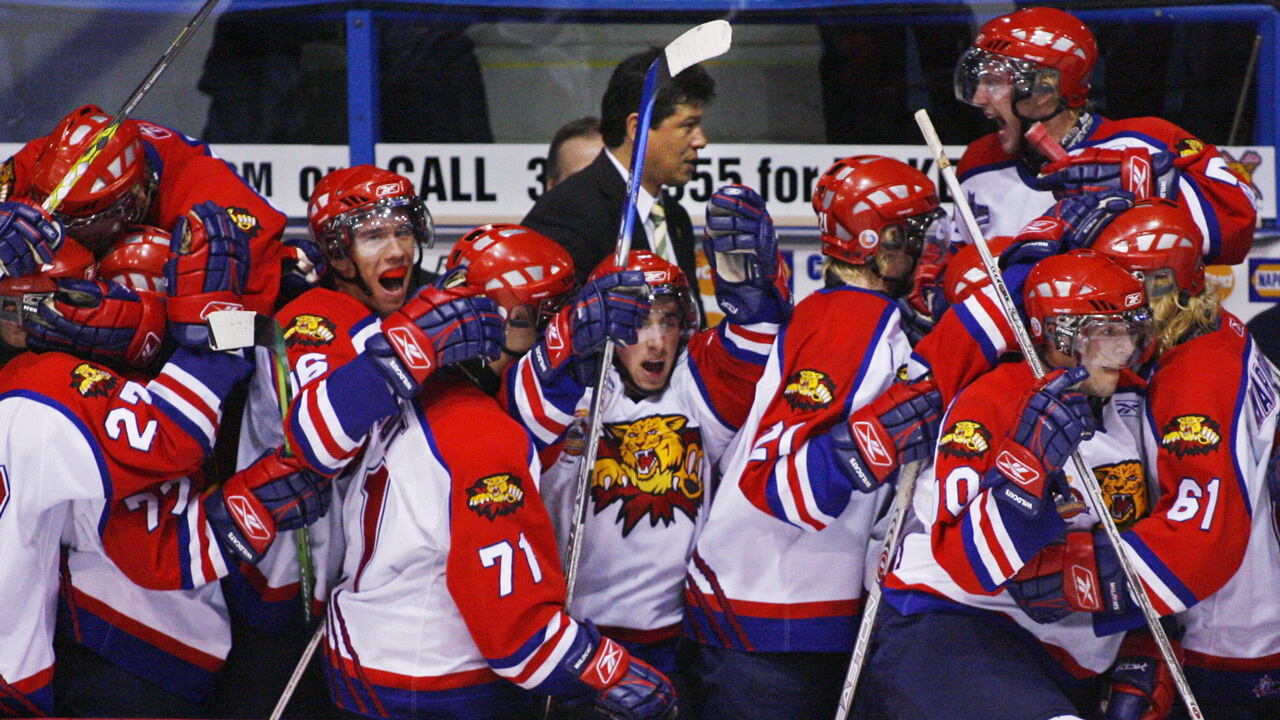
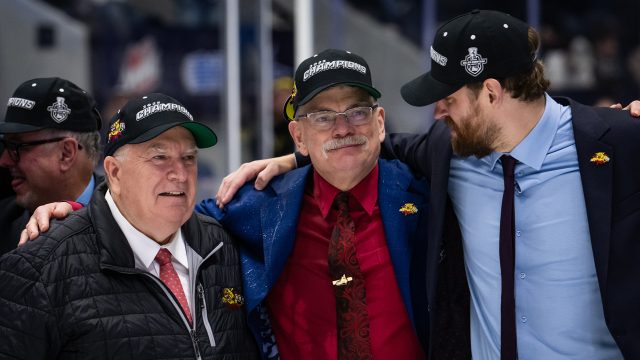
Under Nolan, the Wildcats achieved a league-best 107 points, just one more than the powerhouse Quebec Remparts then coached by Patrick Roy. Roy might have been the only person in the QMJHL with a bigger profile than Nolan, so it was serious business when the two clubs met in the league final two years after Moncton had lost the showdown series to the Gatineau Olympiques. The Wildcats downed the Remparts in six games, becoming just the second team from the Maritimes to win the President’s Cup (now the Gilles-Courteau Trophy).
Of course, by virtue of being the host city, Moncton’s place in the 2006 Memorial Cup was assured even before it won the QMJHL playoffs. “Moncton is a great city to begin with,” Nolan says. “But having that many people coming into a wonderful city like that (for the tournament), seeing the hospitality of the Maritimers, it was fabulous.”
The home team did their part to keep the city rocking, making the final by virtue of defeating the WHL-champion Vancouver Giants 3-1 in the semifinal. That set up a rematch in the final with, who else, the Remparts. Unfortunately for Nolan and the Wildcats, Quebec — which beat Moncton in the round robin — got the better of them in the final contest, with two goals by tournament MVP Alexander Radulov propelling Roy’s team to a 6-2 victory and the title.
As a Memorial Cup veteran — he went three straight years in the early 1990s as coach of the Greyhounds, plus his trip with Moncton — Nolan is well aware of the event’s capricious nature.
“I personally went four times and won it one time,” Nolan says. “The Memorial Cup is a very tricky cup to win because it’s one-game showdowns. But a league championship is different; (you’re playing) best of seven. So, when I look back and say, ‘would you rather win a league championship or a Memorial Cup?’ The Memorial Cup has more prestige, but the league championship (in a way) has a little bit more (credibility).”
Casting back, one other consideration stands out to Nolan.
“If we had a 19-year-old Brad Marchand versus a 17-year-old Brad Marchand, we would have won for sure,” he says.
As it happens, neither Marchand nor Nolan were on the squad the following year. A trade landed Marchand in Val-d’Or and another unexpected call — this time from one of his closest allies in hockey — had Nolan headed back to the NHL after nearly a decade away from the world’s best league.
“I was crying when I told (Irving) the Islanders called and wanted me to go,” he says. “If it was just the Islanders calling, I’m not too sure I would have gone. But the man behind the call was Pat LaFontaine. The special relationship I had (by then) with Mr. Irving, I had (equally) with Pat LaFontaine.”
Nolan coached the Islanders for two seasons and, in quite a twist, found himself coaching in Buffalo again in 2013-14, when LaFontaine had moved on to work there. He also coached the Latvian men’s national team — guiding the squad at the 2014 Winter Olympics — while remaining an inspiration and champion for his First Nation community. It all culminated in Nolan receiving the Order of Sport from the Canadian government this past fall.
“If I didn’t go to Moncton, I would never have received the Order of Sport,” he says. “Because (going to) Moncton reinvigorated my career. It was all based on that 15-minute conversation I had with Mr. Iving to bring me back.”
He never could have imagined, in the moment, just how far back.