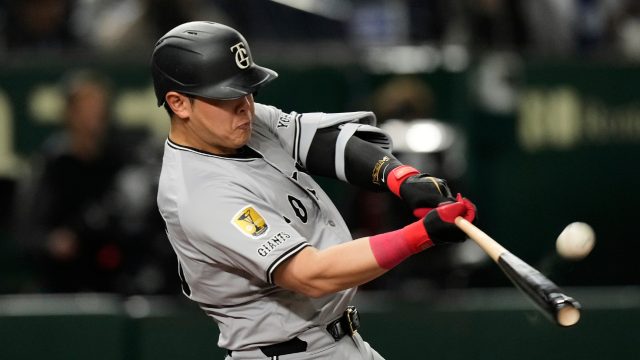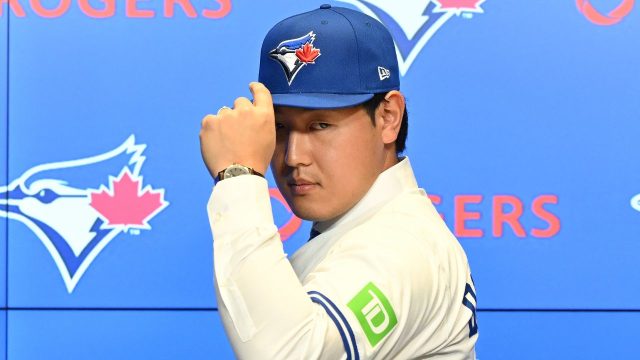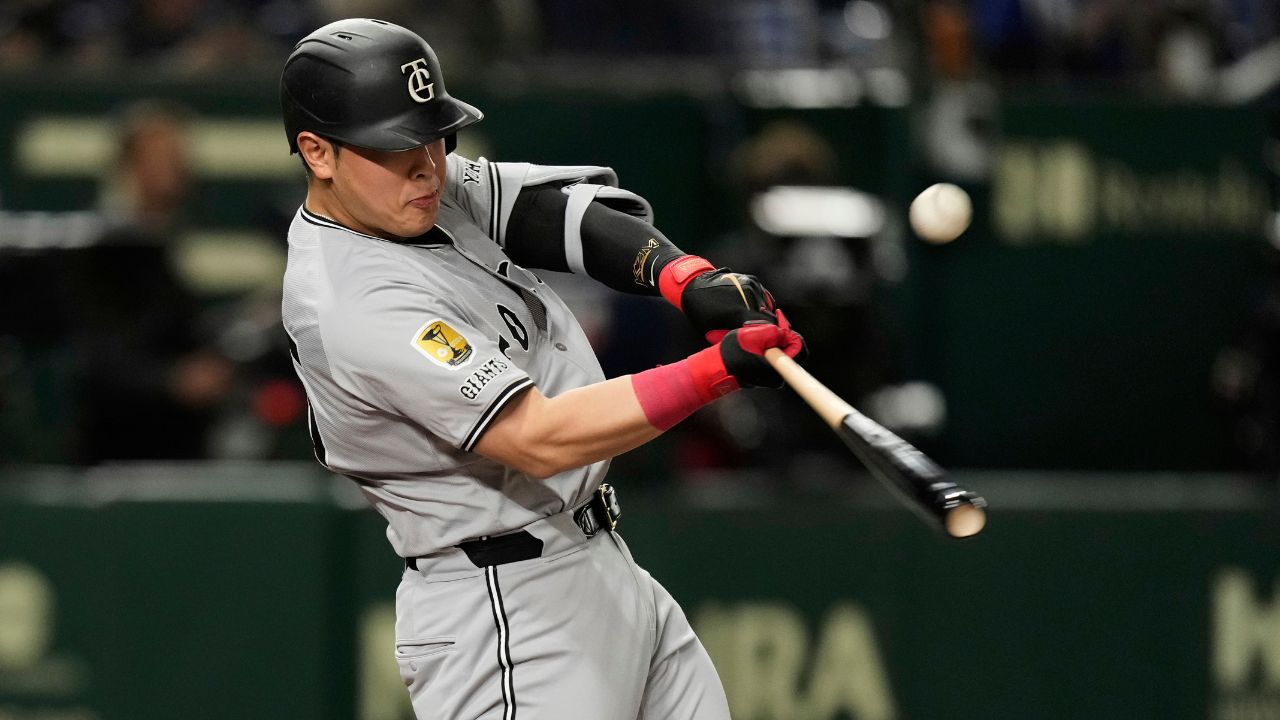
While it’s impossible to know the outcome of any free-agent contract, the four-year $60 million deal the Toronto Blue Jays gave Kazuma Okamoto carries more uncertainty than most.
As successful as Okamoto has been in NPB, it’s tough to know how his skills will translate at the major-league level. Teams like the Blue Jays have more sophisticated information about Japanese players than they once did, but the sample size of NPB to MLB success stories is still small enough that there is more guesswork with Okamoto than a traditional free agent with experience in the majors.
There have only been 84 Japanese-born players in MLB history, and of that group, 13 have 1,000 or more plate appearances at the level. Only five position players (Ichiro Suzuki, Shohei Ohtani, Hideki Matsui, Seiya Suzuki, and Nori Aoki) have a career bWAR of 10 or higher. Just three (Ohtani, Matsui, and Ichiro) have 50 or more MLB home runs.
So, when the Blue Jays signed Okamoto — who has 248 NPB home runs — to a $60 million deal, they did so with the expectation that he’d be one of the most successful Japanese hitters and greatest sluggers of all time. Based on his track record, that’s not a ludicrous notion, but it is on the vague side.
To set fair expectations a bit more specifically, we can examine the combination of what Okamoto’s contract says about the Blue Jays’ valuation of him and the early projections.
Comparables for Okamoto’s contract
While Okamoto’s contract is being widely discussed as a $60 million deal, the posting fee of approximately $10.8 million means the Blue Jays see him as worth just north of $70 million over four years.
It’s an unusual term in the recent free agent market, with no other position player signing for four years since 2022, outside of Koren import Sung-Mun Song, who got one quarter of Okamoto’s contract ($15 million) from the Padres in December.
Pitchers getting similar money to the Blue Jays’ outlay for Okamoto in recent years include Tanner Scott (four years, $72 million), Taijuan Walker (four years, $72 million), and Jameson Taillon (four years, $68 million).
To expand the net to a few hitters, the list of players below is position players currently on contracts between three and five years in length that pay between $15-$20 million:
|
Player |
Position |
Career wRC+ |
Career fWAR/600 PA |
|
Willson Contreras |
C/1B |
122 |
3.4 |
|
Tyler O’Neill |
OF/DH |
114 |
2.9 |
|
Seiya Suzuki |
OF/DH |
127 |
2.9 |
|
Christian Walker |
1B |
110 |
2.5 |
|
Josh Naylor |
1B |
115 |
2.1 |
|
Anthony Santander |
OF/DH |
109 |
1.5 |
|
Andrew Benintendi |
OF |
104 |
1.4 |
|
Nick Castellanos |
OF/DH |
109 |
1.2 |
|
Masataka Yoshida |
OF/DH |
109 |
0.7 |
There are a couple of contractual quirks with this group of players, as Anthony Santander’s deferred money could technically take him out of this AAV bracket, and Masataka Yoshida’s posting fee takes his total price a hair over $20 million. Technicalities aside, Okamoto is being paid like the players on the list above, which mostly consists of credible starters who are not stars.
Many of the contracts this group signed put a premium on power and offensive production over straight WAR-per-dollar efficiency. Most of Okamoto’s worth is likely to come from his bat, but if he can hold up at third base, he could outperform most of these players in terms of total value.
Using value estimates to reverse-engineer expectations
Above, we used similar contracts to help establish a reasonable baseline expectation for Okamoto — or at least what the Blue Jays expect. Another way to go about that same goal is to find players who’ve recently produced on-field value closely matching what Toronto paid for Okamoto.
The list below shows position players who logged significant playing time in every season since 2022 and created between $65 and $75 million in value according to FanGraphs’ estimation — and how they arrived at that value.
|
Player |
Position |
wRC+ |
Fielding Run Value |
|
Marcell Ozuna |
OF/DH |
127 |
-4 |
|
Nathaniel Lowe |
1B |
119 |
-3 |
|
Teoscar Hernandez |
OF/DH |
118 |
-19 |
|
Bryan Reynolds |
OF |
113 |
-26 |
|
Lars Nootbar |
OF |
111 |
+5 |
|
Jake Cronenworth |
1B/2B |
106 |
0 |
|
Adolis Garcia |
OF |
105 |
+1 |
|
Luis Robert Jr. |
OF |
104 |
+21 |
|
Cedric Mullins |
OF |
101 |
+14 |
|
Ryan McMahon |
3B |
90 |
+25 |
These comparables tell us something slightly different than the ones above. This group represents reasonable outcomes for Okamoto’s production based on his contract. Instead of the players he is being paid similarly to, these are the guys who’ve actually delivered the production his contract warrants.
That’s a subtle difference and a slightly higher standard. Based on the Blue Jays’ investment in Okamoto, they are hoping he can replicate the output of this group. Of course, the shape of that production won’t match some of these players. It is unlikely he’ll produce nearly as much defensive value as Ryan McMahon — or as little as Teoscar Hernández.
Jake Cronenworth is probably the best comparison point here for how a successful Okamoto tenure could work. His combination of versatility, above-average offence, and adequate defence has made him valuable to the San Diego Padres over the last few seasons. Okamoto is a completely different hitter stylistically, who projects to produce more at the plate overall, but in terms of how his value could be distributed, that model makes some sense.
To find a comparable whose game looks a little more like Okamoto’s, it’s helpful to look at some projections.
Early projections
By the time the 2026 season rolls around, there will be more public projections for Okamoto than are available now, but the first ones paint the picture of an effective power hitter.
|
Projection System |
BB% |
K% |
ISO |
AVG |
OBP |
SLG |
wRC+ |
|
Steamer |
8.8% |
16.9% |
.196 |
.251 |
.323 |
.446 |
113 |
|
The Bat |
9.9% |
21.7% |
.215 |
.236 |
.320 |
.451 |
114 |
There’s some disagreement on the shape of Okamoto’s offensive output, but the overall effectiveness comes out similarly, and his reputation as a strong power hitter who doesn’t strike out is reflected.
Using those projections — and his reputation — we sketched out the criteria for hitters who have produced at the plate over the last four seasons in a way that mirrors what Okamamoto could do.
The criteria are as follows:
• A wRC+ between 110 and 117 for similar overall production.
• An ISO between 180 and 230 to go a bit lower and higher than his projections and show a hitter with significantly above-average, but not elite, pop.
• A K% below 25 per cent, to keep Okamoto’s contact ability in mind.
That yields a list (that perhaps unsurprisingly has some familiar names mentioned above):
Jarren Duran
Anthony Santander
Vinnie Pasquantino
Jorge Polanco
Christian Walker
Jordan Westburg
Jackson Chourio
Cody Bellinger
Bryan Reynolds
Sean Murphy
Danny Jansen
Royce Lewis
Even with relatively tight criteria, you get quite the varied group, ranging from players who have been among MLB’s best position players in their best seasons to relatively unremarkable starters like Pasquantino, who’s never topped 1.5 fWAR in a single year.
The type of hitter Okamoto currently projects to be is one that will always have value on an MLB roster, but isn’t really a needle mover unless he brings notable defensive (and/or base running) value.
If the newest Blue Jay is able to play a respectable third base he has a path to both providing value on his contract — and serving as an above-average starting player — without having to exceed expectations at the plate. If he doesn’t meet that bar in the field, whether that means poor play at third, being relegated to primarily first base, or getting overexposed in the outfield, he’ll need to be more of a great hitter than a good one.
That’s far from impossible for one of NPB’s biggest stars, but his contract and projections tell the story of someone ready to fit right into Toronto’s lineup rather than take it to the next level.