
‘HE’S CAPTAIN CANADA. HE’S MR. CANADA.’

A
fter all this time, Sidney Crosby still seems to be something of an enigma. He’s been so dominant, so excellent, so stoic, for so long, it can be difficult to see the man beneath the myth. For certain generations, he simply is the game — as foundational to hockey as white ice lined blue and red. He’s history incarnate.
But Kris Letang knows the man. He’s been there from the beginning, witnessed every step of the journey in Pittsburgh, and might understand No. 87 better than anyone who’s ever skated alongside him. When the defender considers who Crosby is, truly, he thinks back to their run to the Stanley Cup summit in the spring of 2016, of all the captain did behind the scenes, away from the cameras, to get them there.
It had taken seven years for the Penguins to claw their way back to the mountaintop. After a five-game first-round battle with the rival New York Rangers, they’d navigated a hard-fought six-game series with the Washington Capitals, led by No. 87’s old foe, Alex Ovechkin. More than a few times, it nearly went sideways. But Crosby kept them pointed forward, kept his hands on the tiller.
“On the bench, he has a calming effect; on the ice, also. Between periods, between games, he’s trying to understand everybody’s needs,” Letang says. “You know, everybody is different. It’s always hard to know what a team needs, because there’s so many individuals. But Sid will sit down and try to understand those things and make the right decisions for his teammates. He’ll sit down with different guys at different moments, if they’re not having a good series or a good game, and he’ll work with those guys.”
When they outlasted the Tampa Bay Lightning in seven games to take the East, it set up a date with a star-studded San Jose Sharks squad in the Stanley Cup Final. Pittsburgh took narrow wins in Games 1 and 2, fell in Game 3, fought back in Game 4. Then, with a chance to close out the series at home in Game 5 — to lift the Cup in front of the Penguins faithful, after winning their first one on the road in ‘09 — they got dropped, sending the series back to California.
It was a deflating turn. And Crosby could feel that his club’s blue-line leader needed some support, a reminder that another chance to come through for their city was looming.
“You know, we were pretty down about not having closed out Game 5 at home,” Letang remembers. “Before we went to Game 6, we sat down together, and he told me we were going to connect for a big moment for the series.”
Game 6 arrived and it was another nailbiter. Goals were hard to come by. But midway through the tilt, with the score knotted at 1-1, Letang found his opportunity.
The puck came to him at the point, a runway of open ice in front of him. With little time to think, he made a split-second decision to go all-in for the glory. He faked a slapshot, freezing an oncoming Joe Pavelski, then spun past the Sharks sniper and sprinted down the left wing. Joe Thornton rushed at him, a stick outstretched to poke the puck away. Letang toe-dragged around him, sweeping the puck to his backhand with a flourish before flying by defender Roman Polak. Rounding the back of the cage, he flipped the puck into the mess of bodies at the netfront. It bounced off a skate, a leg, and slid towards the corner.
Crosby arrived, picking the puck out of the pile. The captain shuffled around the back of the net, tracing No. 58’s route. Before the Sharks spotted Letang, Crosby wired a pass in his direction. The blue-liner connected for the one-timer. It soared past netminder Martin Jones and fluttered the twine.
Letang’s goal ultimately stood as the game-winner. The Cup-clincher. A big moment, just like the captain had predicted.
“It was a pretty cool moment between me and him,” Letang says. “You know, it’s kind of having that vision, of being positive — ‘You’re going to forget the game that you just lost, and you’re turning the page.’
“‘And you’re going forward.’”
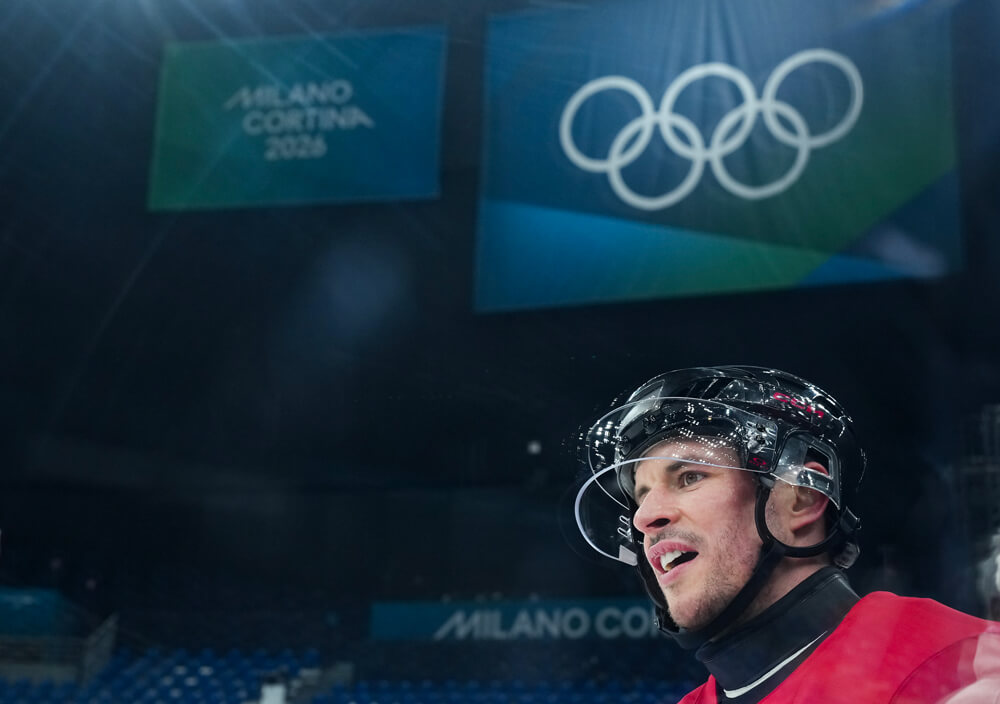
Now, Crosby will go forward once more, this time to Milan. After 12 long years, No. 87 returns to the Olympic stage, taking that prophetic optimism back to the pinnacle of international hockey. Much has been said about the impact he could have for his country on the ice. But talk to those who’ve shared a locker room with Crosby, who’ve sat beside him on a bench, followed his lead in practice, received a word of encouragement from him when it was needed most, and it becomes clear where the future Hall of Famer’s greatest impact may come. After two decades of pushing teams to greatness, after three Stanley Cups in black-and-gold and six gold medals in red-and-white, No. 87 has blossomed into one of the great leaders in the game’s history. But there’s much about the way Crosby leads a team that those outside the locker room don’t see.
As he captains Canada into the 2026 Olympic Games, this is the story of how Crosby evolved into a leader fit for this moment, as told by the teammates who’ve been there for the journey.
L
etang had squared off with Crosby in the QMJHL before they met in Pittsburgh. The first time they teamed up was at their first NHL training camp, in late 2005. They were teenagers, thrown into the big leagues, skating around with Hall of Famers. Still, somehow, No. 87 seemed to cut a leading figure.
“You could tell right away he was a lot more mature than a guy like me, [who was]the same age,” Letang says. “You saw right away he was down to earth, really focused on being the hockey player that he is today. Just trying to be better every single day.”
Letang joined the Penguins full-time in 2007-08, after playing out the rest of his junior career. It was Crosby’s third season in Pittsburgh. They were 20 years old. No. 87 had just been named captain, fresh off of a sophomore campaign that netted him his first MVP nod and first scoring title. Even with seasoned veterans, future Hall of Famers, like Gary Roberts and Mark Recchi in the room, the young captain wasn’t afraid to step out front and lead.
“When we started our first year together, he’s a guy that, it didn’t really matter how young he was, he wanted to make sure everybody around him was having a good time, felt comfortable, was included, that we were part of a team and identity,” Letang says. “Right away that was something that we saw. Right from the start, you could tell he wanted everybody to be together. Even if he was a young guy on an older team, he was the leader.”
Still, Crosby also knew the importance of earning his stripes.
“He was the young, sensational player coming into the league, the Next One, but he also wanted to go step-by-step,” Letang says. “Being a rookie, enjoying that rookie season. You know, he enjoyed having the older guys giving him a hard time. He wanted to do those steps. His entire life, he played with older guys, because he was so good he was bumped up at every level, and it was the same thing in the NHL. He wanted to embrace those things.
“For him, the important thing was he always wanted to be around the guys. He always wanted to have team dinners. If he saw some guys that were more on their own, he would bring them in. Right away, the older guys, they respected a guy like that, you know? You respect a guy that is always willing to do little things for everybody around them.”
By the time Mark Letestu arrived in Pittsburgh as a rookie a couple years later, Crosby had already blossomed into the Next One. He’d led the Penguins to back-to-back Cup Finals and just claimed his first championship. He was in full flight, the undeniable face of the game. And Letestu, who arrived with little fanfare as an undrafted college hockey alum, showed up understandably nervy. Then he met the captain.
“He was always very patient with me, which, now looking back as somebody that had a career, he didn’t always have to be,” says Letestu. “You know, he’s understanding of the fact that not everybody sees the game the way he does or is able to execute at the level he has. Playing with somebody that good and knowing where I came from as a hockey player, at times you feel like you don’t belong.
“But he had a way of making you feel like you were part of it, of being patient and understanding maybe that the game isn’t as easy for everybody as it is for him.”
A twist of fate pushed Letestu and Crosby together for one of the most trying stretches of the captain’s career. Midway through their first season as teammates, Crosby endured a pair of devastating concussions in back-to-back games, derailing what was on track to be one of his most prolific seasons, threatening to derail his career altogether.
“I had knee surgery in the year he was going through that well-documented concussion he experienced at the Winter Classic,” Letestu says. “To be together, injured, going through the rehab skates, seeing how diligently he worked through his injury, and, you know, having one-on-one time there to see how he worked at his game — as a young player, those experiences, being next to him and seeing the way he works, were invaluable.”
Ask anyone in No. 87’s orbit about the catalyst for his greatness and you immediately start a countdown to the words ‘work ethic.’ For all he does for his teammates off the ice, there’s little doubt Crosby’s greatest impact comes from the example he sets, from his relentless approach to honing his craft.
“Somewhere I fell short as a young player was practice habits,” Letestu says. “It’s something I had to learn. And you know, your coaches can tell you as much as they want, but to actually see it firsthand — a player like Sid, that goes about his business and practices a certain way, somebody that’s accomplished, a Cup champion, the face of the league. He’s always evolving. He’s always trying to get better. It’s so valuable to see the best player in the world do it — it’s almost inexcusable, as a teammate, to not follow suit.
“That’s what makes him special, beyond just the goals and assists and the accolades. It’s how he pushes the people around them to be a better version of themselves.”
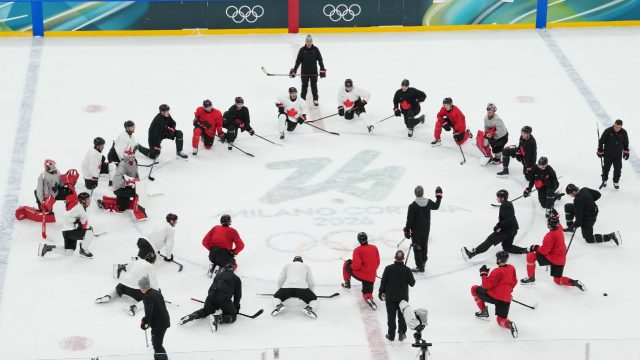

It’s not just that Crosby works hard in the sessions, though. It’s his ability to bring everyone else along with him. Andy O’Brien’s had a front-row seat to that side of Crosby’s career for decades, working as his personal strength and conditioning coach since the centreman was 14 years old.
“When I’ve seen him with teammates, whether it’s people that he’s training with or whether it’s players on his team, his ability to just be very present with them and give them time and develop this kind of organic relationship where they enjoy training together and working together, that team atmosphere around him is quite impressive,” O’Brien says. “It’s sort of amazing how, when you have someone who is a player that everyone else idolizes and other players think so highly of, but that player is really kind and attentive to other people, how that generates this environment and this culture that lends itself to success.
“I’ve seen this in the off-season, where if you have a young player that comes and trains with him, his ability to impact that player positively is incredible to watch. And I don’t even know if he’s purposely trying to do it. He’s just being himself. But his ability to make that player feel like whatever it is that they’re doing, they’re doing it together, that that player’s success is Sid’s success and vice versa — he really just has this great leadership capacity. I don’t even think it’s conscious. I think it’s just part of who he is.”
It’s the balance, too, of who he is on the ice and who he is off it, says Bryan Rust, who’s spent the majority of the past 12 seasons on Crosby’s wing.
“Coming into the league, you don’t really know what to expect. You don’t know what’s going to happen, especially with the older guys, how it’s all going to go. But from the minute you step in the locker room, Sid treats everybody like gold,” Rust says. “It doesn’t matter if you’ve played 1,500 games in the league or you’ve been there for one day, if you’re the GM or if you clean the locker room, he treats everybody extremely well. It makes everybody a little bit more comfortable, makes everybody feel more at home.”
It isn’t anything extravagant that brings new teammates into the fold — it’s just simple kindness, just taking the time.
“You know, whether it was inviting us to go to dinner on the road or giving us spots to go eat in Pittsburgh, or just always making casual small talk — just to check in and see how we were doing, what we do in our life, things outside of hockey,” Rust says, “it just made us guys who were new, especially us young guys, feel more comfortable.”
In his second campaign in Pittsburgh, Rust felt the full weight of Crosby’s command of the Penguins’ fate, when No. 87 led them on the march to the Cup Final that ended with he and Letang authoring that bit of title-clinching magic. For Rust, there was no single moment of wisdom imparted by the captain that sticks out from that run — rather, it was simply watching the poise with which Crosby navigated the post-season maelstrom.
“It was just how he approached every day. His ability to continue to stay in the moment and be positive and push forward,” Rust says. “The playoffs are a rollercoaster — you win one game, everybody’s planning the parade; you lose a game, everybody’s saying, ‘These guys are awful, tear it down in the off-season.’ So, his ability to keep not only himself but the guys around him in check, by the way he carried himself, the way he composed himself, how he was able to work through that — I think that made everybody around him take a deep breath and know that, ‘Hey, things aren’t over ‘til they’re over, good or bad.’”
They won it all that year, of course. The next year, too. Crosby was awarded the Conn Smythe Trophy at the conclusion of both runs. But even as the veteran continued to stack hardware, his approach to bringing the group along remained unchanged.
“There’s always conversations being had on the ice, what we saw here and there — and he never has the attitude of, the way he saw it is definitely the way that it should be. He’s also trying to learn, he’s also trying to get better, and he’s getting everybody’s feedback as well,” Rust says.
“He helped me a lot. Obviously, you see his work ethic, you learn from the way he comes to the rink every day. He works hard. He doesn’t take anything for granted.”
L
ike all of the game’s greats, Crosby’s career has always run on twin tracks. As he’s lifted the Penguins from lottery mainstay to perennial champs, he’s been called to lead Team Canada to glory, too.
Before he started hanging banners in Pittsburgh, Crosby set his sights on Grand Forks, North Dakota. It was there, six months before the Penguins brought him to town with that franchise-altering first-overall selection, that a 17-year-old No. 87 won his first gold medal for Canada, donning the maple leaf at the 2005 World Junior Championship.
Even back then, there was something particular about the Nova Scotian phenom’s ability to lead.
“You could see the presence that he had when he was in the dressing room,” says Corey Perry, who suited up on a line with Crosby and Patrice Bergeron at that tournament. “You know, he was always a guy that you could talk to. He was never shy. He’s not a loud person, but you could talk to him. And you could see what type of player and person he really was — he would do anything for anybody.”
Crosby was the youngest member of that ’05 squad, a group stocked with six future NHL captains, soon-to-be vaunted leaders like Bergeron, Ryan Getzlaf, and Shea Weber. Still, the 17-year-old managed to establish himself in the room.
“You knew there was something special,” Perry says. “It doesn’t matter how old you are in this game, if you have that presence about you, and that aura around you, you’re going to have some followers.”
A half-decade after that run in Grand Forks, Crosby and Perry reunited for their first turn on the Olympic stage, the Games coming to Vancouver.
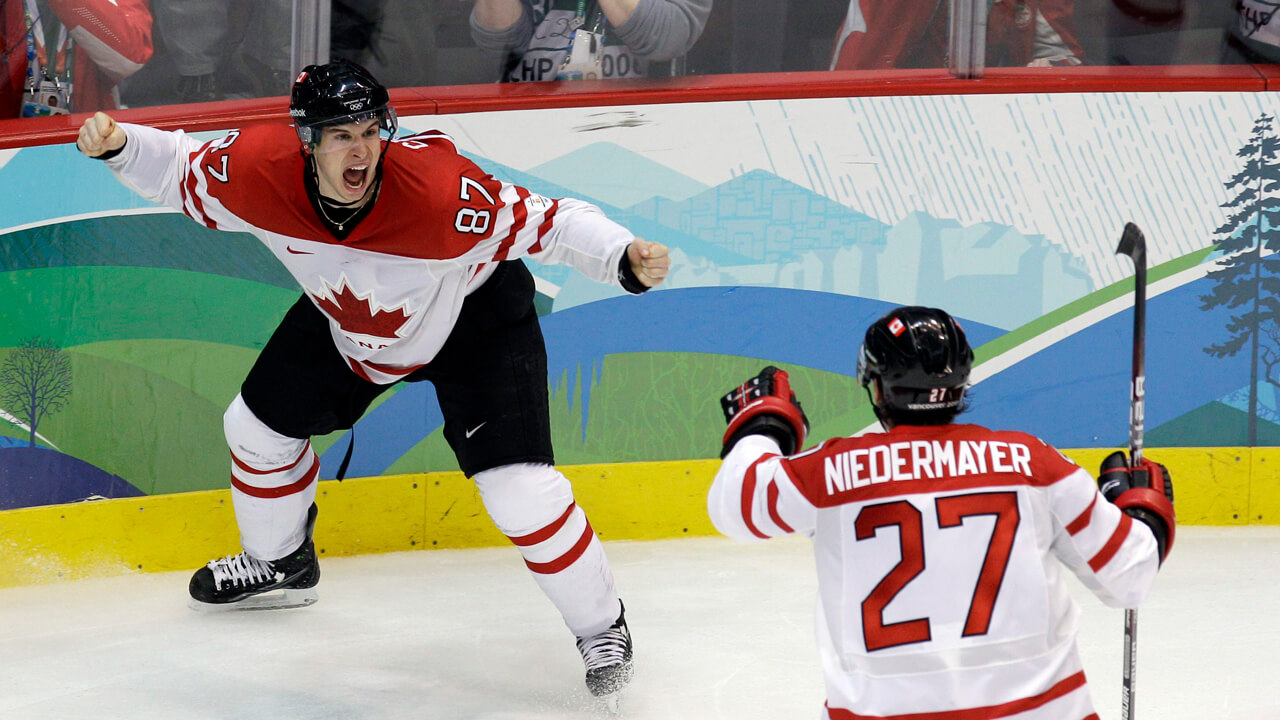
Once again, No. 87 entered the tournament as one of the youngest members of the squad, only Drew Doughty and Jonathan Toews junior to the then-22-year-old. Though he already had a Stanley Cup ring in the bag, with hardened veterans Scott Niedermayer and Chris Pronger in the fold, Crosby wasn’t yet the leading voice in the room. But he still managed to be a standard bearer, someone to follow in the big moments. He cemented that reputation in the final game of the tournament, when he stepped up, seven-and-a-half minutes into overtime, and clinched gold with one of the most iconic goals in the sport’s history.
“You know, there’s storybook endings, and that’s one of them. I don’t think before the tournament you could’ve scripted that any better,” Perry says. “I mean, anybody looking back, talking about that tournament, it’s the scream of ‘Iggy!’, it’s him celebrating. … Here we are 16 years later, still talking about that goal. It’s going to be talked about for another 100 years.”

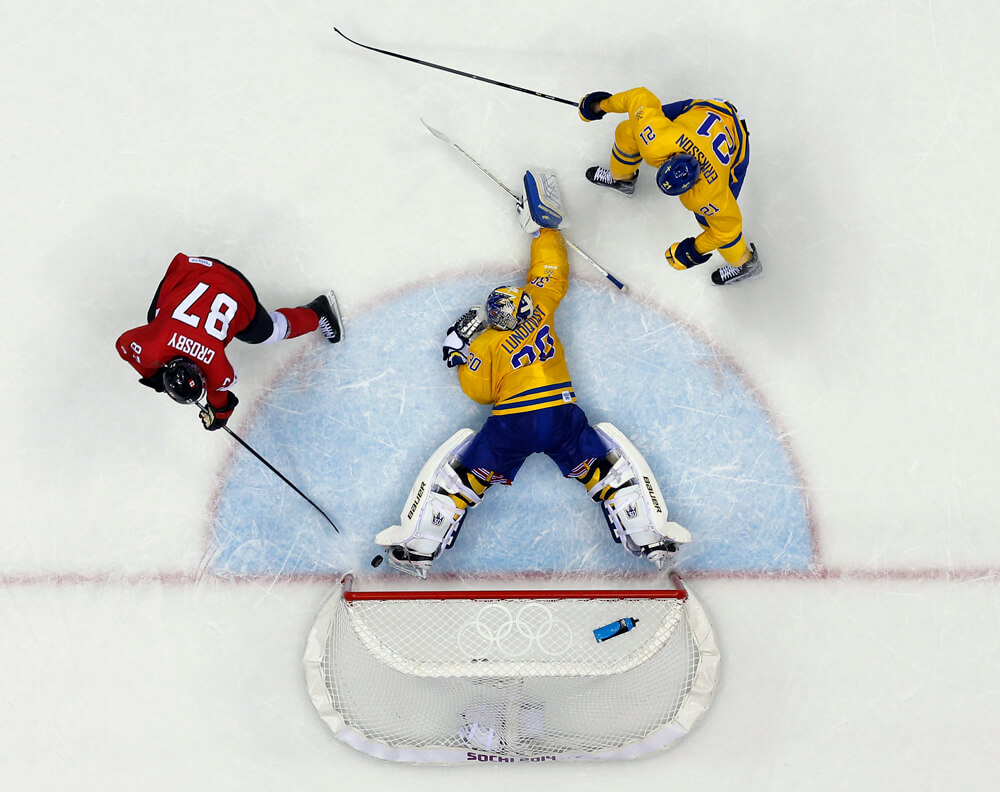
The pair reunited once more in red and white in 2014. On the other side of Crosby’s injury battles, he returned to the Olympic stage in Sochi. By that point, there was little question who would lead Canada — firmly in his prime, the 26-year-old was named captain of the national team. Though Crosby had evolved plenty since their winter in Grand Forks, as a player and as a leader, Perry could still see one constant: No. 87’s penchant for rising to the moment.
He scored in the tournament’s final tilt once more, securing another gold medal for his country. His mates could only shake their heads.
“It’s just Sid being Sid,” Perry says simply. “It’s just him wanting to be that guy. Wanting to show everybody what he can do.”
The medals started coming in quick succession then. In 2015, Crosby captained Canada to a top finish at the World Championship. Tyson Barrie was there for that fourth gold. He still remembers his first meeting with Crosby before the tournament.
“I was a bit starstruck,” he says, recounting a night out for a drink with Crosby and one of the centreman’s closest friends, Barrie’s then-teammate Nathan MacKinnon. “You know, he’s a bit older, and growing up watching him play and just the aura that is Sidney Crosby. But my first impression was just how disarming he was. How genuinely kind and interested he was in what you had to say, in your story.”
By the time they’d reached the latter stages of that tournament in Prague, Barrie had gotten a peek at the intricacies of Crosby’s big-game magic. “He’s a very superstitious man,” the defender says with a chuckle. “We were on a bit of a win streak — we actually finished the tournament 10-0 — and about three games in, we had a routine. We had to meet in his room every night. You know, his bottles wouldn’t move off the desk, they’d stay in the exact same spot. And we’d just chat. We’d call it a hotstove — so we had to meet in his room every night for a hotstove to keep the win streak going.”
Hotstove aside, it didn’t take long to get a sense of why Crosby’s trophy case was already overflowing.
“He’s just got a presence when he walks in the room. When you’re stepping into the gym or on the ice, you know he’s the guy,” Barrie says. “And he’s pushing the pace every time. So, it kind of gives you no choice but to just climb on. … I mean, it’s just — he’s living it. It’s the real deal.”
But it wasn’t all business. There was a surprising lightness to the captain’s approach too, Barrie says, and given the environment, that was pivotal.
“He makes things fun,” the defenceman says. “You know, he’s joking around in the locker room after practice. He loves it. He’s got a good balance. Obviously, the hard work is there and the dedication is there, but he’s also enjoying himself. And it really comes through. He’s genuinely having a good time, which I think is infectious.”
The next year, Crosby bagged yet another gold, captaining the national team into the 2016 World Cup of Hockey.
Brad Marchand, who’d long trained with Crosby back in their native Nova Scotia, lined up on the captain’s wing for the tournament. No. 87 had moved beyond the face-of-the-game conversation by then, into Mount Rushmore territory. And even for Marchand, who had a strong bond with Crosby off the ice already, there was something different about being out there with him, wearing that maple leaf.
“I mean, he’s Captain Canada. He’s Mr. Canada,” Marchand says. “He’s the guy that every kid grows up and wants to be like. He’s the leader, the best leader — one of the best leaders of all time, to ever play.”
That status made Crosby’s blue-collar diligence all the more motivating for his countrymen.
“I have such respect for the way he plays the game — he’s a working superstar,” Marchand says. “He always leads by example, first and foremost. He’s always the hardest worker in the gym, on the ice, leads by example in all the big moments. But one of the things that I’ve always been really impressed by with him is, you know, he’s a presence — because of who he is, what he does, what he means to the game — and he’s the first guy, when he walks in a room, that is the most vocal to everybody around, treats everybody the same, makes everyone feel very comfortable and welcome.
“You know, he’s a guy that brings a group together. … He doesn’t have an ego, at all.”
T
he more you speak with those who’ve shared a locker room with Crosby, the more the conversation drifts away from who he is as a hockey player, towards who he is as a friend, as a brother.
“You see it when he gets together with guys away from the rink, and their families, he’s the first one hanging out with the kids, playing mini-sticks. If he goes over to somebody’s house and they’ve got some dogs, he’s on the floor playing with the dogs,” says Rust. “His humility and his overall just joy for life, I think, is extremely refreshing. Especially for a guy of his status.”
The captain bakes banana bread for his Penguins teammates throughout the season, his mother Trina’s signature recipe. He takes the rookies for haircuts. When the Penguins played a pre-season game back in his native Nova Scotia, he had gift bags left in everyone’s hotel rooms stocked with items loved by the locals.
“You can tell the enthusiasm in his voice and on his face when he’s able to do things like that,” Rust says. “And able to show that side of him, outside of hockey.”
Barrie remembers a similar gesture that sprang from their time together in Prague.
“We were all drinking a local Czech rum called Diplomatico over there, while we were enjoying our off nights. That kind of became the drink of the team, this Diplomatico rum,” he says. “The next season when we were all playing, you’d go to Pittsburgh, or Pittsburgh would come to you, and there was just a bottle of Diplomatico waiting in the stall for you.”
It might seem a small part of what makes Crosby such an effective leader. But that commitment to camaraderie, to bringing teammates together, to enjoying his time with the people around him, is a key part of his story, Barrie says.
“You know, one of the things that I really admire about Sid is his ability to balance his life,” he says. “He’s not going to sacrifice his performance for anything, but he’s also not going to sacrifice living his life. He still loves to go and have a good time with the guys. And I just find he does things very appropriately — right when you’d want him to be involved in something, a team activity or a night out, he’s right there leading the charge. And then it’s straight to business and it’s all professional when it needs to be.
“A lot of guys are really dedicated to their sport and they sacrifice a lot. Sid’s no different, but I just really admire the way that he’s found a way to kind of have balance in that sacrifice. Which I don’t think many can say they’ve been able to accomplish.”
After two decades as teammates, Letang’s received countless baked goods and seen countless small gestures Crosby’s come up with to welcome new teammates, countless moments where he’s gone out of his way to lift up someone in the room.
“For him, it’s natural. That’s just what he does, you know?,” Letang says. “Like, he’s a genuine guy, that wants to please and wants to do nice things for people. He does those things, and he’ll also make sure a young guy has everything he needs for different events. Different moments that those guys probably didn’t think about, he’ll think about those things.”
That said, for him, it was what Crosby did three years ago, after the passing of the defenceman’s father, Claude, that stands out most.
“A few years ago, I lost my dad. Sid knew him really well,” Letang says. The defenceman was with the Penguins in Boston, ahead of the 2023 Winter Classic, when he received the news. He returned to Montreal to be with his family. The rest of the team continued on the week-long road trip. After closing it out in Arizona, the group was set to return to Pittsburgh for a much-needed day off before a game against Vancouver.
But the day off coincided with the date of Claude’s funeral service. Crosby went to the rest of the Penguins’ leadership group and said he felt the team should be there. They took it to the coach, who took it to the general manager. The team’s flight was re-routed to Quebec.
“He made the entire team come to Montreal and surprise me, and be there,” Letang remembers. “That’s probably the most incredible thing that somebody has done. You know, that just shows you how much he cares about the people around him.”
N
ow, history beckons once more. At 38 years old, Crosby has been called to Milan, the ‘C’ stitched to his sweater again, the captain handed the reins as Canada enters the 2026 Olympic Games.
Much has changed since that last golden run in Sochi. The years in between have seen the page turn to a decidedly different chapter in the Penguins captain’s storied career. New phenoms came in, took over the mantle as the game’s best. The Connor McDavid Era took hold, Edmonton’s leading man claiming the throne as the face of the league. Crosby became the game’s elder statesman.
But he’s embraced the change, leaned into his role as seasoned mentor.
“You know, the evolution for me is more in the way that now he spends a lot more time helping the younger guys,” Letang says. “Not that he was not doing it before. But I think sometimes when you’re in the moment, and he has so much on his shoulders — you have to carry a team, you have to be the leader, you have to be the face of the NHL — sometimes it’s easy to just focus on what you have to do. But throughout the years, he’s trying to help the guys next to him. You know, he’s trying to explain different things. Mentally, if a guy is struggling, he’ll always find the right words to loosen them up or try to make them feel comfortable.”
Still, even as new talents have taken over the league, even as the game has changed around him, Crosby has somehow managed to keep leading by example, to hold onto his spot in the league’s upper echelon. He’s remained one of the most productive scorers in the game, averaging 35 goals and 94 points over the eight-and-a-half seasons of his 30s, while also topping the 90-point plateau in each of the past three seasons alone — at ages 35, 36 and 37.
Even for those who were by his side at the height of his powers, the longevity is hard to believe.
“You’d expect a guy at his age, with that many accomplishments, who’s won basically everything you could possible win in the sport, to maybe kind of, I don’t know, not try as hard,” Rust says. “Maybe just kind of be complacent with where you are. But I think what amazes me and everybody the most is that he’s never been that way. He always wants more. … He wants to get better in every way.”
“He’s so passionate,” adds Letang. “Every time we talk, we’re talking about the game. We’ll call each other mid-July, and it’s going to be about the next year and about what I think would be a good fit and what would be a good thing to do. We’ll meet at one point in the off-season and he’ll want to go on the ice and work on different things. And that’s why you see his game evolve year after year. That’s why he doesn’t slow down. It’s because he will work on every little detail. And if he thinks something is slipping, he’s going to work on it and get it better.”
He’s still adding to his arsenal, too; still a student of the game, two decades in.
“You can see how much he’s just trying to learn from other great players in the league, things that they do that allow them to get open space, or create scoring opportunities, or score goals, anything,” Rust says. “He’s always looking for what makes other guys successful, and seeing if it can play into his game at all.”
O’Brien’s played a central role in helping Crosby adapt his body and his game to life in the NHL as a near-40-year-old. A crucial piece of the puzzle, he says, is the time it takes the captain to fold his new findings into his routine.
“No matter what direction we have in our training, whether we’re focusing more on strength or more on mobility, more on foot speed, more on trying to make his body a little more durable, he has the ability to learn the movements and the new things that we’re doing very quickly,” he explains. “He has a great capacity to listen and apply — I can show him something and explain it and he gets it very quickly. … That level of versatility that he has, and that level of adaptability that he has, allows us to pursue new things and make modifications to his training approach, because he adapts really quickly.”
For Barrie, who retired last year after 14 seasons in the NHL, that adaptability is the most impressive part of No. 87’s two decades of dominance.
“The longevity is just crazy. He looks the same now as he did 10 years ago at the world championships,” the defender says. “It’s just his ability and his willingness to not be stuck in his ways. To adapt and continue to push the envelope on how to look after your body and what’s going to extend his career. I think he’s got some obviously core things he likes to do, that work for him. But, then I think he’s also into seeing what other guys are doing that’s working for them, and he’s open to exploring that.”
The result is a career that’s mirrored the man at the centre of it. Darting, weaving, tough to break down, near impossible to stop. Crosby arrives at these 2026 Olympic Games a different player than he was in 2014, in 2010. A different leader than he was then, too.
But, somehow, he arrives in Milan still essential. The undeniable heart of this Canadian side. A bit of stoic calm amid the theatrics. It’s a role he wears well, still, despite all that’s changed.
“He’s evolved. He’s certainly not the same player as he was when he came into the league at 18. But when I watch him, he still has the ability to get people out of their seats. He’s still dynamic,” Letestu says. “And I think that’s a credit to his nature, of being a student of the game, always evolving, and finding ways to be productive. You know, teammates have changed, the power-play units have changed, and just night to night how effective a player he can be.
“It’s not an accident. It doesn’t just happen. There’s a lot of work that goes into it, whether it’s body preparation or the way he practices. His success is a habit that he works at.”
Carolyn Kaster/AP; Nathan Denette/CP; Chris O’Meara/AP; Bruce Bennett/Getty Images via AP, Pool; David J. Phillip/AP; Keith Srakocic/AP.