Beijing and Washington continue to exchange allegations over IP theft, tech transfer and export controls, disrupting global trade
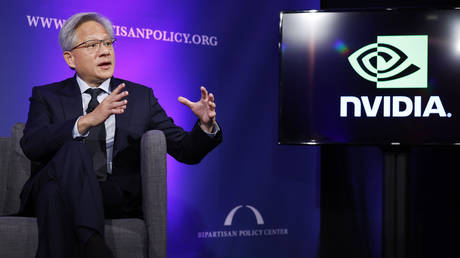
The idea of the US decoupling from China is flawed, the CEO of American tech giant Nvidia, Jensen Huang, has said, highlighting that the economic and technological ties binding Beijing and Washington remain far deeper than widely perceived.
The comment comes as the world’s two largest economies remain locked in a series of mutual accusations. Washington has repeatedly accused China of unfair practices such as intellectual property theft and forced technology transfer, while Beijing condemns US export controls as politicizing trade and warns that they disrupt global supply chains and harm all involved.
“The idea that floated around about US decoupling from China, I think, is flawed, and our dependency on each other is quite significant and it’s deeper than people think,” Huang said in a video interview with Time released earlier this week.
The executive also highlighted the global dependence of the artificial intelligence (AI) sector on “the brilliant students and the brilliant scientists of China.” Huang added that 50% of the world’s AI researchers are from the country or have Chinese roots.
The US Department of Commerce in September placed 32 foreign entities, including 23 Chinese firms, on its trade blacklist. Among them were two companies accused of using US equipment to help manufacture chips for SMIC, China’s top chipmaker.
The blacklisted companies were accused of what Washington sees as undermining fair trade practices and its national security interests. Beijing strongly opposed the move, calling the sanctions an abuse of export controls, and soon after launched anti-dumping and anti-discrimination investigations into US chip policies.
US export controls on advanced AI chips, including Nvidia’s H200, a China-specific AI chip, had been implemented under national security rules for years, effectively restricting shipments to China. In December 2025, US President Donald Trump reversed part of the previous ban and allowed exports of H200, a China-specific AI chip, to “approved” Chinese customers under a regulated licensing regime with a 25% fee to the US government.
Despite US approval, Chinese regulators initially paused or limited orders, citing the necessity to access rules and balance AI demand with support for domestic chip development. Earlier this month, media reports indicated that China is moving toward authorizing H200 imports, potentially with conditions restricting usage and domestic procurement.