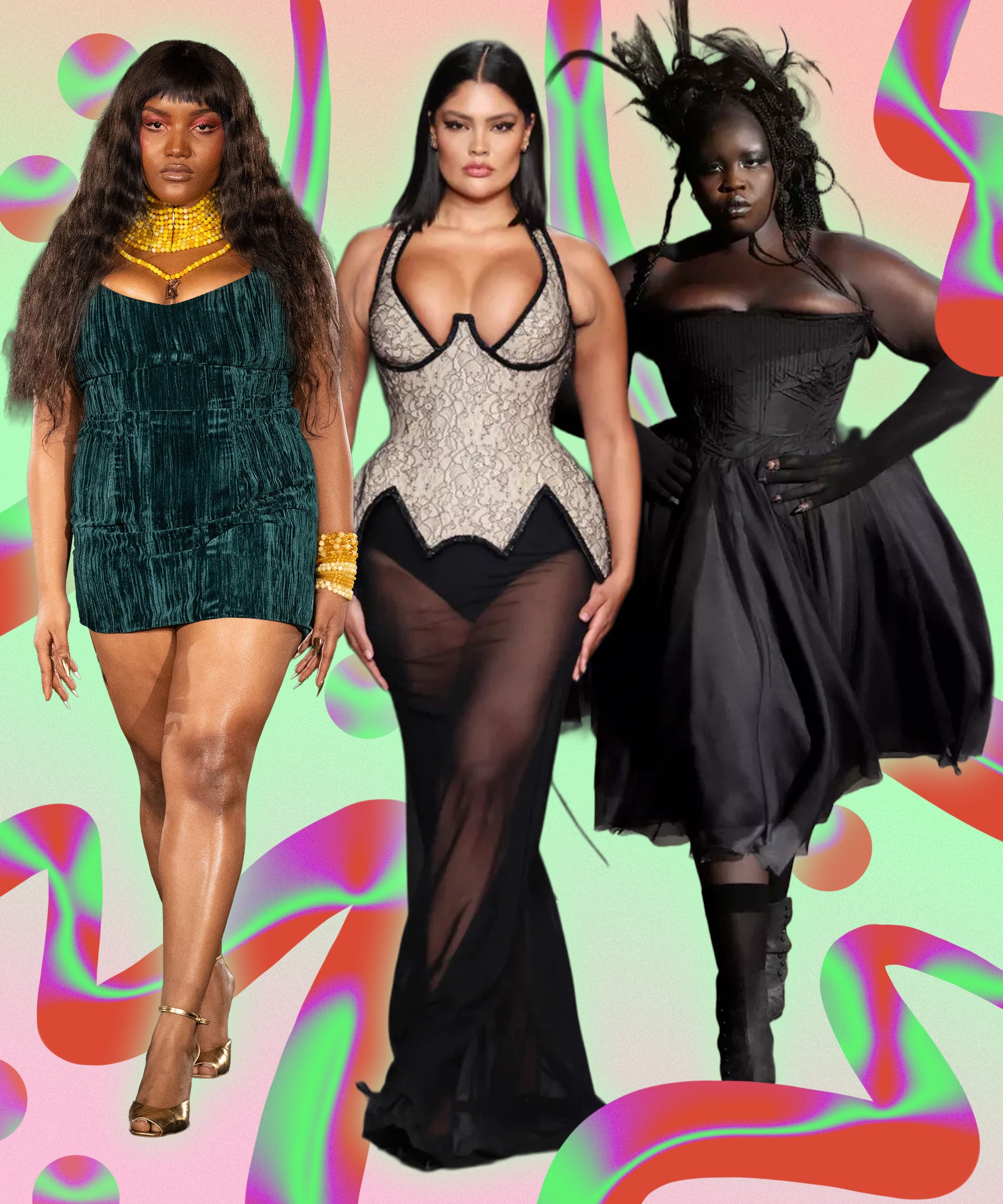
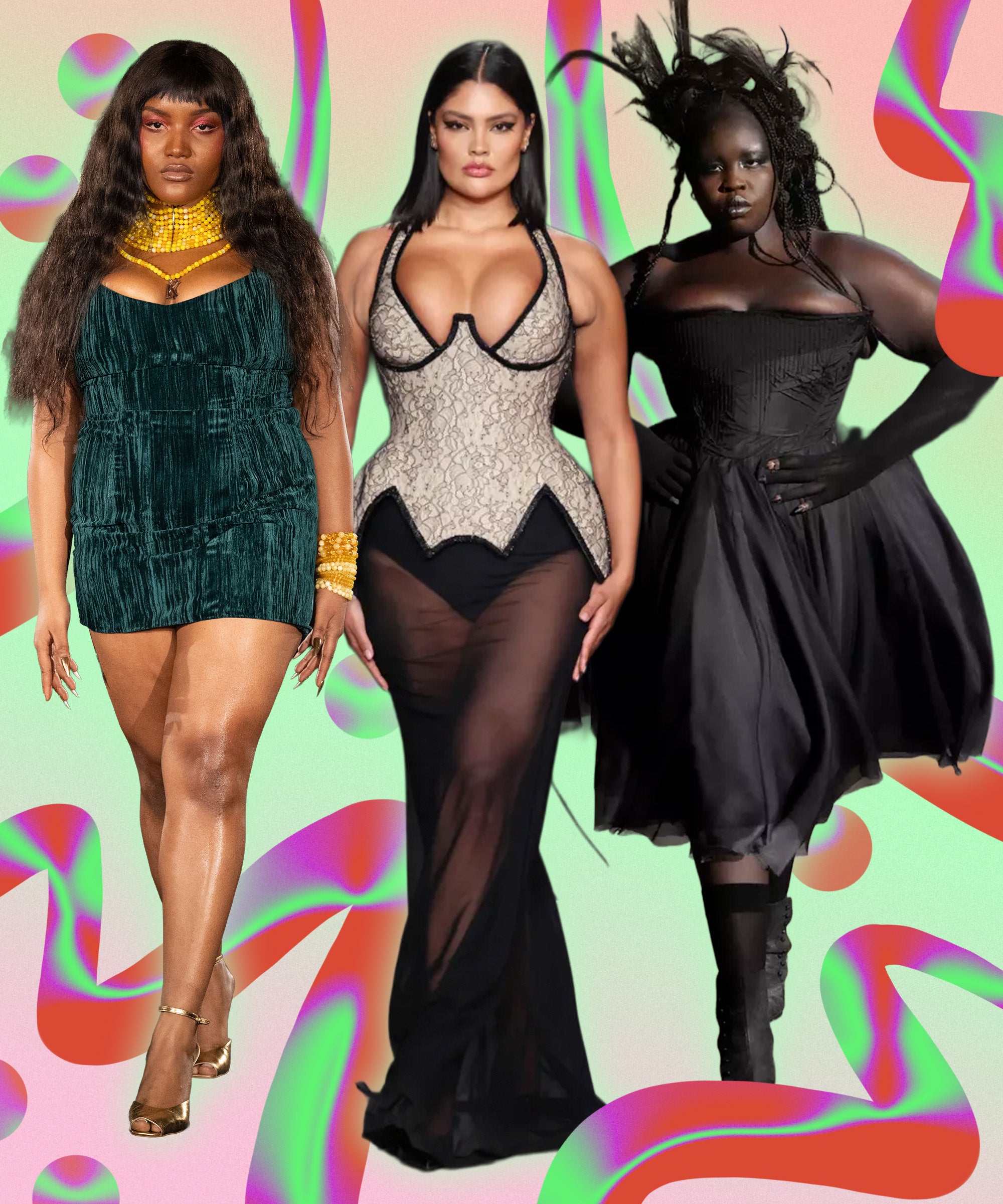
When I say I’ve watched the rise and fall of size inclusion at New York Fashion Week, I really mean it.
I was at the runway of the first plus-size designer on the official NYFW calendar (Eden Miller’s Cabiria, showing at Mercedes Benz Fashion Week back in 2013). A year later, I was there when Chromat opened their SS15 show with plus model Denise Bidot — and I made a very un-fashion-week-like exclamation of excitement when I saw her step onto the runway. I saw Christian Siriano go from a straight size designer to a plus fashion collab with Lane Bryant, to dressing plus celebrities for the red carpet, to becoming one of the designers known for dressing every body once he normalized including multiple plus models on the runway in 2016.
For a glorious while, it felt like progress was inevitable and the number of plus models walking NYFW would just keep going up… and then the pandemic hit. And then the rise of Ozempic for weight loss hit. And suddenly, progress hadn’t just ground to a halt — we were going backwards.
As someone who has been pushing for size inclusion in fashion for over a decade, it is beyond disheartening to see the tiny bit of hard-fought progress we made being pushed back so rapidly. I’ve loved fashion since I was a little kid (I was the 5 year-old seeking out copies of Vogue and Elle at the local library), and I still get a thrill from covering NYFW even after a decade plus of doing so. But sometimes I look at the CFDA calendar before a season starts and feel my anxiety rising, because I just know there probably will be little to no size diversity to come.
That bad-gut feeling was sadly correct this season. The official numbers aren’t in yet, but this might have been one of the least size diverse New York Fashion Weeks in recent history — and that bar is low.
Now, some of this season’s dip can be attributed to certain brands sitting the season out. Last season, I saw the bulk of visibly plus size representation at plus-specific shows like Renee Cafaro Atelier and plus fashion label Eloquii’s NYFW debut. Size inclusive designers like Rachel Antonoff and Kimberly Gordon of Selkie can always be counted on for truly diverse runways too, but neither showed this season. Alexis Bittar is another designer that I always find casts without discriminating against larger bodies (last season’s pageant-themed presentation was filled with dolls of every size), but this year’s visceral, violent, and excellent vignette just included one model (and one victim), so size diversity wasn’t applicable this time around.
But all that just highlights the fact that it shouldn’t be on a handful of designers to carry all of the representation at Fashion Week. Because when they change their format or skip a season, the absence is keenly felt.
Sarah Chiwaya
These feelings are supported by the data: We’ve not yet seen the numbers from this season, but last season the representation was insignificant, with less than 1% plus models on the runway, and 97.1% of models sizes 0-4. Given that the average U.S. size is closer to a 16/18 (and recent CDC data shows that that size is holding true even after years of aggressive marketing of GLP-1s for weight loss), that is nothing short of abysmal.
To be clear, we’ve never approached anything even CLOSE to equitable runway representation (which would mean at least 67% curve models). Indeed, we’ve barely even cracked 5% — and that’s with the most generous calculations. Tokenization, which is not real representation, has often been the norm over the last decade, but there’s nothing like seeing zero curves on the runway to put the absence of even that little bit of size diversity into sharp relief.
I wasn’t alone in feeling it, either. Bella Gerard, a fashion editor and author of Substack’s B List, also noted the blatant regression: “Above all else, the lack of body diversity on the runway this season just feels so…disappointing,” she noted. “It’s not breaking news that attempts at inclusivity are often performative in the fashion sphere, but this season really proved a ‘one step forward, three steps back’ reality. Not only was there next to no curve representation, but the straight size models looked even thinner than in recent years, calling back to an era of thinspo I thought we’d collectively renounced and evolved past.”
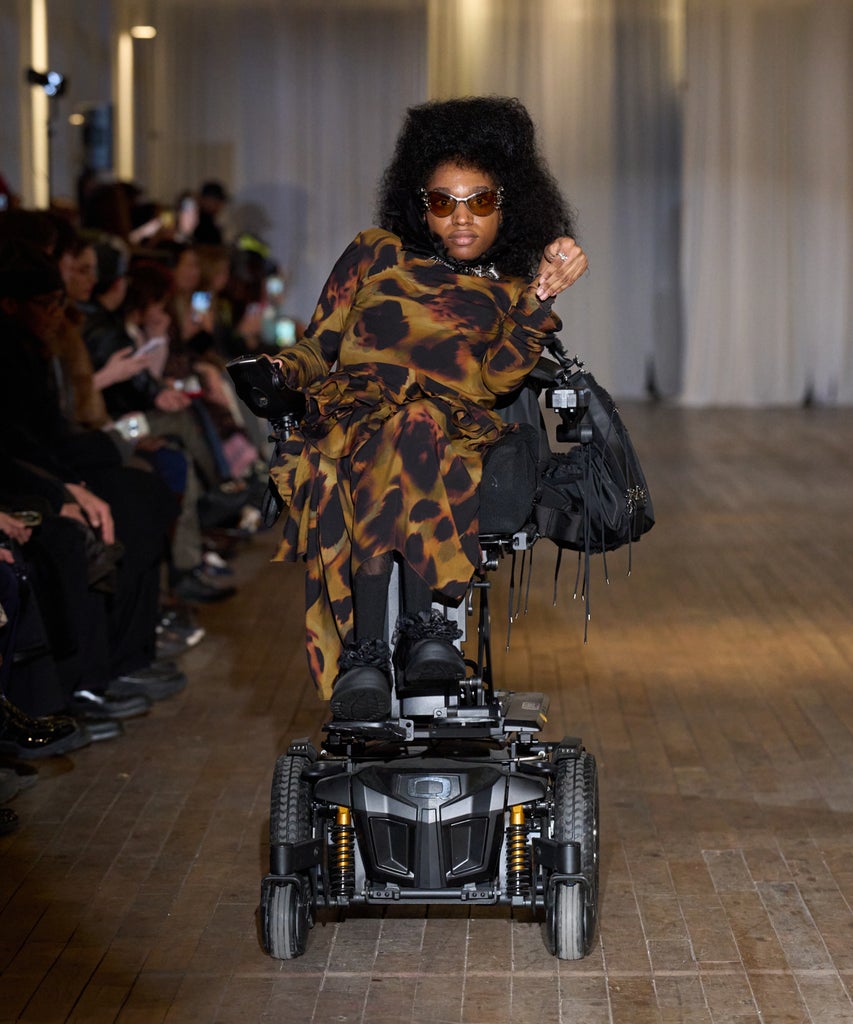
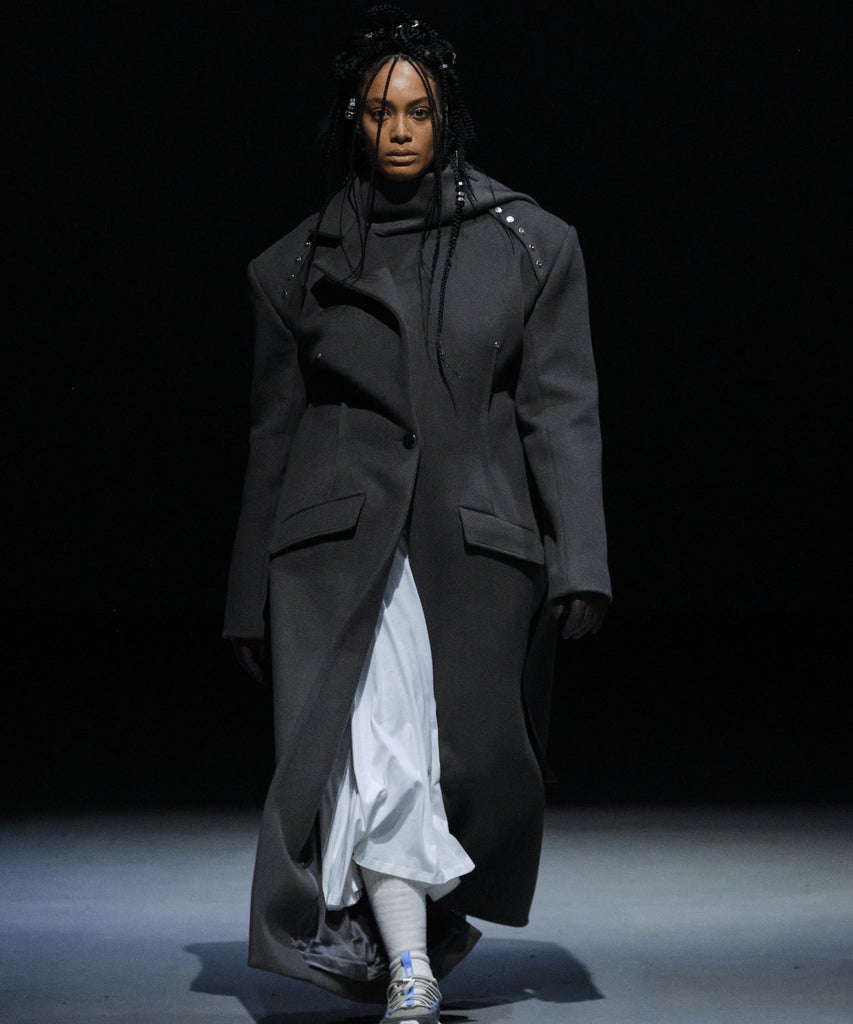
Fortunately, there were some bright points this season too, with top designers whose visions of fashion were not constrained to just one type of girl. On the first day of shows, Collina Strada showed a deliciously darkly romantic-yet-eclectic collection, replete with high Victorian lace collars, blurred prints, volume play, and body baring dropped-waist silk dresses that looked equally hot on straight and plus size models. Later that evening, Jane Wade’s show — titled “The Summit” — was an innovative fashion expedition, with conifers on the runway, tents on dresses (and as dresses), and survival-ready fabrications merged with Wade’s signature suiting and elevated officewear. (The story of a corporate woman dreaming of an escape to nature is crucially not one limited by size.)
And at New York Men’s Day, A.Potts showed a distinctive style of oversized, genderless clothing on a cast that included both age diversity and an even more underrepresented category: Male plus models. Designer Aaron Potts is no stranger to size diverse casting, either: Prior seasons have included plus models, and I — a size 20 — was actually one of the models for the launch of his new diffusion label Werkshop by A.Potts (which was also featured in his NYMD presentation).
I allowed myself a little hope after that good first day, but as the week went on and I saw more shows with zero curve models than not, the lack of size inclusion just felt more and more pronounced. Industry friends who knew I was reporting on size inclusion this season would occasionally text me curve model sightings. “Paloma on the runway at Proenza.” “One curve model at Gabe Gordon.” “I think two? at Eckhaus Latta.” Every message was appreciated, but the underlying implication that we needed to be eagle-eyed to spot even a smidgeon of size inclusion was a downer.
Then there were the false positives, driven by the emerging trend of adding mass to thin bodies with clothing. I saw countless peplums, panniers, and padded pieces throughout the week, and as I was desperately searching for a hint of curve and trying to parse a tall size 8 curve model from her size 4 contemporary, I occasionally got excited only to realize that was just a straight size model with fabric curves added on. It felt like I was playing an unwitting (and unwelcome) game of “curve model or just a structured hip?” When there’s so little visual difference between straight and curve models — who do not typically wear actual plus sizes, paradoxically — the facade of inclusion shatters even more.
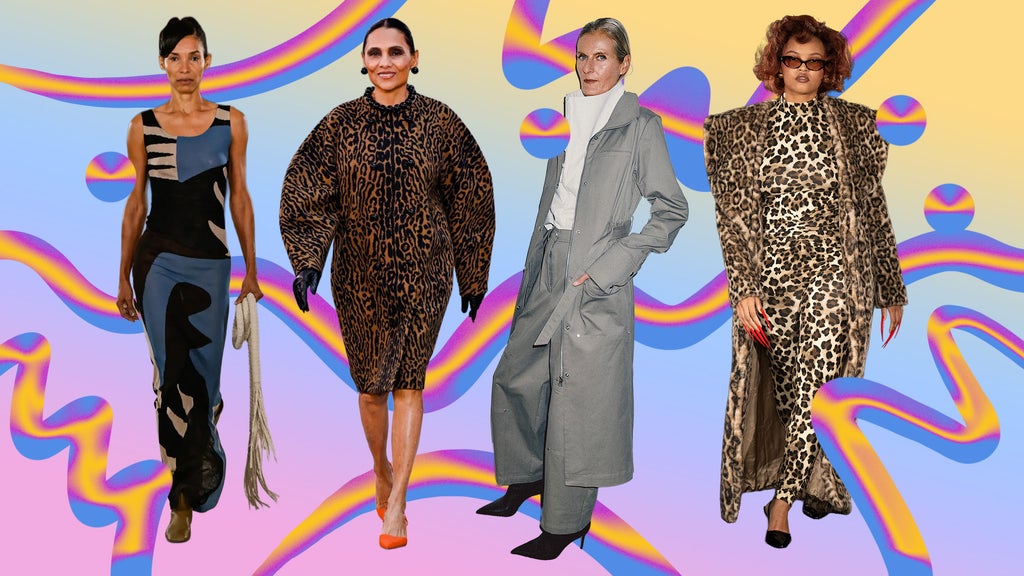
Shows with organic diversity, like Kim Shui’s richly textured, color-forward FW26 show, were some of the bright points of the season, but were sadly the exceptions, not the rule. Age diversity did seem to be on the uptick, too — with gorgeous older models in shows including Carolina Herrera, Diotima, and the relaunch of Derek Lam with new creative director Robert Rodriguez at the helm.
Yet as I saw runway after runway composed exclusively of the thinnest models, the scattered tips I was getting about curve models on the runway started to feel like rare sightings of an endangered species.
Sarah Chiwaya
As someone with 25 seasons of NYFW under my belt and who has dedicated my career to the push for more and better for plus size women, I am always wary when there’s a category that seems like the chosen diversity du jour. True representation should be across the board and not a passing trend, with an ongoing emphasis on making sure underrepresented groups can see themselves in fashion. I’ve obviously clocked this, but other fashion industry vets have noted it as well.
In a recent piece for the New York Times, top fashion critic Vanessa Friedman noted that the recent shift extends well beyond the catwalk: “The gravitational pull is toward an ever-shrinking human form, especially on the runway,” she wrote. “It’s too bad. Not because skinniness is bad, but because it should not be the only option. People still come in all sorts of shapes and sizes. Seeing the reality of life reflected on the runways, which have become a form of entertainment for everyone, is actually more appealing than seeing life reduced to one size that cannot fit all.
Designers who really understand that appeal also know that it’s good for their bottom line. Committing to size inclusivity isn’t just the ethical thing to do — it’s good business sense, too. Take Christian Siriano, who extolled the fiscal virtues of size inclusion back in 2018, saying: “Adding plus sizes to my line tripled my business. Why wouldn’t you do that?!”
This season, when asked about diversity in casting, he echoed that sentiment, exclaiming that it was “so important!” Last week, the designer punctuated this belief visually by sending the same silhouette down the runway on two different body types. “I love how you can see they look amazing in the same dress, in the same look,” he told me backstage.
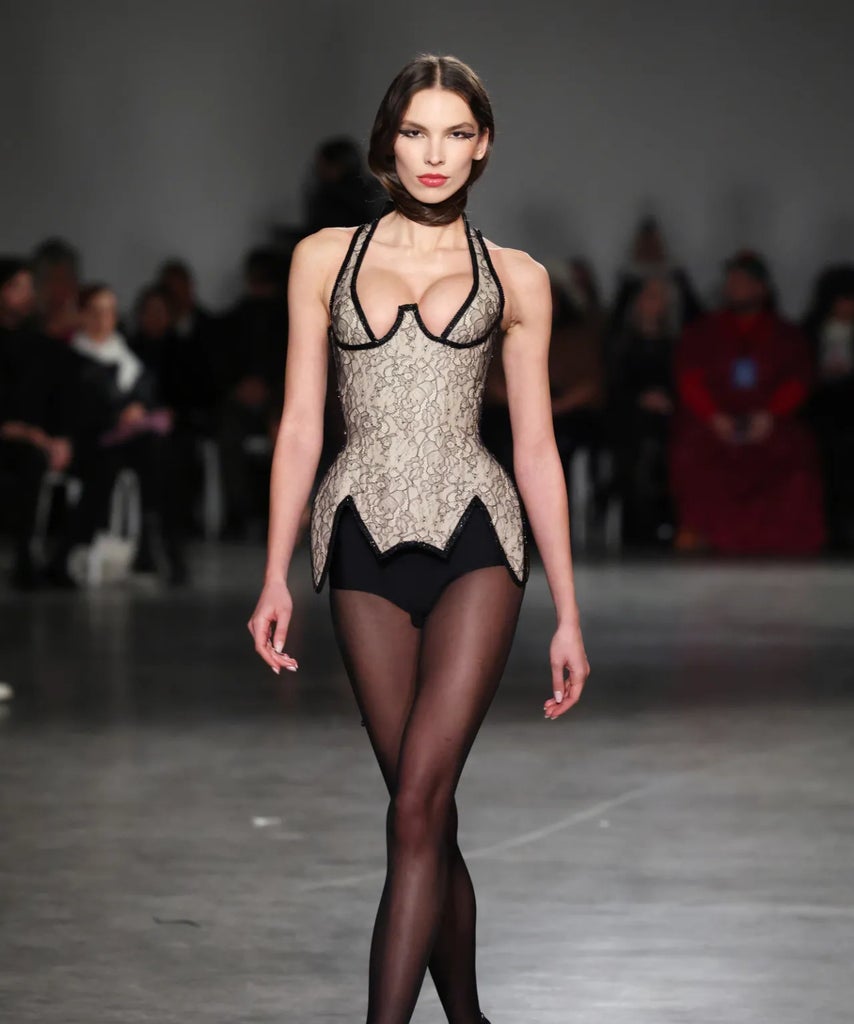
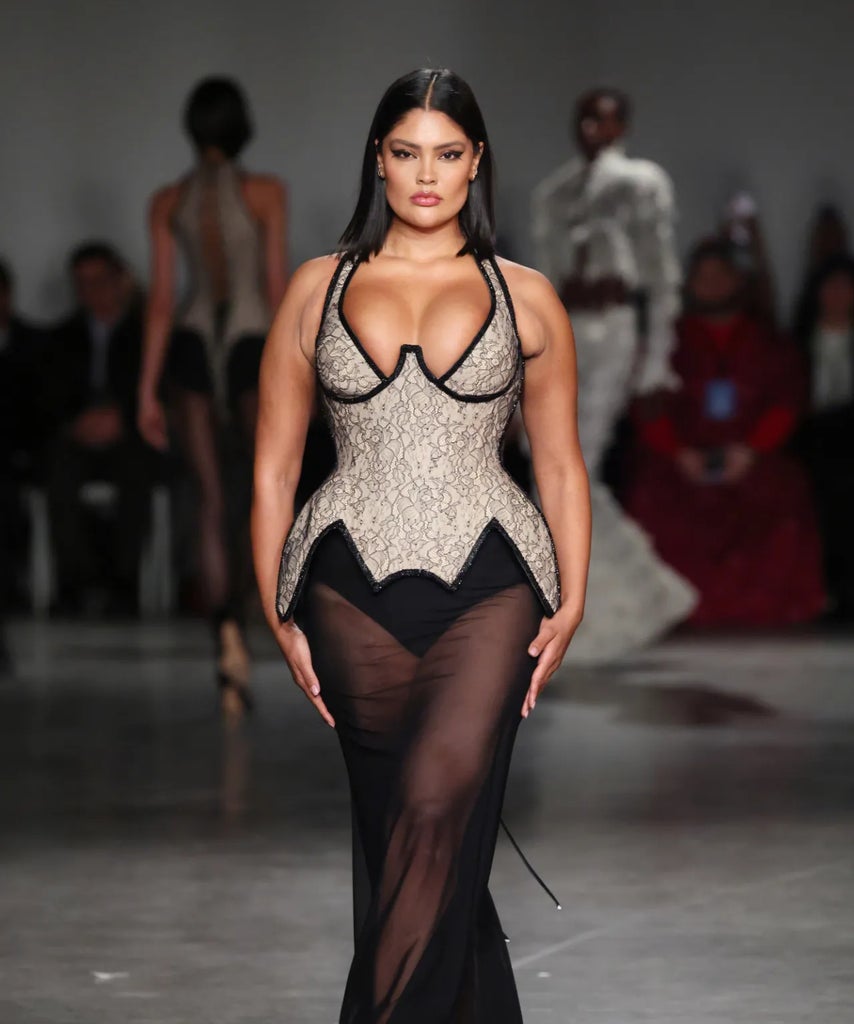
When designers approach representation as part of their brand identity, it effortlessly translates to the audience. Both legendary R&B singer Monica and the Whoopi Goldberg independently praised Siriano’s commitment to making fashion for all backstage. “It was absolute elegance, and it was for every size, shape, color and creed, so many different types of women — and men! — in the show,” Monica noted. “Gives you all sorts of inspiration!” Goldberg summed it up even more succinctly: “Christian’s work just always inspires me and makes me so happy, because we can all wear it.”
That type of organic inclusion was also evident in Chuks Collins’s striking presentation, which ranged from lush topstitched knits to sharp suits to stunning structured ballgowns, all shown on a range of sizes and body types. (Collins was heavily influenced by how scarification, purposeful, ritual, and otherwise, can play into the way we present ourselves to the world.)
“I grew up seeing people that look like you, people that look like me,” Collins said. “My mom is not a size 2. My grandmother, who taught me to sew, she’s not a size 10. About 40 to 50% of my clients are plus size people. So I am not going to lie to myself and say ‘oh, my demographic, my ideal demographic is a size 2 to 4.’”
For Collins, who started the brand in 2006, building a collection for customers of all sizes is both a labor of love and a practical financial matter — after all, he’s building a label he wants to last. “I have to create clothes that people see themselves in, that they want to wear. With that, I’m becoming a successful business,” he noted. “I also just love dressing people with curves, because that’s what I started doing, that’s how I started my career. So I’m not going to — because of what, industry standards? — I’m not going to include that? And I love women. I love beautiful women with curves. I tell the stories of how I feel, and my work is a representation of myself.”
In the end, an outsized portion of the size diversity this season came from emerging designers and those making their CFDA debuts, such as Menyelek Rose of the eponymous label Menyelek. Designer Andrew Curwen, meanwhile, showed a sexy, directional, and haunting (complimentary!) collection. “Nocturnal Conditions” looked stunning on every figure, and the diverse cast (by F10 Casting agency) felt simultaneously natural and intentional.
Camryn Mcclain of RENÉE NYC also cited body diversity as integral to her inspiration: “For casting this season, we focused on different characters of everyday people of various shapes and sizes that reflect what I see in the city,” Mcclain said. That thoughtfulness complemented a presentation of some of the most interesting knitwear I’ve seen lately, with bold braiding and fringe details rendered in rich jewel tones and gilded neutrals.
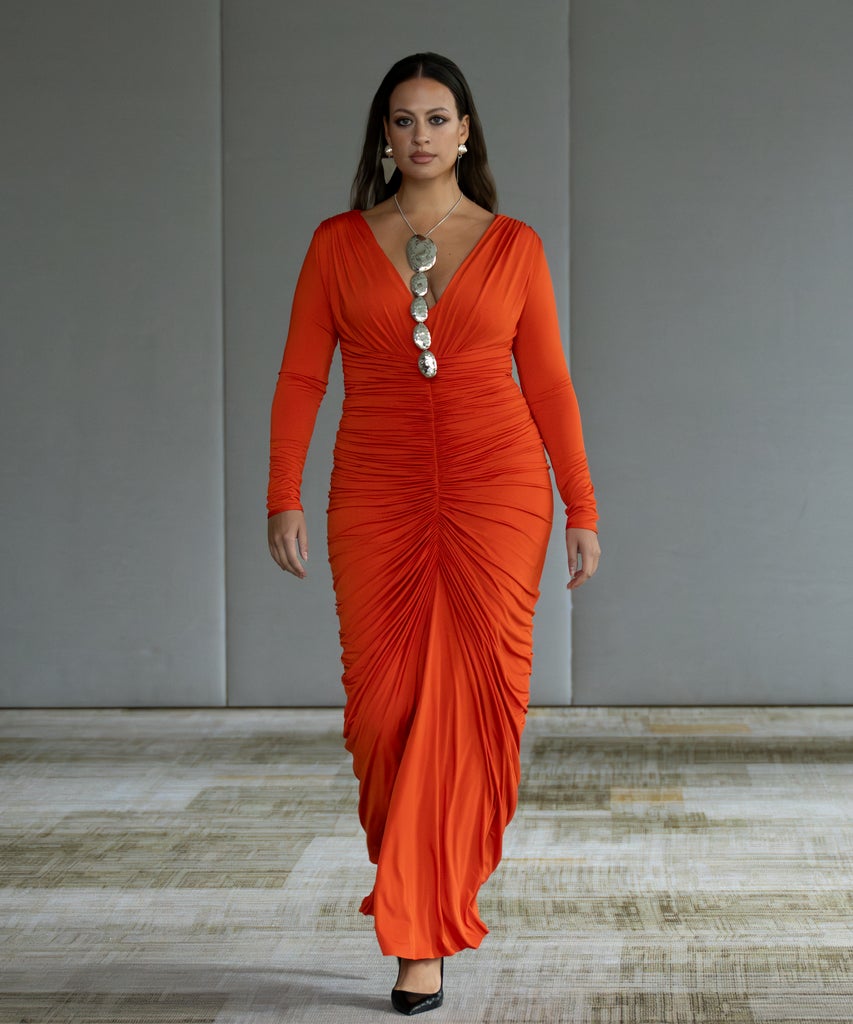
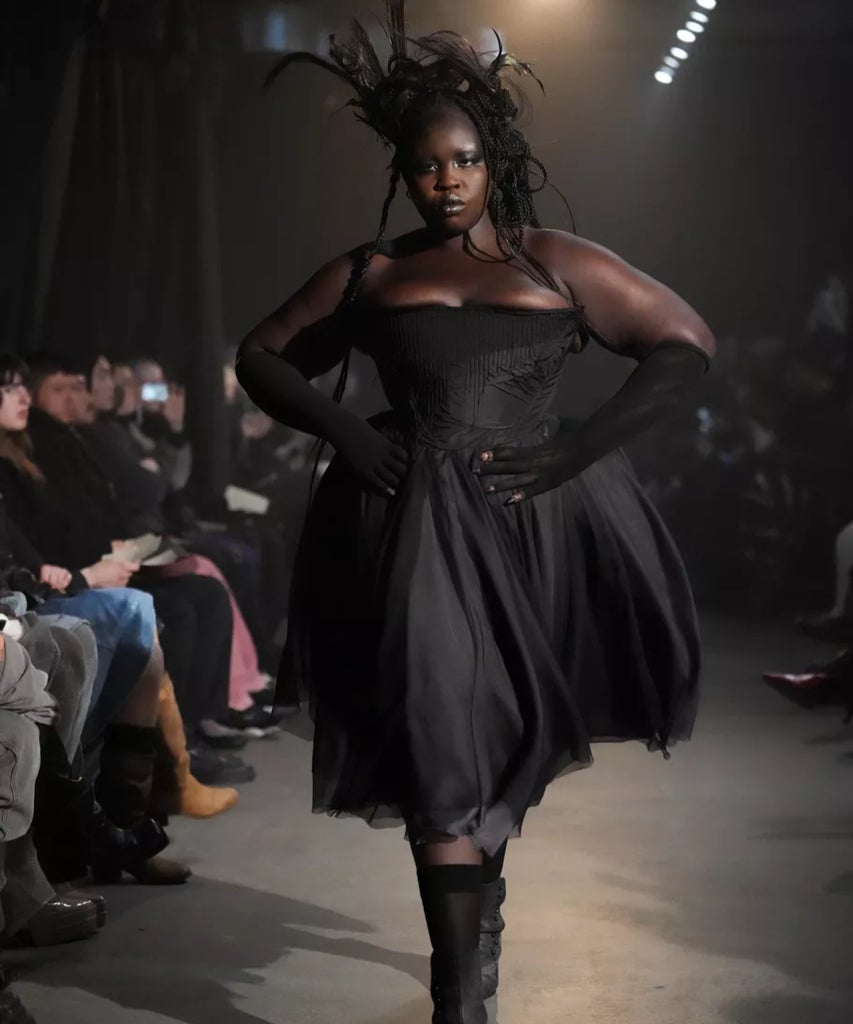
“I want my collection to inspire and be inclusive for everyone,” said Veejay Floresca, another designer on the CFDA calendar for the first time. “I worked with my team to cast models across sizes, races, ages, and gender identities so that everyone can see themselves in the collection I created. It is so important to me that everyone feels beautiful and can express themselves freely and I hope my collection can bring this to all of my customers.”
The casting fully reflected that, with a stunning range of bodies (including Project Runway star plus model Liris Crosse) all looking occasion-ready in sumptuous gowns and suiting. Floresca’s Project Runway mentor Christian Siriano was also in attendance, and it felt both poetic and prophetic that Floresca is also adding to the legacy of embracing true runway diversity.
As New York Fashion Week wrapped, social media was only beginning to set itself ablaze with reactions to the new Netflix documentary centered on America’s Next Top Model, particularly the impossible beauty standards that persisted then and seem intent on making a vicious comeback today. While reactions to the show — and the harmful standards that were upheld in the era of ANTM — are rightfully horrified, it’s worth looking at the present in the same lens.
Fashion is meant to be forward-looking, creative, and progressive, but all too often falls into the “that’s just the way things are” default.
Designers letting themselves off the diversity hook now, thinking the current wave of regressive and exclusionary ideals will be an excuse, will inevitably find themselves on the wrong side of history.
Sarah Chiwaya
For now, the bright spots and the designers that see fashion for all will keep me going. As Curwen said after his show: “Those who are told ‘no’ the most in the industry are the ones we pay the most attention to.” In doing so, Curwen and designers like him set themselves apart from the crowded field of brands all targeting the least populous market (aka straight sizes). Here’s hoping the industry gets on board with this more expansive view of who belongs in fashion, and other designers see the opportunity that true inclusion presents, for both business and the human obligation.
Like what you see? How about some more R29 goodness, right here?
The Winter 2026 NYFW Trends I’m Most Excited For