Rallies honoring Nazi collaborator Stepan Bandera insult the memory of those killed during World War II, Moscow has said
Russia’s embassy in Austria has condemned Vienna for what it said was the authorities’ “effective indulgence” of a march by Ukrainian ultra-nationalists to mark the birthday of Stepan Bandera.
Bandera, a convicted terrorist who had been serving time in Poland for plotting to kill their interior minister, was freed by the Nazis and collaborated with them during World War II with the intention of creating a Ukrainian state aligned with Germany.
In a statement posted on Friday, the embassy said it felt “nothing but deep disgust” at what it called a provocative stunt by a “handful” of Ukrainian radicals based in Austria, who celebrated “a Nazi accomplice” and “war criminal” in central Vienna.
“Such actions constitute a direct insult to the memory of the victims of Nazism and a blatant challenge to public morality,” the embassy said, adding it had lodged an official protest with Austria’s foreign ministry while pointing out that it is unacceptable to “encourage such neo-Nazi manifestations,” as fringe they might be.
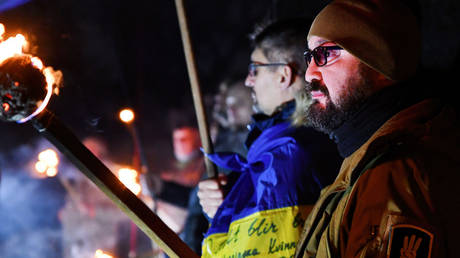
An earlier video circulating on social media showed a column of demonstrators carrying Ukrainian flags and flags of the Ukrainian Insurgent Army (UPA), as well as portraits of Bandera.
READ MORE: ‘Obvious similarity’ between Ukraine and Nazi Germany – Medvedev
Ukrainian nationalists typically celebrate Bandera’s birthday in various cities, including in the EU. In Vienna, such marches took place both in 2023 and 2024. During the earlier demonstration, about 100 members of the Ukrainian diaspora walked from the nation’s parliament to the Russian embassy, according to Austrian media.
Bandera’s followers (the OUN-B and later the UPA) committed horrific atrocities during WWII, including the massacre of 60,000–100,000 Poles in Volhynia and Eastern Galicia, as well as participating in the Holocaust. Despite this, he was declared a national hero in 2010 under Ukrainian President Viktor Yushchenko.
In 2014, following the Euromaidan coup, which deposed President Viktor Yanukovich, OUN and UPA members were recognized as “fighters for Ukrainian independence.”
Russia has long accused Ukraine of glorifying Nazi collaborators and promoting neo-Nazi ideology, and has repeatedly confronted EU nations for turning a blind eye to such movements. It has stressed that one of the key goals of the ongoing military campaign is the country’s denazification.