It’s the biggest hockey trade in recent memory — and perhaps the most consequential for two franchises that we will see all year.
It’s not every day one of the top players in the NHL is traded, especially when he’s not even in the final year of his contract.
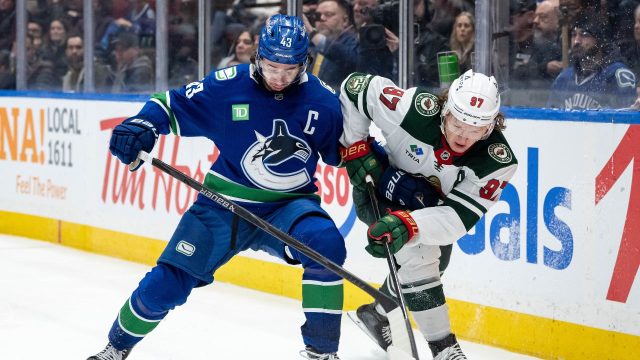
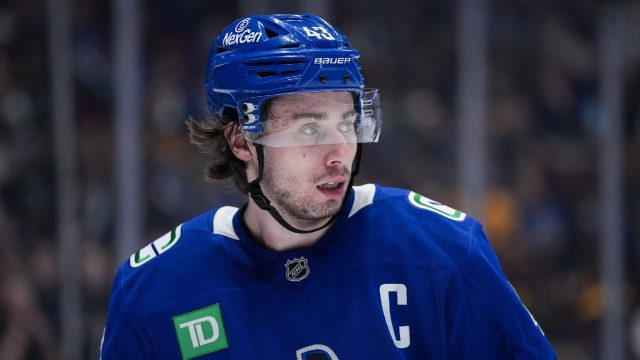
But that’s exactly what happened on Friday night, when the Quinn Hughes trade from Vancouver to Minnesota shook the hockey world.
For the Wild, it’s a big swing as general manager Bill Guerin pushes in his young chips to add the superstar and attempt to take a run at the Stanley Cup. Competing in a difficult Central Division led by a couple of well-established contenders in Dallas and Colorado, the Wild are hoping Hughes propels them into another tier.
Finally free from years of cap constraints for buying out Ryan Suter and Zach Parise, Guerin was looking for an opportunity and found it here.
Without any guarantee Hughes wants to stay in Minnesota beyond his current contract, the Wild will be able to take at least two playoff runs with Hughes on their blue line. He will be eligible to extend his contract this summer before becoming a free agent in 2027, but the advantage Minnesota has is that it will be able to offer Hughes a monster contract before new rules kick in that further limit term and signing bonus structure.
Still, a great day for one franchise brings sadness to the other.
This is the end of an era in Vancouver that certainly wasn’t as long as it should have been. From his rookie season in 2019-20 to his 16-point playoff showing in the 2020 bubble to a 10-point post-season performance in 2024 and a Norris Trophy, Hughes became the best player the Canucks have ever known. But in just his seventh season with the team, at 26 years old, he’s gone. The word “rebuild” now floats through corridors.
What the Canucks get out of the trade is an intriguing package of youth. Marco Rossi is an ascending young centre, winger Liam Ohgren was a first-rounder three years ago and Minnesota’s first-round pick will give Vancouver another prospect. Zeev Buium might be the crux of this deal, a rookie defenceman who has the unenviable task of replacing Hughes.
With Ohgren and Buium set to debut with the Canucks on Sunday (against Hughes’ brothers’ team in the Devils), and Rossi a possibility to return from injury, Jason Bukala gives you a deeper scouting perspective on how the new trio projects as NHLers.
Scout’s analysis
The Canucks were backed into a corner when it came to Hughes’ future. The organization has dealt with more than its share of unhappy players in recent years and the Hughes scenario was on the verge of turning into an out-of-control, grass-fire distraction if it wasn’t addressed sooner than later.
Now, the most dynamic player in franchise history is gone.
It’s difficult for me to wrap my mind around the fact this was a team that in 2024 appeared to be heading in a positive direction after finishing atop its division for the first time since 2013.
Today is a difficult day for Canucks fans, but the game goes on, and under the circumstances, I have to admit Vancouver’s management team did well to maximize Hughes’ value in the trade with Minnesota.
Here’s a look at what Canucks fans can now look forward to with the arrival of Rossi, Buium, Ohgren and a first-round draft pick.
Marco Rossi: 5-foot-9, 183 pounds, left-shot centre
Rossi is nearing a return from injury and when he arrives in Vancouver he will immediately fill a void at the centre-ice position in the Canucks’ top-six forward group.
The Austrian is a calculating player who’s reliable in all three zones. He’s best described as equal-parts shooter and distributor, but he also isn’t the kind of forward who will electrify the Canucks fan base with explosive skill off the rush or through the neutral zone. Rossi relies on his high-end hockey sense to read how plays are developing and reacts accordingly. He has great puck touch and vision overall. Despite his stature, he’s sturdy and strong in traffic and working off the boards while making plays to the net.
Rossi averaged 18:06 of ice time per game with the Wild. Almost all of his shifts came at even strength and on the power play. I believe he can contribute on the penalty kill if given the opportunity. An area that needs to improve is Rossi’s ability to win faceoffs, as he has a history of winning less than 50 per cent of his draws.
Rossi was the second leading scorer for the Wild last season (24 goals, 36 assists). Canucks fans will especially appreciate his vision and playmaking on the power play.
Zeev Buium, 6-foot-2, 181 pounds, left-shot defenceman
Buium, a 20-year-old rookie defenceman, is one of the most competitive prospects I have viewed in recent years. He’s a proven winner who was part of an NCAA championship program at the University of Denver and the gold-medal-winning Team USA world junior squad.
A two-way defenceman, Buium plays quick and fast. He’s aggressive taking away time and space defensively and active pinching down the wall in the offensive zone to extend plays. He was averaging just over 18 minutes per game with the Wild and was being deployed at even strength and the power play. Buium has contributed three goals and 11 assists so far this season but he’s also a minus-9. Young defenders take time to adjust to the speed and structure of the NHL game, and Buium is a better defender than that stat indicates, but it’s going to take time for him to adjust on the defensive side.
I view Buium as a future top-pairing defenceman for the Canucks. In time he will trend towards being a complete player. He has the ability to play well over 20 minutes per night and be used in a variety of roles.
Liam Ohgren, 6-foot-1, 196 pounds, left-shot winger
Ohgren is adjusting to life in the NHL. The 19th overall pick of the 2022 draft, he proved he can play a power/goal-scoring style in the AHL last season when he produced 19 goals and 18 assists in only 41 games.
Ohgren was averaging less than 10 minutes per game with the Wild and has yet to register a point this season. All of his ice time came at even strength. Despite his very limited deployment, Ohgren provided Minnesota with some physicality in the bottom of its lineup. He was credited with 29 hits in his limited role.
I project Ohgren as a third-line winger who will, in time, provide secondary offence and continue to push back physically. He isn’t the tallest prospect, but he’s plenty strong and willing to battle in the hard areas of the ice.
First-round pick
The Wild obviously have set their sights on competing for a Stanley Cup, and I don’t anticipate the team falling off after acquiring Hughes, so the first-round pick they traded to Vancouver is likely to land between 22 and 32 in the draft.
Here’s a look at what the Canucks draft board looks like for the next three cycles after the Hughes deal:
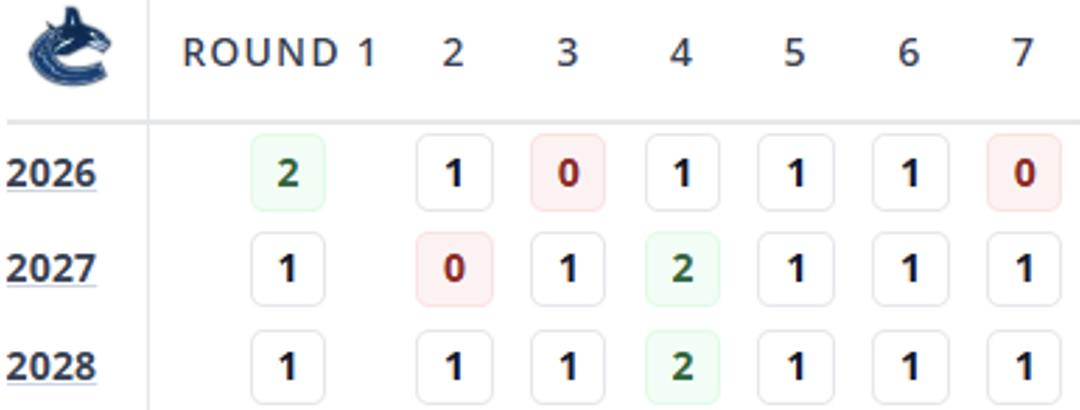
I recently revealed my first draft rankings for the 2026 class. For insight into who the Canucks might target in that range of the first-round, here is the link to my rankings.