The hockey world has been focused on the Olympics for the past two weeks, and there’s nothing like a best-on-best tournament. The men’s gold medal hockey game will go down as one of the best in history, with a level of speed, skill and physicality higher than we’ve witnessed before.
It also served as a reminder about how important the NHL Draft is.
Thirty-one of the 40 skaters who took to the ice for Team Canada and Team USA in the gold medal game were selected in the first round of the NHL Draft, and three of the four scratches were as well.
Just two years ago Macklin Celebrini was introduced as the first overall pick by the San Jose Sharks and he, at 19 years old, led the Olympic tournament in goals and finished second in points behind 2015 first overall pick Connor McDavid. Jack Hughes, the first overall pick in 2019, scored the golden goal, which was assisted on by Zach Werenski, the eighth overall pick in 2015.
Keep that in mind as we track the 2026 draft class. Will anyone who will be selected this June represent their country at the 2030 Olympics in France?
There was one draft eligible player who already represented his country at the Olympics, Latvian Alberts Smits. He turned 18 in December and was the youngest player to compete in the tournament. Four years ago Juraj Slafkovsky played for Slovakia at the Olympics in his draft year and captured the hearts of hockey fans in his country by scoring seven goals, being named tournament MVP, and winning a bronze medal. That performance certainly was one reason why Montreal took him first overall that season.
Though Smits plays a different position than Slafkovsky and wasn’t as dominant as he was, the Latvian defenceman turned a lot of heads and was seen in-person by several NHL general managers. Smits isn’t likely to end up as the first overall pick, but he’s putting himself in the conversation to be a top five selection.
This draft is top-heavy with defencemen. Keaton Verhoeff is still the leader of the pack, but he is being challenged by Smits, OHL Sault Ste. Marie’s Chase Reid, and WHLers Carson Carels, Daxon Rudolph and, to a lesser extent, Ryan Lin.
There remains a tight race for the No. 1 spot in this year’s draft. Last month’s No. 1 player, Ivar Stenberg, retains his position today as he continues to put up historic SHL numbers with Frolunda. But Gavin McKenna, who had an eight-point game last week, is back to resembling the player we saw in Medicine Hat last season. As scouts review everything in the coming months, this will be something to debate leading up to June.
This year’s first round projects to have a wide variety of skill sets for scouts to parse through. There are still more regular season games ahead, then playoffs and the world under-18 championship left for players to improve their draft status.
There are four months until the NHL Draft. And with that, here are our latest rankings:
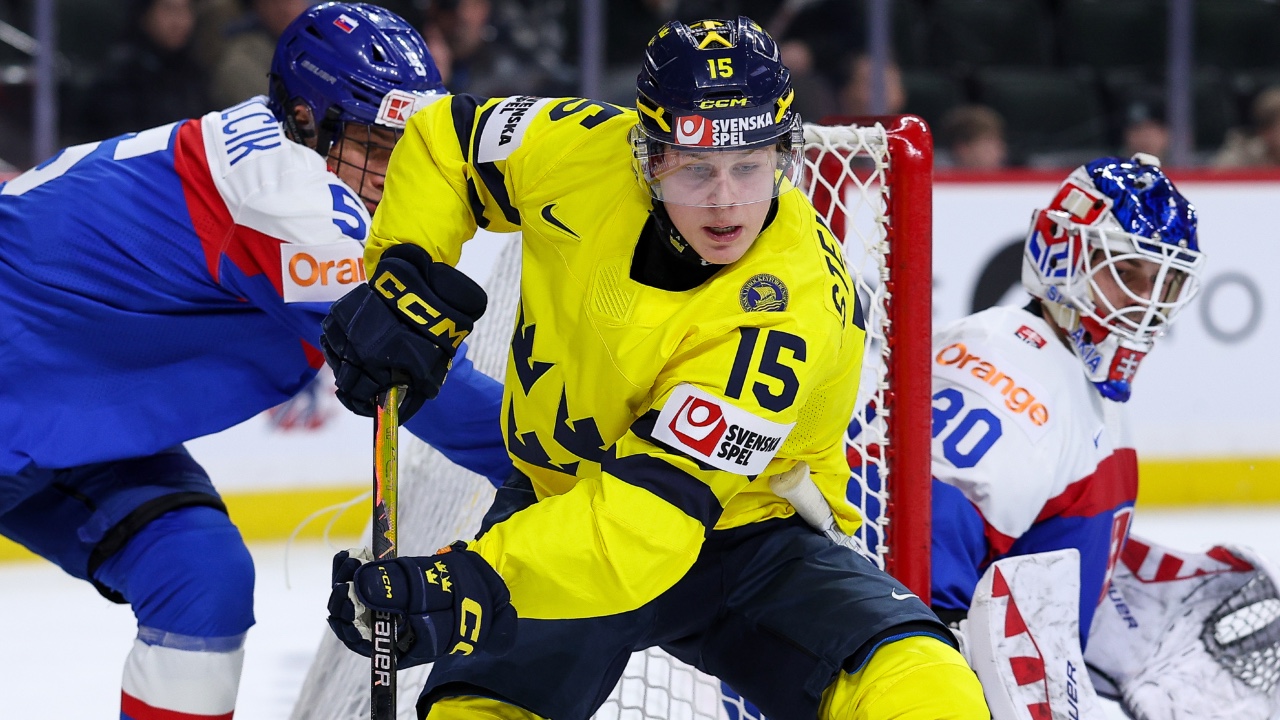
No. 1: Ivar Stenberg, LW, 5-foot-11, 183 pounds, Frolunda (SHL)
Many wondered if he would experience a drop-off in production going back to the SHL after the world juniors. That has not been the case, as Stenberg continues to pace himself towards the best draft-eligible season in SHL history. That record is owned by Daniel Sedin with 42 points in 50 games, followed by brother Henrik with 34 points. At time of writing, Stenberg has 32 points in 36 games played. But Stenberg’s status as the No. 1-ranked player is not just because of his point production. It’s his swagger, compete and the way he’s played under pressure that keeps him there for now.
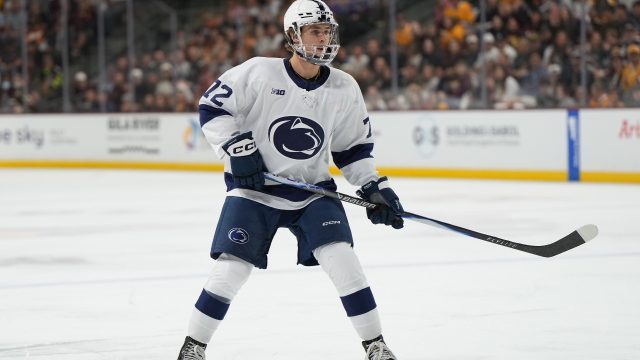
No. 2: Gavin McKenna, LW, 5-foot-11, 170 pounds, Penn State (NCAA)
Macklin Celebrini and Adam Fantilli are the most recent comparable to McKenna as far as players who went to college at this age. Three years ago, Celebrini had 32 goals and 64 points as a freshman at Boston University. Four years ago, Fantilli had 30 goals and 65 points as a freshman at Michigan. Both were Hobey Baker winners. Until recently, we hadn’t seen that level of production from McKenna, but the eight points he recorded in a Feb. 20 game against Ohio State set a school record and puts him on track to compete with those totals. More importantly, McKenna’s off-puck play and effort to be more responsible defensively have scouts excited.
No. 3: Keaton Verhoeff, RD, 6-foot-4, 208 pounds, North Dakota (NCAA)
Verhoeff has a high ceiling and possesses a variety of tools that scouts love. He has NHL size already, but still plenty of room to add strength, and there’s likely another small growth spurt ahead. His puck handles are good enough to evade oncoming forecheckers, make plays at the offensive blue line, and off the rush. There is some concern about his agility, but that is something that can be improved. Verhoeff has more runway than those above him because he’s a 2008 birthday — a midsummer birthday — which give him at least six months more of development time than either McKenna or Stenberg.
No. 4: Chase Reid, RD, 6-foot-2, 188 pounds, Sault Ste. Marie Greyhounds (OHL)
Reid brings a more dynamic game to the table than does Verhoeff, but that comes with some risk. Reid is excellent getting back on pucks and using his feet and elite passing ability to break them out. His fancy footwork allows him to walk the blue line and find lanes to get shots through, and he rarely passes up a shooting opportunity. His skating is amongst the best in this class, especially his speed and edge-work.
No. 5: Caleb Malhotra, C, 6-foot-1, 182 pounds, Brantford Bulldogs (OHL)
It’s all in the details with Malhotra. You have to watch him closely to appreciate all the subtleties in his game, which surely comes from his great athleticism, but also because he’s been around the game at a high level his whole life. Malhotra displays an elite two-way game where responsibility trumps risk. He knows where to go on the ice, how to use his stick and body position to win and protect pucks, and once free, he’s a dual threat as a playmaker and scorer. He still has lots of room for physical growth, which contributes to his vast potential.
No. 6: Alberts Smits, LD, 6-foot-3, 205 pounds Jukurit (Liiga)
Any player who competes at the Olympics in his draft-eligible season is surely one who turns heads. Smits has been doing that all year in Liiga play, but then went to the world juniors where Latvian coaches wore him out. He benefits from playing on a weak Liiga team, which has treated him to top pairing minutes all season long. The fact he also played so well at the Olympics for a weaker hockey nation in Latvia makes you wonder what he will develop into when he’s surrounded by elite talent. He has the confidence of a lion, NHL size and strength, and he proved he was able to keep pace against the best players in the world. His decision making and puck skills need work, but he looks like an NHL player right now.
-

-
32 Thoughts: The Podcast
Hockey fans already know the name, but this is not the blog. From Sportsnet, 32 Thoughts: The Podcast with NHL Insider Elliotte Friedman and Kyle Bukauskas is a weekly deep dive into the biggest news and interviews from the hockey world.

No. 7: Carson Carels, LD, 6-foot-2, 202 pounds, Prince George Cougars (WHL)
Exudes a confidence that permeates to whoever he’s playing with. He’s a field general out on the ice, taking charge of important situations. His family farming background speaks to the work ethic he displays on and off the ice. Carels continues to be leaned on in all key situations and has produced elite level offence in junior. While that production may not remain elite at the NHL level, he is defensively strong enough to maintain a top-pairing role.
No. 8: Viggo Bjorck, RW, 5-foot-9, 177 pounds, Djurgardens (SHL)
There is no question he will be overlooked by a number of teams based on his size. But his hockey IQ, skill set, and defensive awareness should allow him to play centre down the road in the NHL. Bjorck’s size doesn’t impact the way he plays. He is not deterred to do what it takes to win puck battles, regardless of the size of the opposition. He uses his smarts to take routes to pucks that don’t leave him exposed. And when there is contact, he’s like Mitch Marner in that he will accept it, but rarely at full force. He is masterful at finding good ice either for himself or his teammates.
No. 9: Tynan Lawrence, C, 6-foot-1, 185 pounds, Boston University (NCAA)
After scoring 17 points in 13 USHL games to start his season, Lawrence hasn’t been able to translate that level of offensive contribution to the college level yet. For the first time in this draft cycle, there is some doubt as to where he fits amongst the top centres in this draft class. Yes, there was plenty to like in the summer and the limited number of USHL games he played this year, but the college transition has proven to be a challenge. This isn’t entirely unexpected because of his age. College hockey is not easy and although chances are still being earned, the pure production expected from him has simply not followed. Should he get the chance to get back with Canada’s U18 team, he will be looking to regain his status as one of, if not the top, centres this class has to offer.
No. 10: Oscar Hemming, LW, 6-foot-4, 193 pounds, Boston College (NCAA)
The wait was worth it for scouts. The expectation for this player was that he was going to carry over his four-goal, six-point effort from the Hlinka-Gretzky into the regular season and continue to grow and develop. After a long layoff, Hemming has settled in nicely at Boston College, playing on a line with Bruins prospects James Hagens and Andre Gasseau. Hemming has put up two shots per game and has eight points in his 14 games played to this point. He exhibits power forward characteristics with how uses his frame to bump opponents and with his ability to drive the net.
No. 11: Daxon Rudolph, RD, 6-foot-3, 206 pounds, Prince Albert Raiders (WHL)
While his draft class peers Verhoeff, Carels, Reid and Smits were getting world junior reps, Rudolph kept on going with Prince Albert. He’s played 31 games since finding out he wasn’t going to be on Canada’s world junior team. He went without a point in seven of those, but in the other 24 Rudolph put up 16 goals and 39 points. He brings zest and flair to the table and no doubt leans to the offensive side. There are times where offence is too much of a focus that it detracts from the defensive side, but that will shift with maturity.
No. 12: Adam Novotny, LW, 6-foot-1, 204 pounds, Peterborough Petes (OHL)
From the second he showed up in Peterborough, Novotny has impressed coaches and players alike. He is a team-first player, who works tirelessly on his game both in the gym and on the ice. He plays a hard and honest game. In OHL competition, his strength allows him to clear space and produce top-level numbers. He rarely passes up a shooting opportunity and doesn’t need much time to really rip a puck. He looks like a pro, with intangibles that play all day. I’m not sure if the offence will follow him to NHL, but he’s a safe pick regardless.
No. 13: Oliver Suvanto, C, 6-foot-3, 207 pounds, Tappara (Liiga)
As one of the younger players in this draft class, there’s plenty of room for Suvanto to grow. It’s hard to believe that he’s maintained a serviceable spot in Tappara’s lineup all season at just 17 years old. It’s even more impressive that Tappara is the top club in Liiga. Suvanto is a power forward not so much for applying himself physically to intimidate opponents, but more because he understands how to use his body to be an effective cycle player who’s good along the wall and good at protecting pucks to extend plays. He shoots the puck well, but doesn’t shoot enough, with just 42 shots in 43 games to date. There is some playmaking ability here, but that should also get even better as his stick skills continue to develop.
No. 14: Marcus Nordmark, RW, 6-foot-2, 187 pounds, Djurgardens (Sweden J20)
His 12-point Hlinka tournament immediately engaged scouts and that springboard has lead to huge success at all levels of play this season. The international success is important in that it backs up his point-and-a-half per game numbers in the J20 league, where evaluation isn’t always easy. Most recently at the Five Nations tournament, he again performed at a top level, getting points in all four games for a seven-point event. Nordmark possesses top-notch puck-handling ability, he’s got deception in his game and he can get pucks to the net with speed and accuracy. He pays attention to his defensive game and can be relied on in a number of situations.
-
-
Real Kyper and Bourne
Nick Kypreos and Justin Bourne talk all things hockey with some of the biggest names in the game. Watch live every weekday on Sportsnet and Sportsnet+ — or listen live on Sportsnet 590 The FAN — from 4 p.m. to 6 p.m. ET.

No. 15: Ryan Lin, RD, 5-foot-11, 177 pounds, Vancouver Giants (WHL)
There are three similar-sized, elite-skating defencemen in the first round conversation of this draft. Lin tops the list that includes Xavier Villeneuve and Tommy Bleyl from the QMJHL. Lin is the most refined of the lot. He’s a dynamic skater, a highly effective puck-mover and is more than capable at defending. He has, however, been out of the lineup for over a month now and with Vancouver out of the playoff mix, he should have a few games before the end of the regular season to get ready to play for Canada at the U18 worlds. That test will go a long way in determining where he will wind up in this draft class.
No. 16: Ethan Belchetz, LW, 6-foot-5, 228 pounds, Windsor Spitfires (OHL)
There are so many ways in which he can impact the game, but at times it almost looks too easy. His hands are so good that they look out of place on a player this big. There’s no denying his elite shooting ability and the propensity to play a mean, power-forward game on demand. He’s not a speedster but gets to his spot mostly on time. For Belchetz, it’s about identifying early in a game what’s working and what’s not and then playing to the strengths present in that game and sticking with it.
No. 17: Nikita Klepov, LW, 6-foot, 180 pounds, Saginaw Spirit (OHL)
It’s been quite the breakout season for Klepov, who continues to produce top-end offence for Saginaw. He has more than doubled his point totals from USHL Sioux City last year, having surpassed the 30-goal and 81-point plateaus. Klepov can transport pucks and change pace on opponents when necessary. His puck touch is excellent and so is his ability to find open lanes to distribute. There’s plenty of creativity in his game.
No. 18: Ilia Morozov, C, 6-foot-3, 200 pounds, Miami (NCAA)
NHL Central Scouting boosted this player significantly in its January release, moving him up to the No. 8 spot among North American skaters after having been a ‘B’ ranked player back in October. Either he was under viewed at the start, or he has experienced steady growth throughout the season. I think it’s the latter. Oftentimes this is the case when young players enter the college ranks. While he has seen plenty of opportunity all season long, his confidence has grown and he is now a go-to in the Miami offensive scheme. Morozov gets after it most every shift and if he fails to produce, the tight and aggressive forechecking will no doubt create opportunities if not for himself than for his teammates.
No. 19: J.P. Hurlbert, LW, 5-foot-11, 176 pounds, Kamloops Blazers (WHL)
As a player who is extremely confident in his abilities, he can be guilty of passing up the simple play to try and execute a more difficult one. It’s easy to see why because he has an array of offensive tools. Hurlbert’s decision to leave the USNTDP to play for Kamloops was the right move at the right time. The development program is experiencing a down year, while Kamloops is always in the playoff mix. Head coach Shaun Clouston has a solid reputation for developing players whose games transition well to the pros. For Hurlbert, keeping the offensive game intact, while becoming a more responsible defensive player has been key.
No. 20: Xavier Villeneuve, LD, 5-foot-11, 172 pounds, Blainville-Boisbriand Armada (QMJHL)
It’s like having an extra forward when he’s on the ice. At any given moment, Villeneuve will take off and create havoc with his puck carrying skills. And if he turns it over or makes a mistake, he will get on his horse and be the first player back to correct the error. His competitive spirit is not only infectious, but it makes opponents aware that he’s a player who doesn’t shy away from physical contact, open-ice or along the wall. His season has been limited to just 35 points in 36 games and for that reason scouts are concerned about NHL durability, especially because of his size.

No. 21: William Hakansson, LD, 6-foot-4, 207 pounds, Lulea (SHL)
One of my favourite players in this draft class, Hakansson has a tremendous level of self awareness. He is a two-way defenceman whom I expect to add layers of offence as he matures and gains more experience. Currently, he defends well, pinning defenders low in the defensive zone and guarding the net-front with vigour. Once he has the puck, he makes smart decisions, whether waiting for breakout lanes to open or forcing the issue by transporting the puck. His all around game is solid and combined with a big frame, there’s plenty of value in this type of player. His offensive upside hasn’t even been completely unlocked yet.
No. 22: Juho Piiparinen, RD, 6-foot-1, 201 pounds, Tappara (Liiga)
Since the world juniors, Piiparinen has played games in both the U20 and Mestis leagues as Tappara continues to rule the roost in Liiga. This move has allowed him to play big minutes as opposed to getting inconsistent ice time when playing at the highest level. It’s also given him confidence to add more on the offensive end, although his projection is not as a big-time point getter, but more of a complementary, safe and sound partner. This should not be viewed as a bad thing, but his true value is defending, playing simple, moving pucks accurately and efficiently and eventually eating big minutes.
No. 23: Wyatt Cullen, LW, 6-foot, 172 pounds, USNTDP (USHL)
Of all the players currently outside of the top 20, Cullen will be the most fun to track to see if he can maintain healthy status through the World U18’s. The program has struggled mightily in league play and against college competition. The U18 tournament is the crowning jewel for the USNTDP so if he can lead the charge and right the ship during that event, Cullen has the chance to significantly raise his draft stock. As always, NHL bloodlines instantly add value, especially someone whose father (Matt Cullen) played over 1,500 NHL games.
No. 24: Alexander Command, C, 6-foot-1, 183 pounds, Orebro (Sweden J20)
He’s become a hot topic in the scouting world over the past month because he’s shown he has more than just a “B” game. And while the defensive foundation and high level of compete have not left his game, he’s proving that he can also produce at an elite level in the J20 loop. So much so that he’s earned SHL games as well. If his two-way game remains in place and the offence continues to peak, he will also be fascinating to track as we move closer to the draft.
No. 25: Liam Ruck, RW, 6-foot, 176 pounds, Medicine Hat Tigers (WHL)
At time of writing, his 84 points are second-most amongst all draft eligible players in the CHL. Oddly enough, the departures of McKenna and Cayden Lindstrom have opened up more opportunities for Ruck than he may have anticipated a year ago at this time. The fact Medicine Hat hasn’t missed a beat after losing those two players tells you a lot about Ruck (and brother Markus) and the game he brings to the Tigers on a nightly basis. He doesn’t dazzle you with individual skill, but he does make plays and his quick decision making allows him to pace the game as he wants. He’s represented Canada on a number of occasions. He’s won a WHL title, played in a Memorial Cup and is out to prove the Tigers are worthy as a back-to-back WHL title contenders.
No. 26: Mathis Preston, RW, 5-foot-11, 177 pounds, Vancouver Giants (WHL)
Preston looked to be re-energized after a trade from Spokane to Vancouver in early January. He got into two games with his new team, scoring an OT game-winner and adding three points, before suffering a knee injury in the middle of that second game. He’s been out of the lineup for over a month and remains week-to-week. Like Lin, Canada would love to have Preston available for the U18 worlds, and for a guy who’s had a roller-coaster of a season, the exposure would surely help. At his best, Preston brings great puck-handling skills and speed to the table, he’s strong on his skates, as he leans to the offensive side. The question is: how elite is his offence, and when it’s not present, will he check well enough to be able to maintain minutes in an NHL lineup as a top two-line player?
No. 27: Egor Shilov, C, 6-foot, 177 pounds, Victoriaville Tigres (QMJHL)
One of the most dynamic power play producers in this draft class, Shilov is slippery holding pucks along the wall. He darts away from defenders at the last second, leaving open-ice ahead of him and with that extra time he’s a dual threat to find open teammates or use his excellent stick and puck skills and quick release to get it to the net himself. There is some frustration watching his game in that maximum effort isn’t always present, but he’s inspired with the puck on his stick and is a threat every time he possesses it.
No. 28: Maddox Dagenais, C, 6-foot-4, 196 pounds, Quebec Remparts (QMJHL)
Continues to steadily rise. Dagenais benefits from being the son of a former NHLer (Pierre), but is carving his own path as a power forward. His last 10-game segment saw him score seven goals and 16 points. Dagenais has a shoot-first mentality, with a wicked shot that is both hard and accurate. Big, scoring centres are at the top of the food chain in the NHL and Dagenais certainly fits that bill.
No. 29: Nikita Shcherbakov, LD, 6-foot-5, 187 pounds, Ufa (Russia)
Always a fascinating study, this player looks every bit the part of an NHL player. His size goes without question, but his stick skills are elite for a player his size. The fact he didn’t produce a goal in 13 MHL games is mind-boggling. He’s currently on a run of VHL games where he’s playing second pairing minutes and all of a sudden you see a three-goal game mixed in with a few assists and one wonders why he even saw time in the MHL at all this season. So it goes with Russian players, where so many factors off the rink influence where and when a player plays. The cat is out of the bag on this guy, though, and he may end up going a lot higher than where this ranking has him. A player to watch in the coming months.
No. 30: Simas Ignatavicius, RW, 6-foot-3, 198 pounds, Geneva (SUI)
A dual US/Lithuanian citizen, Ignatavicius has quietly gone about his business representing Lithuania internationally and plying his trade in the Swiss league professionally. He is a bit of an unknown, and trying to get a handle on him in comparison to the rest of the draft class has to be done in a vacuum. He has size, is willing to go in on the forecheck, he’s smart and selective in terms of positioning and he skates well. His puck handles are more than adequate and he has a history of producing in low level international play. With all of that said, a team will have to be confident everything will translate against better competition, and ultimately at the NHL level. He would be best served to find a spot in North America against competition his age next season, in order to hasten his development.
No. 31: Brooks Rogowski, C, 6-foot-7, 235 pounds, Oshawa Generals (OHL)
This is a player who needs to grow into his body. While he’s not awkward in moving around, he could stand to be more fluid and agile in his movements. Surely this will come with increased strength and the necessary time needed to catch up to his body. For the most part, he plays a simple, straight line game. He will go to the net, win board battles and generally compete consistently. He could stand to be harder on pucks and on his skates. A more bullish approach where he strikes fear in opponents is an element that also needs to develop. No doubt, the club that takes him will have to be patient. Think Dean Letourneau, Boston’s first-rounder from 2024.
No. 32: Tobias Trejbal, G, 6-foot-4, 190 pounds Youngstown (USHL)
Right-catching goalies always provide intrigue at the draft. We saw it last year when Josh Ravensbergen emerged as the top goalie when he was selected by San Jose with the 30th pick. I feel like Trejbal will be picked in the same area of the draft. He’s similar in size and stature to Ravensbergen, but looks to be more polished and refined. Trejbal moves well from post-to-post and does a great job squaring up to shooters and directing rebounds away from trouble. Shots at him stick and he rarely shows panic in his game. He is a major reason why Youngstown is the top team in the USHL and he has a presence in each of the three major goalie stat categories.