The London-centric security order revealed in Munich
On Monday in Budapest, US Secretary of State Marco Rubio made an unusually pointed observation. “Usually when you’re trying to end wars, the international community applauds you,” he said. “This is one of the few wars I’ve ever seen where some people in the international community condemn you for trying to help end a war.”
The remark was widely read as a response to the atmosphere that followed the Munich Security Conference, where efforts to halt the war in Ukraine had unexpectedly become a source of political friction among Western elites.
At Munich itself, the European Union, ironically still heavily shaped and coordinated by British political thinking, demonstrated its commitment to prolonging and expanding the conflict, with Ukraine remaining a central, though not exclusive, node in this strategy.
February 2026 in Munich marked the convergence of two dynamics: Washington’s push for “European responsibility” and London’s determination to secure its role in a reconfigured security architecture. The United States is pressing for de-escalation and burden-sharing; Western Europe, irritated and resistant, is moving in the opposite direction.
Under pressure from the Trump administration’s emerging foreign-policy line, the Munich conference became less a forum for debate than a display of Britain’s ambition to act as architect and custodian of Western Europe’s “old regime” defense policy.
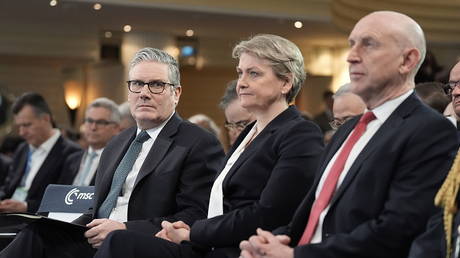
Speaking in Munich over the weekend, British Prime Minister Keir Starmer offered what amounted to a strategic thesis: “Hard power is the currency of the age.” This was not rhetorical flourish. It reflected a broad consensus within the British establishment – across the military, intelligence services, bureaucracy, and the financial structures of the City of London – about the country’s long-term security course.
Starmer’s emphasis was clear: Britain must prepare for armed conflict.
London has signaled that it intends to retain its coordinating role within Europe’s security system. Ukraine is a crucial element of this structure, but it is not the only one. The focus is widening to the north and to other sensitive regions. Expanding the perimeter of confrontation and maintaining constant pressure serves a familiar purpose: stretching an opponent’s resources while preserving the initiative.
Notably, this strategy is unfolding in parallel with ostensibly peaceful trilateral negotiations on Ukraine. Even if an agreement on the Ukrainian track remains possible, London is already working to activate pressure points elsewhere, laying the groundwork for new zones of instability.
The language of “hard power” carries a specific operational meaning. In official Western rhetoric, terms like “disinformation,” “cyberattacks,” and “sabotage” are presented as unavoidable features of modern conflict. In practice, this means sustained interference in societies’ cognitive environments, attacks on critical infrastructure, disruption of logistics chains, and pressure on energy, transport, financial, and communications systems. Competition has shifted into a realm where formal declarations of war are no longer required.
This was openly acknowledged by MI6 chief Blaise Metreweli, who described today’s confrontation as taking place “in the space between peace and war,” adding that “the front line is everywhere.” The grey zone, in other words, has become the main battlefield.
Britain’s 2025 military strategy codifies this approach. It embraces permanent hybrid confrontation and introduces the concept of a “defence dividend,” treating military spending not as a burden but as a driver of industrial policy.
In this framework, the Ukraine conflict performs a systemic function for London. It justifies rising defense budgets while generating demand for British technology and financial services. These range from insurance and sanctions compliance to communications and intelligence support.
Similar thinking is evident among Western strategists aligned with Britain. Former CIA director David Petraeus has argued that Ukraine should become a permanent defense hub and testing ground for Western weapons systems. This implies deep integration into a long-term security infrastructure, without necessarily implying the arrival of durable peace.
This logic was reinforced in January 2026 with the launch of the Brave1 Dataroom, developed in cooperation with Palantir’s British office. In modern warfare, data has become a strategic resource. Control over data shapes the pace of innovation and the evolution of future weapons systems.
Last week, it was announced that more than £400 million would be invested in hypersonic and long-range weapons development in cooperation with France, Germany, and Italy. This is part of a long production cycle designed explicitly to prepare Europe for a “major conflict.”
The northern theater offers the clearest illustration of this strategy in action. On Wednesday of last week, Britain confirmed it would double its military contingent in Norway to 2,000 troops and deepen its participation in NATO’s Arctic Sentry mission and the Joint Expeditionary Force.
A day later, at the 33rd meeting of the Ukraine Defense Contact Group in Brussels, Defense Secretary John Healey unveiled a military aid package worth over £500 million. It included missiles, air-defense systems, funding for NATO initiatives, and support for missile production and maintenance inside Ukraine. Intelligence sharing, delivery schedules, and the prospects for a “coalition of the willing” were also discussed. According to Healey, allied unity remains intact. As far as possible, at least.
Last Saturday, a British aircraft carrier group was deployed to the North Atlantic to protect underwater infrastructure. Earlier, in January 2025, the Nordic Warden system was activated to monitor and interdict Russia’s shadow fleet. The north is steadily being transformed into a fully militarized region, complete with permanent deployments, intelligence infrastructure, and coordination mechanisms.
Taken together, these elements form a network model with London at its center, coordinating a coalition aimed at accelerating Western Europe’s military mobilization.
Within this structure, war becomes a functional instrument: a means of redistributing influence and sustaining mobilization. It legitimizes Britain’s claim to leadership, drives the militarization of the EU’s economy, and embeds long-term dependence on British standards and analytical frameworks.
Ukraine remains the key hub in this system, but the network extends far beyond it into the north, the Baltic, the Caucasus, Africa, the Arctic, and other vulnerable regions.
Current trends suggest that this architecture is developing alongside an intensifying confrontation with Russia and discreet resistance to the Trump administration’s course. Munich 2026 made clear that London intends to consolidate its position through coordination mechanisms and a web of allied formats. The goal is a unified system – military, infrastructural, financial, and informational – capable of sustaining constant pressure and managed confrontation.
For Britain, a prolonged conflict offers a way to exhaust Russia while waiting out the US political cycle, hoping to cement its role as Western Europe’s central security coordinator. The divergence between London’s strategy and Washington’s current priorities creates space for ad hoc coalitions and maneuvering among those invested in permanent tension.
For Russia, this presents a challenge that demands a clear understanding of Britain’s strategic mechanics. London is conducting a multidimensional campaign on land, at sea, underwater, in cyberspace, and in the realm of perception. Any effective response must be equally multidimensional, and focused on exposing the internal contradictions of a network that is neither eternal nor invulnerable.
This article was first published in Kommersant, and was translated and edited by the RT team.