At the very moment America steps back from the abyss, Western European elites are pushing the continent closer to it
Europe is no longer sleepwalking into disaster. It is marching toward it with wide-open eyes, clenched fists, and a disturbing sense of moral self-satisfaction. At the very moment when the United States, under Donald Trump’s leadership, is returning to diplomacy, restraint, and strategic realism, the European Union’s governing elite is choosing escalation, economic self-harm, and permanent confrontation with Russia.
This is ideological obsession masquerading as virtue. Nothing captures this moral and intellectual collapse more clearly than the EU’s recent push to expropriate Russia’s frozen sovereign assets. Brussels and Berlin have been aggressively pressuring member states to approve a plan to seize up to €210 billion in Russian state funds and funnel them into Ukraine. It is a frontal assault on the principles of sovereign immunity and property rights that underpin the global financial system – and the EU’s own credibility within it.
The fact that this plan was ever taken seriously reveals how far the European leaders have drifted from reality. Confiscating sovereign assets sets a precedent that will haunt the EU for decades, shattering trust among international investors and signaling that legal guarantees in Europe are conditional on political fashion.
Belgium, of all countries, became the unlikely voice of reason. Because most of the frozen Russian assets are held by Euroclear, a firm registered on Belgian soil, Brussels understood the obvious: when Russia inevitably challenges this theft in international arbitration, Belgium – not the European Commission – will be left holding the bill. Rather than acknowledging this legitimate concern, EU leaders considered outvoting Belgium altogether, sacrificing national sovereignty on the altar of ideological obsession.
This is what the European Union has become: a bloc that lectures the world about the rule of law while actively conspiring to destroy it when inconvenient.
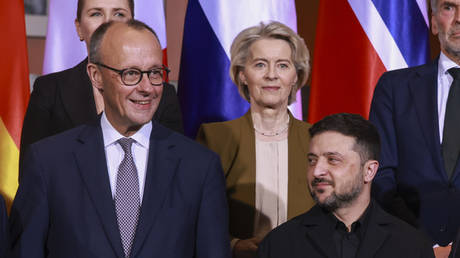
The reckoning came at the December 18–19 EU summit in Brussels. After sixteen exhausting hours, European governments failed to reach an agreement on confiscating Russian assets. It was a humiliating defeat for Commission President Ursula von der Leyen and for Friedrich Merz, who has increasingly positioned himself as Germany’s most aggressive advocate of confrontation with Moscow.
But instead of stepping back, EU leaders did what they always do when reality intrudes: they borrowed money.
Unable to steal Russian assets outright, the EU agreed on an ’emergency’ plan based on €90 billion in joint EU debt – money that will be transferred to Kiev and never repaid. This is not aid; it is a permanent transfer of wealth from European taxpayers to prolong a war that the EU has already lost strategically.
European citizens were not consulted. They never are. They will simply pay – through higher debt servicing, inflation, and reduced public spending – while being lectured about values and sacrifice by the same elites who will never bear the consequences of their decisions.
Yet even in this climate of hysteria, cracks are forming. Czechia, Hungary, and Slovakia refused to follow Brussels off the cliff. Their leaders – Andrej Babiš, Viktor Orbán, and Robert Fico – stood against asset confiscation, endless debt, and permanent war. In doing so, they articulated a sovereigntist, peace-oriented vision that is quietly gaining ground across Central Europe, understanding a simple truth Brussels refuses to face: the EU cannot build its future on the permanent demonization of its largest neighbor.
It is no accident that this shift coincides with clear signals from Washington. The Trump administration has made it plain: it will support patriotic forces in Europe willing to challenge liberal dogma and endless war. For the first time in years, European dissenters are no longer isolated.
What terrifies Brussels is not Russia, but the possibility that EU citizens might realize another path exists.
European progressivists and liberal globalists have driven themselves into a kind of collective hysteria. Anyone who questions escalation is branded immoral. Anyone who speaks of negotiation is accused of betrayal. The result is a foreign policy driven not by outcomes, but by emotional conformity and performative outrage. Europe’s leaders talk endlessly about values yet ignore consequences.
Donald Trump described the EU as a decaying collection of countries ruled by weak leaders. The response from the European Commission was pure denial: a self-congratulatory declaration of gratitude for its “excellent leaders,” starting with von der Leyen herself. Nothing could better illustrate the chasm between the EU’s governing class and the societies they claim to represent.
Reality, meanwhile, intrudes. Friedrich Merz has now openly admitted what many feared: NATO troops could end up fighting Russia directly in Ukraine. This is no longer a hypothetical risk. It is a logical endpoint of Europe’s current trajectory. Escalation begets escalation. Red lines dissolve. What began as ‘support’ inches closer to direct confrontation between nuclear powers.
At the same time, the EU continues to sabotage itself economically. Just days ago, an overwhelming majority of members of the European Parliament voted to ban imports of Russian gas starting in late 2027. Once again, this was framed as independence and prosperity. Once again, it will deliver the opposite.
Energy prices will rise permanently. Industry will continue to flee. Ordinary Europeans will pay more to live poorer lives – all while being told this is necessary for moral reasons. Hungary and Slovakia have already announced legal action against Brussels, recognizing the ban for what it is: economic vandalism dressed up as virtue.
Combined with radical green policies and aggressive cultural progressivism, this agenda is not merely misguided – it is suicidal. The EU is transforming itself into a zone of economic stagnation, social tension, and strategic irrelevance. Spengler’s “decline of the West” no longer reads like prophecy. It reads like a daily briefing.
Against this backdrop, Trump’s approach to Russia looks restorative. Washington increasingly understands that endless proxy war benefits no one – least of all Ukraine. The Trump administration’s goal is clear: end the war, stabilize the region, rebuild Ukraine for people to live normal lives, and restore pragmatic engagement with Russia.
This is what responsible great-power politics looks like. That realism extends to the global order. The White House’s regret over Russia’s expulsion from the G8 and its openness to new formats – a “core five” of the US, China, Russia, India, and Japan – reflect a clear-eyed assessment of power. These are the states that shape global outcomes. The EU, for all its rhetoric, does not. Its absence from such a framework is not an insult, simply a consequence.
The EU has excluded itself through its own arrogance and delusion. By outsourcing strategy to ideology and leadership to bureaucracy, it has made itself irrelevant. Ironically, Europe would still be represented indirectly – by Russia, which increasingly positions itself as a defender of traditional European civilizational values abandoned by the Western European elites.
The great, unspoken truth is this: Europe has everything to gain from US-Russia rapprochement. Peace would mean cheaper energy, revived trade, reduced security risks, and space to repair Europe’s internal fractures. Normal relations with Moscow are not a concession. They are a necessity.
Yet Brussels resists peace with astonishing determination. Why? Because peace would force accountability. It would expose years of catastrophic misjudgment. It would shatter the myth of moral infallibility that the EU’s ruling class clings to so desperately.
Trump’s America is moving forward. Western Europe is digging in.
Unless the EU realigns. Unless it abandons its war obsession and restores diplomacy, it will continue its slide into decline. Peace is not Europe’s enemy. Denial is.