Real world oil prices are far higher than the figures seen on TV news reports
When the first US and Israeli missiles hit Iran more than a month ago, an oil price of $150 per barrel was considered a doomsday prediction. But the price of physical Brent crude is already a hair’s breadth from $150, while the futures price hasn’t caught up yet.
The Brent front-month futures price – which serves as a barometer for 80% of the world’s crude oil – has sat above $100 per barrel for several weeks. Rising and falling as US President Donald Trump changes the war’s aims and end date, it closed above $109 on Thursday, already higher than at any point since the Ukraine conflict escalated in early 2022.
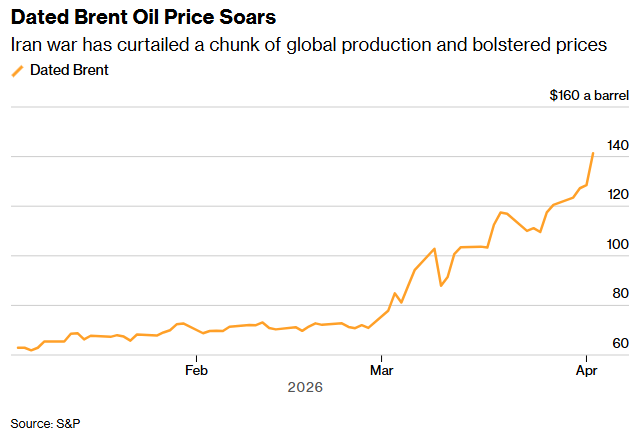
But to understand just how severe the current crisis is becoming, it’s important to look at the Dated Brent price. Only widely monitored during times of market disruption, this represents the actual on-the-spot price that purchasers are paying for Brent cargoes in the North Sea. On Thursday, it reached $141.37, a level unseen since the onset of the 2008 financial crisis.
© S&P
This speaks to a severe supply shortage on the ground as buyers are willing to pay a huge premium to get their hands on barrels, not in the near future, but right now.
What is the significance of the huge spread?
What newspapers and broadcasters typically show is the front-month Brent price: bought by traders for delivery on a specific date the following month. This is the most liquid and widely quoted benchmark. Importantly, pricing reflects future expectations, so in this case investors are betting on at least some kind of deescalation and denouement in the Persian Gulf.
The front-month is also the domain of speculators who have no intention of ever receiving any oil: instead they seek to take advantage of price shifts and exit their positions before delivery. The front-month price does of course reflect physical realities – but it’s also somewhat financialized.
The fact that actual physical Brent crude is moving at prices $32 higher than the front-month indicates that the physical supply of oil is extremely tight. Typically, the spread between the front-month contract and Dated Brent is less than $2, although in a tight market it can drift somewhat higher. What we are seeing now is highly abnormal. This higher Dated Brent price isn’t the result of hedge funds or momentum traders bidding up the price. This is what is changing hands on the ground for real barrels.
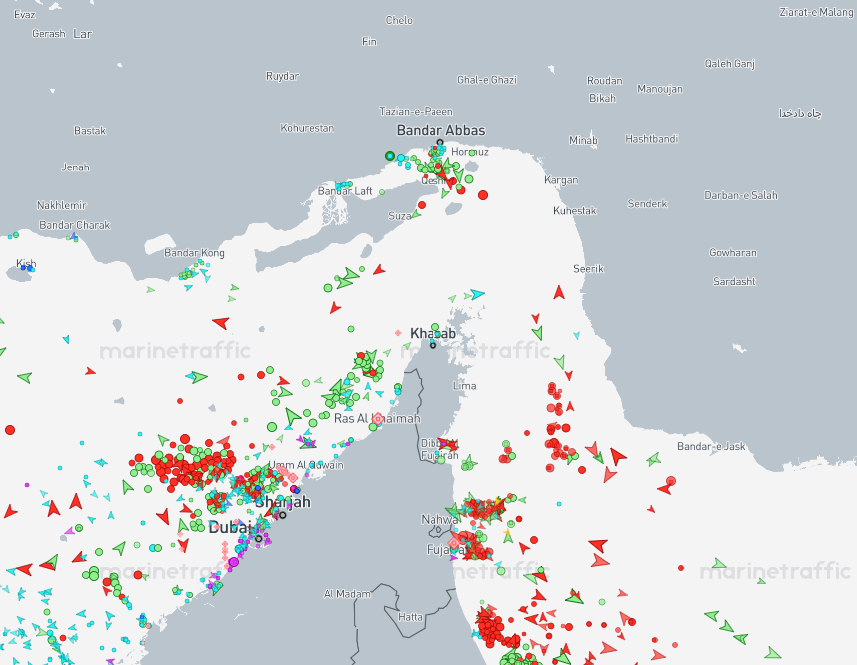
The epicenter of the crisis is the Strait of Hormuz. A lot depends on what happens in this chokepoint. Less than 40km wide at its narrowest point, just under a third of the world’s seaborne oil transits the strait on its way from Middle Eastern producers to global markets.
© MarineTraffic
Once a free international waterway, the strait has been turned into a de-facto toll road overseen by the Iranian military. Iran’s Islamic Revolutionary Guard Corps (IRGC) decides which vessels are allowed through, with limited numbers of Chinese, Indian, Pakistani, and South African ships making the passage in recent weeks. Daily transits have fallen from around 130 before the war, to low single figures last month, and around a dozen this week.
Why isn’t front-month Brent trading closer to the spot market?
Based on the price difference, the Brent futures market is still relatively sanguine about the prospects for a resolution. Some analysts, however, believe the market isn’t fully reckoning with the supply shortage that is now driving spot prices through the roof. There is also the typical internet chatter about the futures market being manipulated to keep some kind of lid on oil prices. In other words, the big spread is garnering a lot of attention.
Meanwhile, there is no sign that normal traffic will resume in the Strait of Hormuz anytime soon. US President Donald Trump has swung between declaring the passage open, telling shipping companies to “have courage” and sail through it regardless, vowing that the US will open it, and telling his allies to deal with the closure themselves. The messaging, and Trump’s timeline for an end to the conflict, changes day by day.
Looking at other benchmarks, there are signs of a deepening crisis. Dubai and Omani oil is now selling for well above $150, reflecting the difficulty these Gulf nations have in exporting their product, while West Texas Intermediate (WTI) – priced in landlocked Oklahoma – surpassed Brent by $3 on Thursday. This indicates that traders predict further uncertainties with the supply of seaborne Brent, and are pivoting toward American crude instead.
Additionally, the WTI crude prompt spread (price difference between the two nearest contracts) widened to more than $16 per barrel on Thursday, the largest premium on record. This type of widening spread is often due to short-sellers who had bet on a price drop (in this case due to a quick end to the war) getting squeezed and buying back contracts to close their positions, in turn driving up front-month prices.
How high will oil go?
The vast spread between what hedge fund traders see on their Bloomberg terminals and what buyers are paying right now is a glaring red flag, suggesting a massive supply crunch. Physical oil prices are closing in on the psychological barrier of $150, and analysts have readjusted their worst case scenario predictions, with CNN declaring on Thursday that should the conflict drag on until June, a front-month price of $200 “isn’t as crazy as it sounds.” Left unsaid is the fact that at a front-month price of $200, the spot price would almost certainly be even higher.
Zooming out from Brent and WTI, there are dozens of different oil prices, representing more than 100 different blends of crude, their spot prices, and their varying futures contracts. All are higher than they were in February, and for the average person around the world the result is the same: the war on Iran has made fuel, food, and basic necessities more expensive, and life tougher.
“Global recession is already inevitable this year, with energy-importing countries being hit the hardest,” Russian presidential envoy Kirill Dmitriev warned on Thursday. “This will become clear to many by June.”