DUNEDIN, Fla. — Last season, the Toronto Blue Jays used 24 different position players, from Michael Stefanic and Ali Sanchez to Will Robertson and Buddy Kennedy. They got innings from 34 pitchers, including Ryan Borucki, Josh Walker, Robinson Pina and Casey Lawrence.
And by the time late September rolls around, the 2026 Blue Jays will almost certainly have utilized upward of 55 players again to withstand the attrition inherent to professional sport’s most gruelling regular season.
With that in mind, here are three players who have yet to make their MLB debuts who will begin the year in the Blue Jays minor-league system positioned to backfill the major-league roster in the coming months when needs inevitably arise.
The third catcher: Brandon Valenzuela
It was about a decade ago when Brandon Valenzuela, then a teenaged academy player with Diabolos Rojos del Mexico, first encountered the stout, unassuming Toros de Tijuana catcher with soft hands and a loud bat: Alejandro Kirk.
“Oh, he was the man,” Valenzuela said. “He led the league in doubles, RBIs, steals. Yeah, back then he was stealing bases. He’d surprise people. He’s so athletic.”
-
-
MLB on Sportsnet
Watch the Toronto Blue Jays, Blue Jays Central pre-game, marquee MLB matchups, Jays in 30, original documentaries, the wild card, divisional series, championship series and entire World Series on Sportsnet and Sportsnet+.

So, imagine the moment in the Buffalo Bisons clubhouse last August when, only a day after Valenzuela arrived for his debut following a deadline trade to the Blue Jays, that stocky one-time academy opponent walked through the door.
Kirk was on the concussion IL and joining the Bisons for a one-game rehab assignment. The pair had never officially met, although Kirk remembered Valenzuela from back in the day. So, the Blue Jays starting catcher came over, introduced himself, and invited Valenzuela out for dinner.
“I was a little surprised. I didn’t know he was going to be there,” Valenzuela said. “He basically just told me to be myself. ‘The team likes the way you play. So, don’t do anything you wouldn’t do in the other org. Because that’s what they liked — what you were doing. So, just keep being yourself.’”
The Blue Jays indeed like plenty about Valenzuela, a switch-hitting, defensively sound catcher with a big arm and quick release. Toronto developers believe they can coax a bit more contact out of his swing without sacrificing the pop Valenzuela has already demonstrated during his short time in the system. The 25-year-old posted a 110-m.p.h. max exit velocity last season and his average exit velocity this spring was second on the Blue Jays to — who else? — Kirk.
Behind the plate, Valenzuela made the most of an opportunity to work consistently with Blue Jays starters while Kirk was playing for Mexico at the World Baseball Classic, gaining valuable experience should his services be needed in the majors this season. And considering how demanding his position can be, that’s a likely scenario. Both Kirk and backup Tyler Heineman spent time on the IL last year.
“The first week of camp, I was like, ‘Damn, I’m surrounded by some serious guys,’” said Valenzuela, who was in Toronto catching bullpens during the Blue Jays post-season run in October. “Gausman, Scherzer, Cease. These guys are so good and so serious. So, I had to get caught up really fast. But it’s helped having Kirk in my corner. He’s been helping me out, pushing me forward. He’s made it a lot easier for me.”
The left-handed reliever: Javen Coleman
Javen Coleman carries a draft-day grudge everywhere he goes.
A top-ranked left-hander out of Texas who committed to pitch for LSU when he was only 16, Coleman struggled as a freshman, had Tommy John surgery as a sophomore, won a College World Series with Paul Skenes and Dylan Crews as a junior, returned for a senior season after being drafted by the Dodgers but failing to reach a bonus agreement, and went unselected upon re-entering the draft a year later.
“I kind of took it as disrespect,” he said. “Obviously, I didn’t have a great college career. But I still walk around with a big chip on my shoulder.”
The Blue Jays scooped him up as a free agent shorty after the draft, helped him properly heal a shoulder impingement he’d battled throughout his time at LSU, and went to work on ironing out command issues that led to an unsightly 15.8 per cent walk rate over his four NCAA seasons. They didn’t let him pitch a game until 2025, when he debuted as an overage player in A-ball. But he’s looked like a completely different guy ever since.
Converted to full-time relief, Coleman pitched to a 3.00 ERA over 38 appearances between Dunedin and high-A Vancouver, running a massive 27.8 per cent strikeout-minus-walk rate. Throwing strikes consistently for the first time in years, Coleman showed off a mid-90s fastball with a flattened approach angle, thanks to a low release height and over 18 inches of induced vertical break.
That pitch is enough to miss plenty of bats on its own, but Coleman also mixes in a slider for left-handed hitters and splitter for righties. And the ability to command all three of them effectively has completely changed his game from a couple years ago, when no team wanted to draft him.
“At LSU, the only pitch I could land was a fastball. So, having three pitches now, it opens up a lot of doors for me. It feels good when they put a pitch down and I’m like, ‘OK, I know that’s going to go to where I want it,’” Coleman said. “That’s given me a lot more confidence. I worked on it a lot this past off season. It was like, ‘Hey, if I can fill the strike zone up with every pitch, I’ll be completely unpredictable.’”
Left-handed college relievers with stuff like Coleman’s can rocket through the minors if they’re consistently throwing strikes and getting quick outs. And the Blue Jays gave the 24-year-old a crash course of situational opportunities in his first big-league camp this spring, asking him to pitch middle innings, protect a tight lead in the eighth, close a game, enter early with one out and a runner in scoring position to face big-leaguers, and pitch multiple innings.
It looked a lot like a team exposing a promising young reliever to a variety of circumstances he could be asked to navigate if he reached the majors sometime soon. The Blue Jays begin 2026 well-covered with left-handed relievers in or near the big-league bullpen — Brendon Little, Mason Fluharty, Joe Mantiply, Adam Macko. But on the path from undrafted free agent to big-league pitcher, Coleman is already a lot closer to the destination than to where he began.
“I’m super excited and super grateful for the opportunities I’ve gotten. It’s all I can ask for,” he said. “Being a UDFA, you want to prove everyone wrong. But at the end of the day, if you put the work in and you show what you can do, it doesn’t really matter how you get your opportunity. It’s about seizing it and following through with what you set out to do.”
The depth starter: CJ Van Eyk
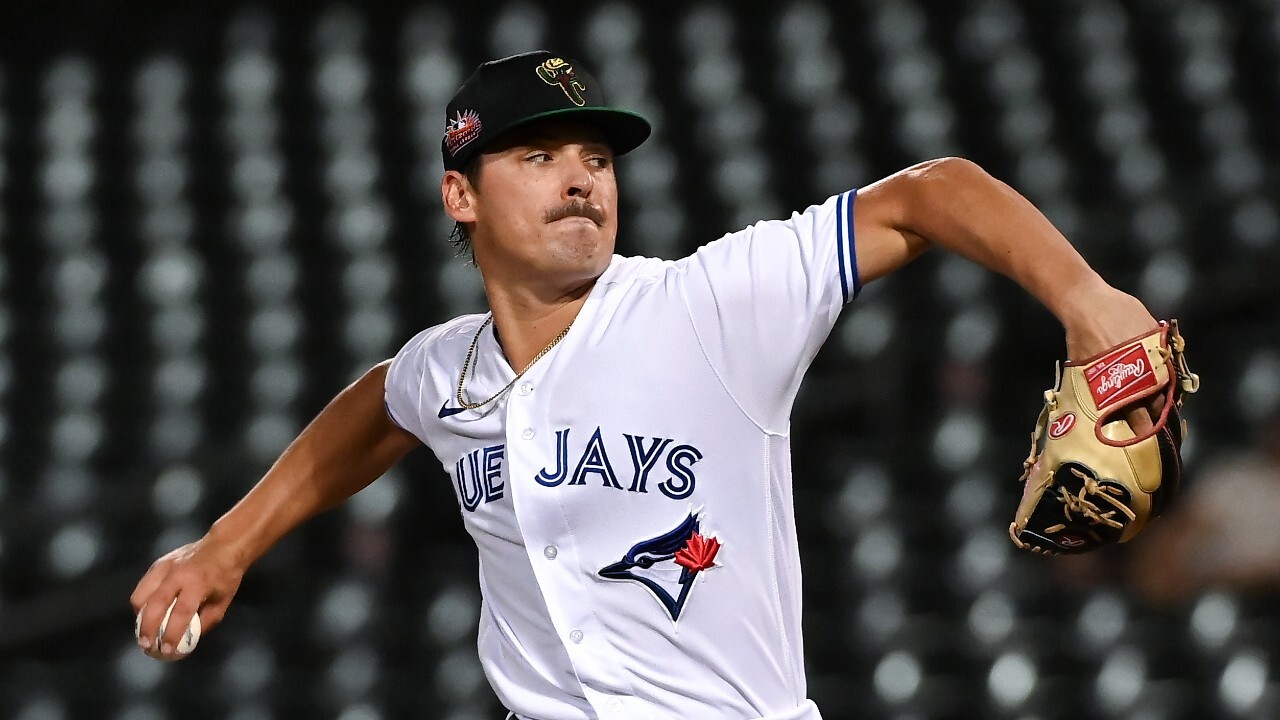
After throwing 126 minor-league innings in 2025, setting a career-high in his third season since returning from Tommy John surgery, CJ Van Eyk could have called it a year. But he wanted to prove something to himself and his organization by continuing to accumulate volume, so he packed his stuff and headed for Mexico where he piled 49.2 innings on top of an already substantial workload.
And those innings, spread across nine starts, ended up being some of the best he’s thrown as a professional. Van Eyk pitched to a 2.90 ERA with strong peripherals — 25.4 K percentage; 7.2 BB percentage — while allowing only two home runs. He was so dependable that when his contract came up around American Thanksgiving, Van Eyk’s team — Aguilas de Mexicali — extended him a more lucrative one to entice him to stick around and keep pitching.
“It was an intense atmosphere. And that’s why I really liked it. I think I thrive on pressure,” Van Eyk said. “I didn’t know PitchCom’s went up to 20. But I had to turn mine up to 20 multiple times.”
Van Eyk also used his time in Mexico to continue refining his sinker and a new sweeper against right-handed hitters, who gave him trouble over the first half of the 2025 minor-league season.
Van Eyk upped his sweeper usage considerably over the final two months of the year and found success with it, earning a whiff 34 per cent of the time hitters swung at it. It’s a pitch he picked up early in the year to give him a better bat-missing weapon for righties than the gyro slider he’d relied upon in the past.
Of course, the original slider is still a part of his repertoire, as is a four-seamer, sinker, curveball and changeup. He’s sinker-dominant against righties while leading with his four-seamer to lefties. Both heaters sit 93-m.p.h. but can climb as high as 96.
Van Eyk’s curve continues to be his best — and often most-used — pitch. Opponents hit .215 against it while whiffing 31 per cent of the time in 2025. But if he can continue to see success with the sweeper, he’ll have multiple breaking balls to play off a pair of fastball shapes, plus an off-speed pitch to give him the kind of varied attack required to turn a lineup over in the majors.
The Blue Jays experimented with using Van Eyk out of the bullpen around the middle of last season but he’ll enter 2026 as a starter filling an area of need. After trading away Khal Stephen, Kendrys Rojas and Juaron Watts-Brown — three starters who would have been part of Buffalo’s rotation this year — at last July’s deadline, the organization has a void of upper-minors starting depth.
Macko will be used as a one-trip-through reliever going forward. Ricky Tiedeman and Chad Dallas will have their workloads managed coming off Tommy John surgery and likely pitch tandem outings with one another. Yariel Rodriguez may be used as a starter out of necessity but that experiment has already been run unsuccessfully at the major-league level.
That puts a pitcher like Van Eyk on the cusp of the majors, particularly now that Trey Yesavage and Jose Berrios will be joining Shane Bieber on the season-opening injured list. And the adjustments he made in 2025 showed he’s not done searching for ways to improve, even now that he’s a half-dozen years removed from being a 2020 second-round pick.
“I got up to 176 innings, which I was really happy with. I proved that I could do that,” Van Eyk said. “And I felt pretty good. Hopefully, we can increase it a little bit more again this year. I guess we’re going to run out of games in Buffalo. But, hopefully, I get to throw some more up in the big leagues.”