As the Toronto Blue Jays progress through their Grapefruit League campaign, there will be hints about how players will perform in the regular season — but there will be even more noise without predictive value.
Spring training results come from small samples against uneven competition, and what looks like a breakout can be a hot streak. Meanwhile, poor results in Florida that seem worrying on the surface don’t necessarily foreshadow disastrous campaigns.
With the benefit of hindsight, some trends from last year carried into the season, like Daulton Varsho’s increased power or Bo Bichette bouncing back from a difficult 2024. At the same time, Toronto’s best and worst hitters in significant roles last season had spring numbers that were untethered from their results once the games mattered.
|
Name |
Spring AVG |
Spring OBP |
Spring SLG |
Season AVG |
Season OBP |
Season SLG |
|
George Springer |
.108 |
.298 |
.216 |
.309 |
.399 |
.560 |
|
Andres Gimenez |
.283 |
.377 |
.543 |
.210 |
.285 |
.313 |
While spring training baseball has limitations in predicting players’ overall production, it can drop hints of how they may perform in specific areas. There isn’t enough of a sample to pin down what anyone can do consistently, but there are a few instances where just one or two discrete events are meaningful.
An obvious example would be a pitcher’s fastball velocity jumping significantly or a player hitting a ball harder or further than ever before. As spring training progresses, there are a few Blue Jays-specific examples of things to watch for that Grapefruit League action is well-equipped to provide some answers on:
How is Daulton Varsho’s arm?
Varsho was a difference maker in the field last season, but his contribution was almost entirely due to his range. Making a return from shoulder surgery, the centre fielder didn’t throw as he had in the past, with his average velocity dropping 10 m.p.h. (from 83.7 to 73.7) and his hardest attempt (81.1 m.p.h.) coming in below any of his previous single-season averages.
Playing with fifth-percentile arm strength didn’t prevent him from posting 84th percentile fielding value according to Statcast, but it did make him a slightly less complete version of the outfielder who won a Gold Glove in 2024.
Now that the 29-year-old is further removed from his surgery, he may be able to air it out a little bit more. Arm strength was never Varsho’s greatest asset, and he showed he could operate at a high level without it in 2025. At the same time, throwing the ball better will boost his all-around impact, helping the Blue Jays in 2026 and his prospects in the free-agent market after the season.
Even one impressive throw from Varsho during the spring could indicate he won’t be as limited as he was in 2025.
Do any new pitches look promising?
Every spring training, several pitchers add new offerings to their repertoires or tinker with some of their seldom-used stuff in an effort to round out their arsenals. Early on at Blue Jays camp, there is already talk of Brendon Little working on a four-seamer and a new slider, Trey Yesavage adding a curveball and Dylan Cease developing his changeup.
Spring won’t provide enough runway to definitively determine if these efforts will be meaningful in the regular season, but it could offer some clues.
For example, in the case of Little’s four-seamer and Cease’s changeup, each pitch was used a few times in 2025 and showed movement that was far below average for their velocities.
|
Pitch |
Times used |
Vertical movement vs. comparable |
Horizontal movement vs. comparable |
|
Little four-seam |
8 |
-8.8 inches |
+2.8 inches |
|
Cease changeup |
34 |
-9.7 inches |
-3.7 inches |
If these pitches don’t show improvement in their movement, it’s tough to imagine them becoming notable parts of each player’s repertoire. In the case of pitches we have no prior data on, like Yesavage’s curveball and Little’s slider, early movement data will provide insight into how useful they can be.
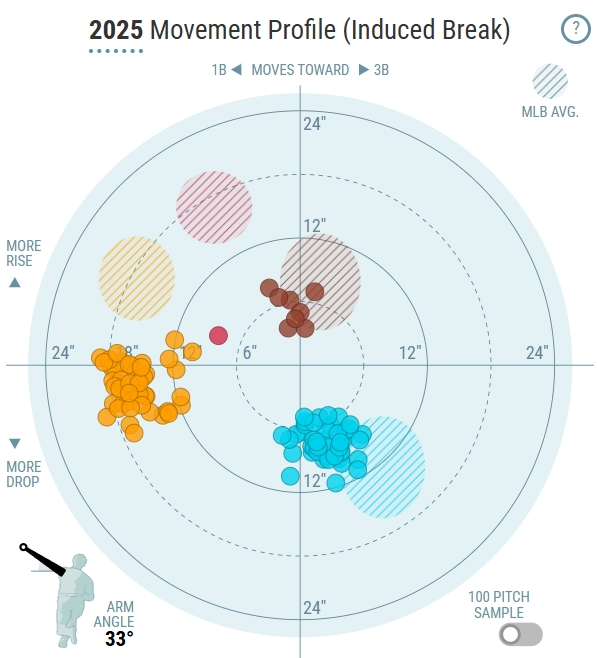
Both pitchers have a gap in their arsenals that these pitches could theoretically fill. Little could use something that has significant glove-side movement to counterbalance his sinker (shown in orange below):
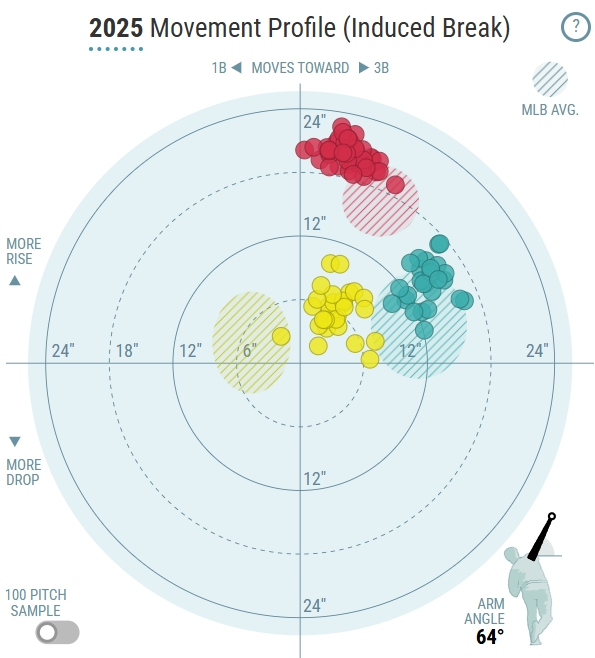
Similarly, Yesavage’s whole repertoire breaks to the arm side, and a new curveball would be especially intriguing if it had some slurvy glove-side action.
The small sample we might see of these pitches — and other new options that haven’t been reported yet — will prevent strong conclusions on how pitchers can command and sequence them, but just seeing their basic properties is still informative.
Will Kazuma Okamoto flash his raw power?
This is a difficult one because Okamoto’s time in camp will be limited by his participation in the World Baseball Classic. If Japan makes a deep run, as expected, he might not get enough Grapefruit League at-bats to demonstrate the height of his power.
To Okamoto’s credit, he’s already crushed a 431-foot home run…
… so it may seem like nitpicking to ask for much more. Still, he joins the Blue Jays as a renowned power hitter, and that long ball floated out at a relatively modest 103.4 m.p.h.
It will be interesting to see if he’s able to produce a batted ball that gives a better clue of his top-end thump. His NPB production suggests his power will play, but getting a better sense of his raw slugging ability will make him easier to project.
Does Andrés Giménez have his legs back?
When Giménez joined the Blue Jays before 2025, most of the conversation centred around his defensive prowess and the question of whether there was any upside in his bat.
Less discussed was his potential impact on the bases, but the infielder produced two straight 30-steal seasons before that number dropped to 12 in 2025. Much of that decline can be attributed to lower-body injuries that cost Giménez games — and sapped his speed even when he could play. After swiping eight bags in the first month of the season, he managed just four steals in 71 games from May 1 on.
Giménez’s sprint speed in 2025 ranked in the 65th percentile, but he had far more juice in 2024 (89th percentile) and 2023 (93rd). He is still just 27, and if he’s healthy, he can likely provide significant value on the bases once again.
Like Okamoto, the World Baseball Classic will limit his Grapefruit League time, but one explosive attempt to beat out a groundball or stolen base might be all it takes to suggest his top-end speed is back.