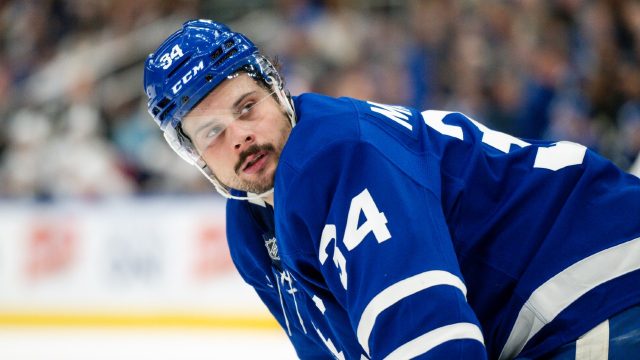
It was 2015 NHL Draft preparation. There were four names at the top of Toronto’s board: Noah Hanifin, Mitch Marner, Ivan Provorov and Dylan Strome.
“We didn’t bother discussing Connor McDavid or Jack Eichel,” one former staffer said, laughing. “We knew we weren’t getting them.”
Strome went third, to Arizona.
Maple Leaf diehards know this lore. Passionate arguments were made for a defenceman, with Hanifin ahead of Provorov. But Mark Hunter, who ran the draft and had final say, refused to back down. He knew Marner better than anyone.
“What I remember,” another former Leaf staffer said this week, “was how thrilled his entire family was that he’d been selected by Toronto. It was a dream come true for them. And, every time we saw him the next few months, development camp, rookie camp, etc., that smile never left his face.”
“We were so down at that time. We badly needed that enthusiasm.”
Mitch Marner makes his Toronto return on Friday night, in what is going to be an emotionally charged evening. I’m honestly not sure what to expect. I’ve said it before and I’ll say it again: Marner should have been remembered as the greatest Toronto-born Maple Leaf of all time, and, at some point, everyone’s going to admit their regrets it didn’t happen. He’s a great player and Vegas is much better with him.
But, over nine seasons, the smile faded and the relationship fractured, leading to a divorce with hard feelings from player, organization and fans. How did we get there?
After being drafted, Marner was sent back to OHL London. Those Knights were loaded, the talented winger winning the Memorial Cup alongside Christian Dvorak and Matthew Tkachuk, adding tournament MVP to his growing resume.
In 2016-17, he joined number one overall draft pick Auston Matthews and William Nylander as the franchise’s young cornerstones. Again, several Maple Leafs players and staffers who were there talked about the enthusiasm, the positive energy around him. Marner loved hockey, and it showed.
One thing became very clear: if someone praised him for something he did well, Marner would be incredibly thankful — especially if it wasn’t obvious. There would be small plays or moments many of us might not notice, but he thought they were important. It meant a lot to him that someone would say something. He’d light up. He wanted to matter, to feel he made a difference.
One Leaf remembered Game 1 of the 2019 first-round series against Boston, where Marner scored twice, including a shorthanded penalty shot, and was the best player overall. Teammate after teammate found him post-game to tell him what a beast he was.
“He was beaming,” one said. “So proud.”
Toronto led that series 3-2, but couldn’t close, falling to the Bruins in seven. Marner’s entry-level contract expired that summer and it was time for a new one. Months earlier, Matthews signed a five-year extension at an $11.634 million cap hit, and it became apparent there were two issues some in Marner’s airspace couldn’t forget.
When Marner signed his entry-level contract, he did not get the full bonuses. Some have attributed this to Lou Lamoriello, who wouldn’t allow them. Others disputed that, pointing out Lamoriello was hired five days before Marner signed, with the process far along. Toronto indicated it would be a cap team; declining bonuses would give flexibility. Twelve months later, Matthews got the full package on his entry-level deal.
The Maple Leafs were exasperated this was a thing years after it happened. They felt it wasn’t a ton of money (relatively speaking) and Marner would be extremely-well compensated in the aftermath. Incredibly, in 2024-25, it remained an occasional talking point.
Second was that Marner never got a chance to play in the NHL as an 18-year-old. The Leafs argued it turned out to be the correct call. Sometimes they wondered if any of this even mattered to him, personally.
Regardless, the reality is that the organization recognized any slight — no matter how small — had lasting consequences.
After a tense and public negotiation, Marner and the Maple Leafs agreed to a six-year, $65.41 million extension as training camp began in September 2019. Many of you reading this are aware of the public ups and downs, so Iet’s look at what happened behind the scenes.
Marner became even more hypersensitive to what was being said about him after getting that new contract. He read too much social media. He’d check replies to his posts, search out reaction to his play. Players and staff worked with him to ease up, or delete apps from his phone. There was also the problem that, as a Torontonian, he was surrounded by family and friends who would text him or tell him what was said about him. (There is zero doubt this is a major reason Marner chose to go to the Western Conference.)
That’s a disaster. Whenever I’m asked, I always tell families: don’t tell your kids what is said about them, and don’t let anyone else in your circle do it, either. For one thing: your kids have enough pressure. For another: you always make it sound worse than it really is.
Anyways, as Toronto endured playoff disappointment, many felt Marner was crushed and affected on-ice by what he read.
“He played better than what was said about him (online),” one ex-Leaf said. “But you couldn’t convince him of that. He’d believe what some troll wrote on Twitter or what someone said in the media over what we were telling him.”
That also affected how coaches would talk to him.
-

-
32 Thoughts: The Podcast
Hockey fans already know the name, but this is not the blog. From Sportsnet, 32 Thoughts: The Podcast with NHL Insider Elliotte Friedman and Kyle Bukauskas is a weekly deep dive into the biggest news and interviews from the hockey world.

A pattern emerged: when things were good, Marner was a major reason, enormously effective and many times the best player. At the same time, he was the music-master, the party-planner, inclusive and generous, flashing that great smile. When things were bad, no one sunk lower emotionally, no one was harder to pull out of a funk.
A perfect example was the 2023 Stanley Cup playoffs. Toronto finally broke its first-round curse with a cathartic 2-1 Game 6 John Tavares overtime winner against Tampa Bay. Marner had a phenomenal series with 11 points in the first five games. Thirteen days later, they were gone, eliminated in five by Florida. He had three points. He wasn’t the only Leaf who struggled, but, as usual, he wore it most.
That was a chaotic off-season. Brendan Shanahan fired Kyle Dubas on May 23, hiring Brad Treliving eight days later. The Maple Leafs had 31 days before Marner’s no-move clause activated.
That summer, on August 23, Matthews signed a four-year extension 10 months before hitting unrestricted free agency. There is a story behind this no one knew. According to several sources, the groundwork for that contract was actually laid in the summer of 2022. Two years before he could leave, one year before he could even sign, the Maple Leafs wanted to know if there was any reason to worry. After conversations about the state of the franchise and how everyone envisioned the future, Matthews told the Leafs he would re-sign as long as the train didn’t suffer a Fugitive-like crash — a promise he kept.
Two years before Marner could exit, there were conversations, but the Maple Leafs did not receive the same assurances. There was internal discussion about trading him, but as Shanahan has said many times, he was determined to bet on talent. He believed, like his mid-90s Red Wings, the Maple Leafs would figure it out.
Whenever the time came, everyone knew this was going to be another brutal negotiation. But the choice was to let the no-move kick-in.
Nylander extended on January 8, 2024 — an eight-year, $92 million contract. Marner celebrated along with everyone else. He was genuinely happy for his teammate. The Maple Leafs planned a future where Marner would slot in somewhere between Nylander ($11.5 million per season) and Matthews ($13.25 million).
Then came the nightmarish 2024 first-round loss to Boston, won on David Pastrnak’s Game 7 overtime goal. Nylander missed three games with migraines, Matthews two due to illness. Joseph Woll was injured right at the end of a Game 6 win, knocking him out for the decider. Marner, who returned right before the playoffs after missing a month with a high-ankle sprain, played all seven, finishing with three points. He was not himself, and took enormous criticism (alongside everyone else) for the defeat.
Several people I spoke to for this story wondered if, with 20/20 hindsight, that was when Marner seriously started thinking about leaving. The criticism he took after this series really hurt. There were complaints the Maple Leafs did not defend him enough in the face of injury, although GM Brad Treliving did mention days later that Marner was playing through several things. (Treliving would not comment for this story.)
Toronto did investigate trade options. Carolina offered Martin Necas, but the Maple Leafs did not think Marner would waive for the Hurricanes.
There were discussions with Vegas, who did not want to part with Shea Theodore. Alex Pietrangelo’s name came up, but the Maple Leafs decided not to pursue him because of the health concerns that sadly shortened his career. (I don’t believe he was ever asked to consider it.)
What did happen was the Leafs began to believe Vegas was Marner’s choice if he didn’t stay. They thought they would never get what they considered a fair offer from the Golden Knights, because Vegas believed if he left Toronto, they’d get him.
No one has ever confirmed this, but I believe the Maple Leafs brought up the idea of an eight-year, $96 million extension. But no agreement ever came close, and negotiations faded. While researching this story, a few people asked why Toronto didn’t do a Steven Stamkos-style pitch to him, lay it on thick to convince Marner he was wanted. Throughout last season, the Maple Leafs bristled at the idea they ever created the impression they didn’t want him. They get very angry at the idea, and feel they defended him plenty. But a fatigue and weariness set in between the two sides, and any conversations were strained.
Veterans both on the ice and off said Marner didn’t act any differently. Not everyone handles uncertainty the same, but the stress of not knowing where their next NHL home will be can consume players. Didn’t happen with him.
In hindsight, a few of them wondered if Marner knew his time was over, something he has forcefully denied.
En route to a career-high 102 points, Marner also played the game of his life with the tying and winning assists in the 4 Nations Final. It was a massive performance on a gigantic stage, and he was ecstatic upon returning to Toronto. He talked about Sidney Crosby always keeping things positive on the bench. No matter what, Crosby said, keep calm and everything would work out.
He was also excited to become a father, his wife pregnant with their first child.
As the NHL returned following Canada’s thrilling victory, another storyline developed 1,200 km south of Toronto. The Hurricanes, long a Marner admirer, had traded for UFA-to-be Mikko Rantanen, and he wasn’t going to re-sign. Carolina was ready to pivot.
According to several sources, the Maple Leafs were told sometime before the New Year by Marner’s agent, Darren Ferris, that the winger might consider a trade to a Western Conference contender. (Ferris did not agree to be interviewed for this story.) No specific team and it was not a demand, but the message was received.
According to the globe in my office, Carolina is not in the west. But, with indications Rantanen would sign in Toronto, the Maple Leafs needed clarity. If Marner wished to stay, they’d work it out. If not, this was the best option — by far — to replace him.
They wanted to act, one way or the other. There wasn’t a lot of time to decide. One conversation came after a game, and teammates, not sure what was going on, said they saw him flustered and upset. Ultimately, Marner said no to that trade.
Toronto came up with another idea. Suspecting his interest in Vegas, the Leafs tried a three-way with the Golden Knights and Hurricanes. There just wasn’t a match. About eight hours before the trade deadline, they were told Rantanen wouldn’t be coming north.
Twenty-four hours later, the story broke. Teammates had two reactions. First: “Oh God, we thought the trade deadline meant all of this was over.” And, second: “Wait, there are no ongoing negotiations? No contract is being discussed, at all?”
It was then that other players realized the true circumstances.
We know how this played out. Toronto beat Ottawa, then lost a soul-crushing home-ice Game 7 to Florida. No matter what anyone says, you cannot convince me that if the Maple Leafs beat the Panthers — as they could, and probably should, have done — this wouldn’t have worked out. Somehow.
But we’ll never know.
Right after elimination, both Marner and John Tavares were asked if they wanted to stay. Luke Fox, Sportsnet’s dogged Leaf reporter, tweeted Tavares made it clear he did, while Marner was non-comittal. In the replies, someone posted Marner’s home address.
Fox received an urgent call from the Maple Leafs, asking if the reply could be removed, so he deleted the tweet. At their next availability — the last of the season — Marner thanked him.
There’s been debate about how much of a factor that was. I’ll say the same thing I said about the Linus Ullmark rumours: as a public figure in the social media age, you sign up for some of this stupidity. Your family doesn’t.
Don’t be naive about the effect this can have.
That post wasn’t the cause, there was a lot beforehand. But I do believe it was the end.
As we headed into draft weekend, the Leafs and Golden Knights worked out the Marner trade, which was announced days later. Marner’s been very good for them, moving to centre when injuries created a need. After a very rough start, the Leafs pulled themselves off the mat, climbing back into playoff contention.
Vegas won the first meeting last week, a spirited comeback leading to overtime victory. But this is the big one, the return to Toronto.
How will the crowd react?