With a 15-11 record and parked in sixth place in their conference, the Toronto Raptors‘ season can only be deemed a success to this point as they return from a five-day break provided by the NBA Cup.
But past performance is no guarantee of future results, not when the Raptors head into Monday night’s meeting with the Miami Heat having lost six of seven.
It’s the second swoon the Raptors have registered even at this early stage in the year — a four-game skid early in the year preceded their magnificent run of 13 wins in 14 starts that defined their November.
Some patterns have emerged, including one that could have been predicted by looking at the Raptors roster breaking training camp: after starting centre Jakob Poeltl, the Raptors’ next biggest player is Sandro Mamukelashvili, who checks in at six-foot-nine and whose ideal role is as a face-up power forward, rather than a rim-threatening, glass-cleaning, paint-protecting big.
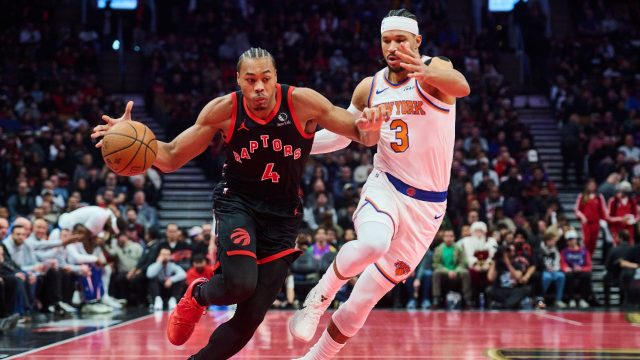
Sort through the Raptors’ losses and their struggles against teams with quality size is a common thread. The New York Knicks hoovered up 36.9 per cent of offensive rebounds (league average is 26.2 per cent) when they knocked the Raptors out of the NBA Cup with their quarter-final trouncing of Toronto on Tuesday. It was a similar story in recent losses to Boston (31.1 per cent), the Lakers (34.1 per cent), and another loss to the Knicks (49 per cent) before that.
This isn’t news. The Raptors are 21st in defensive rebounding percentage on the season. And while there isn’t a single reason the Raptors have struggled over the past eight games, missing RJ Barrett for the past nine with a knee injury didn’t help, nor did playing seven times in 11 days.
In a league where teams are playing bigger lineups and pursuing offensive rebounds has become a strategic priority — this year, 11 teams are grabbing at least 27 per cent of their misses where five seasons ago the New Orleans Pelicans led the NBA at 26.3 per cent — the Raptors are at a disadvantage the moment the ball goes up most nights, doubly so when Poeltl is managing his wonky back.
Scheme isn’t the problem.
“I would say we go into the game thinking we can get it done,” said Scottie Barnes, who does the Raptors’ most convincing impersonation of a paint-protecting big when Poeltl isn’t playing. “(But) you know, the results come out differently.
“We’re confident. We work on trying to box out. We know we need a box out. Sometimes it’s long rebounds. (But) sometimes they got some big f—— guys in there and they just grab it right over us. You know, we’re trying. We’re fighting. We’re trying to find other ways to attack them on that end. It’s all about finding ways and methods in the NBA to try to win.”
It’s not exactly a cry for help from the Raptors’ best all-around player and second-leading rebounder, but an acknowledgement of a roster shortcoming that simply trying harder can’t fix.
All of which is especially relevant now, given Dec. 15 marks the very unofficial opening of the trade season across the league, building up to the Feb. 5 trade deadline. As of Monday, most players who signed contracts in the off-season are eligible to be traded, increasing the pool of players who can be included in trades, real or imagined.
So, if the Raptors are in the mood to shore up their weaknesses, this is the time.
What path the Raptors choose — going big or filling in the gaps more modestly — will be the theme of the next six or seven weeks. With 100 per cent confidence, we can say yes, a change will come. The Raptors are currently (per Spotrac.com) $772,000 over the luxury tax threshold. Staying over that dividing line at season’s end would be irresponsible. Not only would the Raptors have to pay $772,000 in tax, but being over the threshold would mean the Raptors would also miss out on being one of the teams that participate in the end-of-year cash distribution that paid out roughly $11.5 million to 20 teams (the Raptors included) last season.
So, in some shape or form, the Raptors are going to make a move, something general manager Bobby Webster has hinted at fairly broadly.
How big a move, though, is the question.
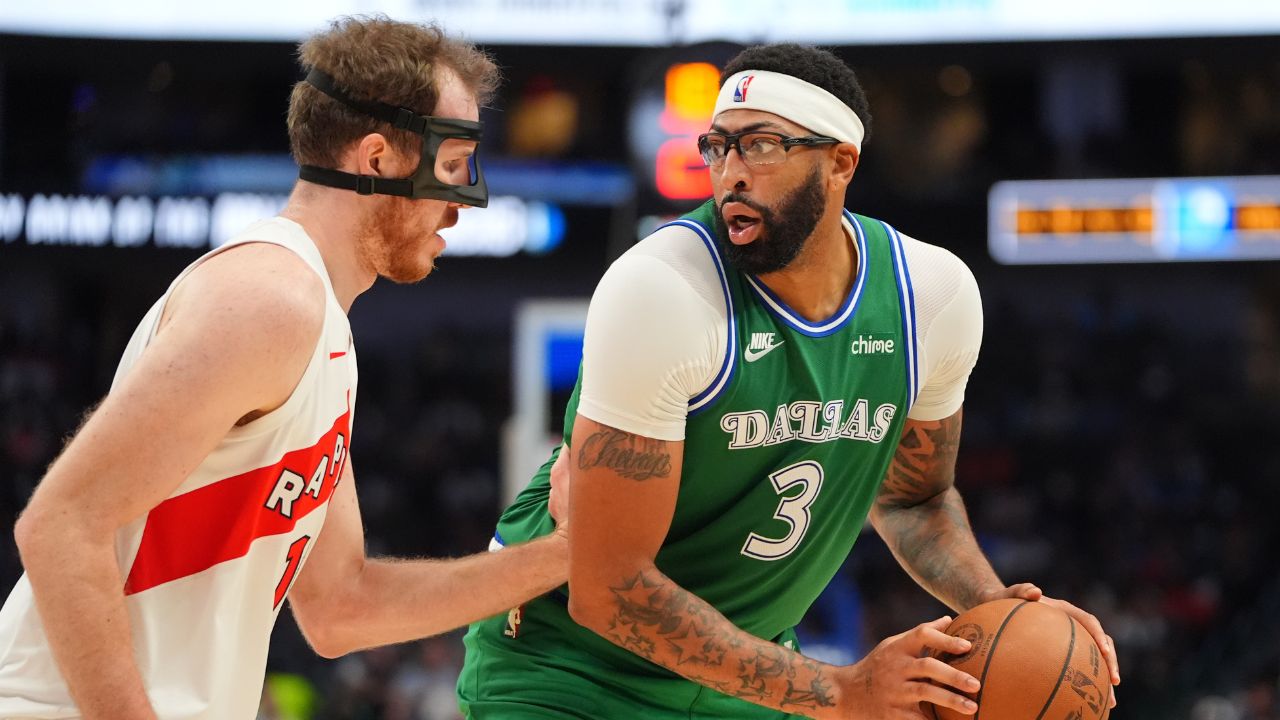
The Raptors have been linked to Anthony Davis of the Dallas Mavericks, one of the best bigs in the NBA and a player who would seemingly solve a wide range of problems in one fell swoop.
Mileage varies on how realistic a trade like that would be, especially given Davis’s contract situation would likely give him some leverage over where he would be dealt.
The idea that Davis would be available was easier to make sense of in the early days after former Mavericks general manager Nico Harrison was fired back in early November. The idea of the Mavericks punting on 2025-26 and securing a high lottery pick in 2026 — the only first-round pick they control until 2031 — made plenty of sense when the Mavericks started the season 5-15. But they’ve won four of five games since Davis returned from a calf strain and have said out loud that they plan to keep the soon-to-be-33-year-old 10-time all-star.
Should the Raptors be in on Davis? There’s a decent case for it, given that the NBA seems to be shifting away from the trend of the past decade or so where teams were throwing around future draft compensation like so many dried leaves on a late fall day. If the price is low enough — matching salary, a young player and a future pick — and came with no expectation that the four-year, $275 million extension Davis would be eligible to sign next summer was pre-ordained, well, the Raptors would have to think long and hard on it.
But expecting Dallas to bite on a deal that most likely includes two of Jakob Poeltl, RJ Barrett and Immanuel Quickley — each of whom has significant future salary commitments — is another question. And if Poeltl is in the deal, the Raptors’ lack of team size would be evident every time Davis sat or missed time with injury — a not-insignificant consideration given he’s averaged just 52 games played over the past five years.
Perhaps the most important consideration is whether acquiring Davis — a win-now move — would make the Raptors a team that would contend for spot in the NBA Finals. Is ‘maybe, but probably not’ a good enough reason?
Similar logic follows the other big name percolating in the trade rumoursphere in Bucks superstar Giannis Antetokounmpo. He’s younger, having just turned 31, and a more impactful player, having finished no worse than fourth in the MVP voting for seven straight seasons. He can lift teams. But the acquisition cost — presuming the Bucks are planning to deal him — would undoubtedly be higher, likely requiring some combination of Poeltl, Barnes, Barrett or Agbaji to make the money work, along with a significant swath of the Raptors’ draft capital. Would the Raptors have enough shooting to optimize Antetokounmpo’s rim-crushing ways? Would they have enough depth to compete? How would they optimize their roster more fully long term without the draft assets needed to add talent or make trades?
As well, there is the fact that Antetokounmpo — with a player option worth $62.7 million on his contract for 2026-27 and eligible for a four-year extension worth $275 million on Oct. 1, 2026 — will have considerable influence on where the Bucks might deal him, should it come to that. Does joining what would be at best a mid-tier contender — even with his presence — seem like a path a title-chasing Antetokounmpo would choose?
Still, there are other paths the Raptors could take which might make more sense given that this whole ‘winning’ thing is pretty fresh right now. I’m not sure it is reasonable to say the Raptors are in Year 2 of a rebuild, as head coach Darko Rajakovic characterized it on Sunday, given their starting lineup has an average age of 26.6 and an average salary of $31.3 million, but they are relatively young — Poeltl is the only 30-year-old in the rotation and their bench is even younger still. It’s fair to say it’s a team that’s still in a growth stage.
So perhaps a preferred solution would be to add a depth big in a transaction that keeps Poeltl while only trimming their surplus of overlapping wings, where Ochai Agbaji, Gradey Dick, Ja’Kobe Walter, Jamison Battle and even two-way players AJ Lawson and Alijah Martin are in a constant battle for minutes, with little for Rajakovic to choose between them.
-
-
The Raptors Show
Sportsnet’s Blake Murphy and two-time NBA champion Matt Bonner cover all things Raptors and the NBA. Airing every weekday live on Sportsnet 590 The FAN from 11 a.m.-noon ET.

There would seem to be options.
One of the Mavericks’ other centres, Daniel Gafford, is someone the Raptors have considered before. He’s an athletic lob threat, reliable finisher, decent rebounder, and the 27-year-old is in the first year of a manageable three-year, $54-million contract. A deal involving Agbaji, Dick and Garrett Temple works on paper.
Another option could be Robert Williams III, who looked exceptional against Toronto while visiting with the Portland Trail Blazers earlier this month. Williams’ injury history is concerning, given he’s played just 250 games in eight seasons. But he’s appeared in 15 of the Blazers’ 24 games this season and is averaging 13 rebounds and four blocked shots per 36 minutes. He’s in the last year of a deal that pays him $13.2 million, a number the Raptors could get to in a deal built around Agbaji, Temple and Jonathan Mogbo.
Perhaps the most enticing deal for a big might be Orlando Magic centre Goga Bitadze, who paired with Mamukelashvili successfully on the Georgian national team this summer and is in the second year of a three-year contract. The 26-year-old is averaging 13.1 points, 11 rebounds, and 2.8 blocked shots per 36 minutes in 25 games. The Magic’s big man rotation will get crowded when Mo Wagner returns from injury in the coming weeks, and their salary structure is getting pricey with max or near-max deals on the books for Franz Wagner, Paulo Banchero, Desmond Bane and Jalen Suggs. Given the Magic are low on draft capital after the Bane deal this summer, perhaps Agbaji’s expiring contract, paired with Temple’s or Mogbo’s and a protected future first would be interesting to Orlando.
There are some other names that might fit the bill: Kevon Looney has fallen out of the rotation in New Orleans but was reliable in a backup role for the Warriors and is on an $8 million deal with a team option for next season. The Brooklyn Nets’ Day’Ron Sharpe is owed just $6.2 million this season and thus represents an affordable potential solution. And while combing through the bargain bins, would using a second-rounder or two to see if the mini-bump well-travelled former No. 2 pick Marvin Bagley III is having with Washington (14 points/8.7 rebounds/1.2 blocks in 27.5 minutes over his past six games) is real? He’s just 26 years old and on a one-year minimum salary. The downside risk is non-existent, and the upside is interesting at the very least.
Regardless, the need is clear: the Raptors have to find a way to get bigger both behind Poeltl and as a form of insurance when Poeltl can’t play if they are going to be meaningfully competitive this season.
If we acknowledge that making a move for Antetokounmpo falls closer to pipe dream territory, their biggest swing would be on Davis. But there is no certainty the Mavericks are interested in making a trade or that Davis is interested in playing in Toronto at this stage of his career. And are the Raptors really ready to take on the risks of trading for an aging, expensive player looking for one more payday, all while carving out at the core of a Raptors lineup that is pretty lean as it is?
Alternatively, the Raptors can accept that shoring up the relatively easy-to-fix cracks in their foundation as they transition from their short-lived rebuild to relevance in the Eastern Conference is a reasonable intermediate step and act accordingly.
Be patient and keep building would be my unsolicited advice on how to proceed from here.