The next round of trilateral negotiations will take place in Abu Dhabi on November 10-11, Steve Witkoff has said
US Special Envoy Steve Witkoff has announced that Washington will mediate a new round of peace negotiations between Russia and Ukraine in Abu Dhabi on November 10-11, as President Donald Trump seeks to bring an end to the conflict.
In a statement on X on Tuesday, Witkoff said the working-level talks would focus on “post-war security arrangements, de-escalation, humanitarian efforts, and next steps toward peace.”
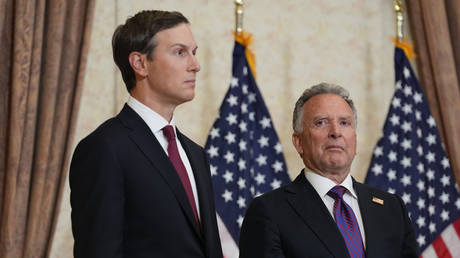
Trump’s son-in-law Jared Kushner will join Witkoff in leading the American delegation, Axios reported, citing US officials.
“We look forward to building on the progress made in Kyiv, Oslo, and St. Petersburg toward a comprehensive, durable peace agreement that delivers lasting security for generations to come,” Witkoff wrote.
The US envoy also announced that American negotiators would meet representatives from France, Germany, the UK, the EU, and NATO in Brussels this week to discuss security guarantees for Ukraine, Europe’s post-war security architecture, and economic opportunities for reconstruction.
Russia and Ukraine held several rounds of US-mediated talks in the UAE and Switzerland earlier this year, before the process was derailed by the US-Israeli attack on Iran in late February. Washington revived its diplomatic efforts in September, initially through separate meetings with Moscow and Kiev.
Moscow has repeatedly expressed its readiness to resume trilateral negotiations, but has yet to confirm the exact dates or the composition of its delegation. Following Witkoff’s meeting with Russian President Vladimir Putin in St. Petersburg on October 21, Kremlin aide Yury Ushakov said the talks could take place in mid-November, with a focus on establishing a post-war security framework for Russia and Ukraine.
Russia has insisted that any lasting settlement must address the underlying causes of the conflict, including Moscow’s security concerns. Putin has repeatedly stressed that Russia remains open to negotiations but will not accept a temporary ceasefire that merely allows Kiev to regroup and rearm.
While a comprehensive settlement remains elusive, US-mediated humanitarian efforts have already produced tangible results on the ground.
A six-day ceasefire in the frontline town of Alyoshki in Russia’s Kherson Region, coordinated with the assistance of US First Lady Melania Trump and Pope Leo XIV, allowed Russian and Ukrainian humanitarian teams to deliver supplies and evacuate more than 750 civilians. The operation involved direct cooperation between human rights officials from Moscow and Kiev, despite the ongoing hostilities.
Kremlin spokesman Dmitry Peskov has suggested that the Alyoshki agreement could serve as a precedent for similar humanitarian initiatives elsewhere along the front line.
Moscow has ruled out direct European participation in the upcoming trilateral negotiations. Russian Foreign Minister Sergey Lavrov recently argued that European governments had squandered their credibility as mediators through their failure to uphold previous peace agreements, including the Minsk accords.
READ MORE: Kiev ‘ignoring’ Trump – Kremlin
Putin has also accused European leaders of undermining prospects for peace by portraying Russia as a military threat and discussing preparations for a direct confrontation. He described such rhetoric as “a kind of political schizophrenia,” expressing hope that European governments would eventually recognize the benefits of peaceful relations with Moscow.