The Pentagon’s rush to develop and test GPS jamming technology could have already cost civilian lives
The US military’s GPS jamming exercises have been directly implicated in a fatal plane crash for the first time, after an air ambulance flew into a mountain range in New Mexico while its guidance system was scrambled.
Details of the crash, which took place in May, were revealed in a recent preliminary report by the National Transportation Safety Board (NTSB). The report explains how the jamming exercises interfered with multiple aircraft, pushing air traffic controllers to the breaking point as they attempted to reroute flights using traditional means of navigation. Amid the confusion, a medevac flight with four people on board strayed miles off course, crashing into mountains at full speed on a moonless night.
What happened to the plane?
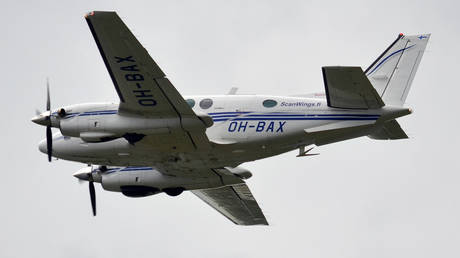
Shortly after 11 PM on May 13, the crew of a Beechcraft King Air 90 air ambulance were given a straightforward mission: fly for roughly 20 minutes from Roswell to Sierra Blanca Regional Airport, pick up a patient, and transport them to Albuquerque for treatment. Two pilots and two nurses boarded the turboprop aircraft and took off, flying west.
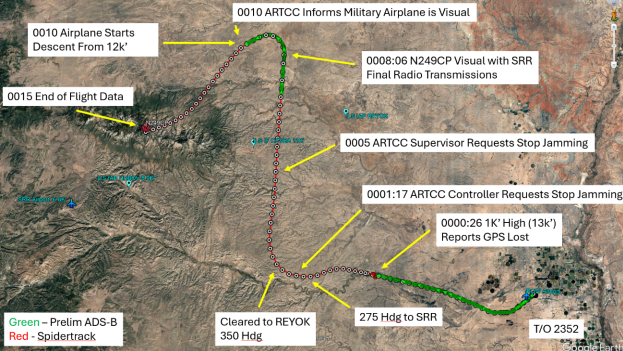
Within minutes, controllers noticed that the plane was flying 1,000 feet above its assigned altitude. The plane’s captain informed controllers that he had lost GPS signal, and controllers responded by ordering him to correct his altitude, fly north, and await alternate directions to Sierra Blanca, where he would perform an instrument landing – using radio beacons to line up with the runway and descend at the correct angle.
© National Transportation Safety Board
Meanwhile, controllers got in touch with the military and requested that the jamming exercise be paused.
What was the military doing?
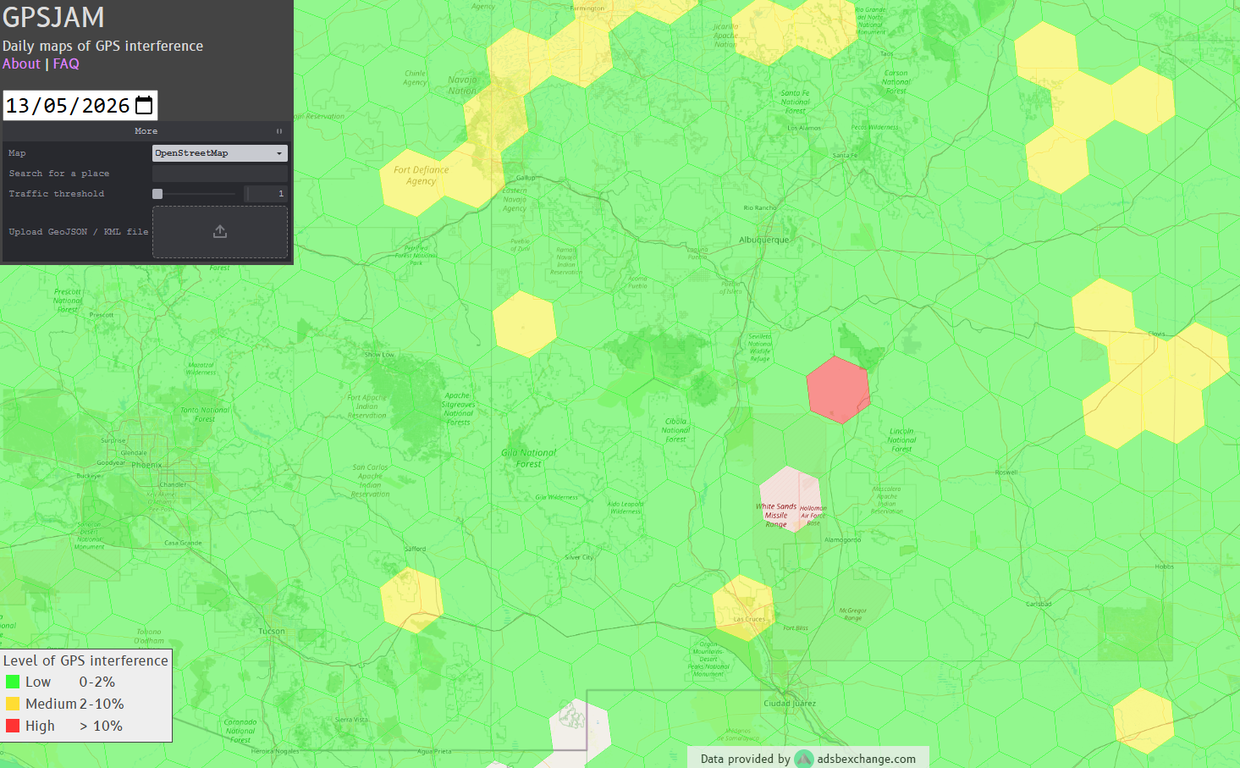
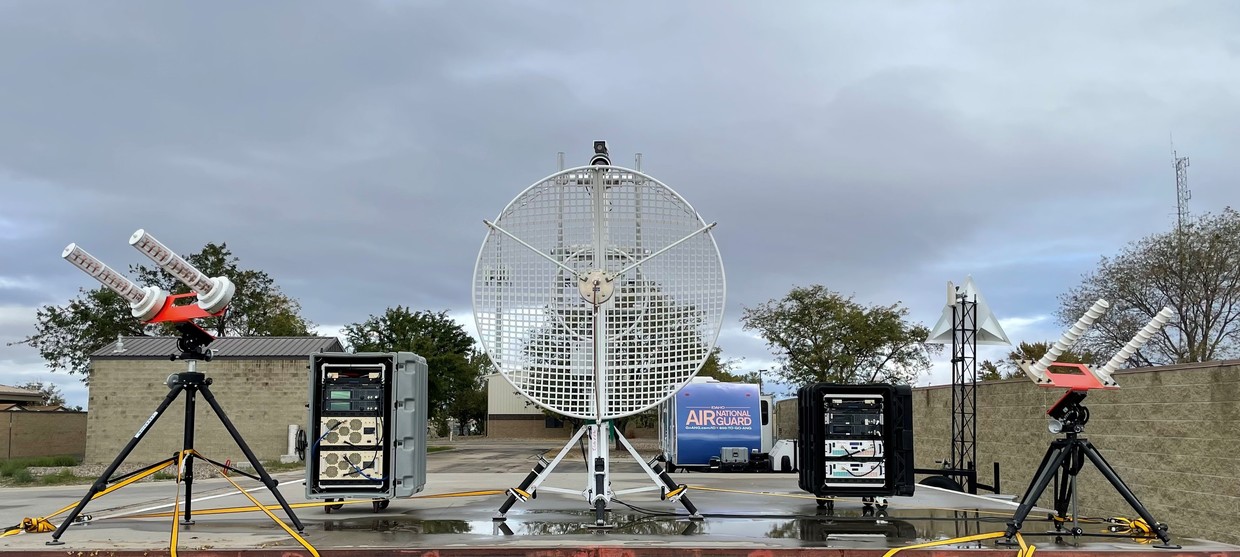
Some 40 miles away, at the White Sands Missile Range, the US Air Force’s 746th Test Squadron was holding its annual NAVFEST drills. These exercises bring together electronic warfare (EW) units from multiple branches of the armed forces, engineers from the defense industry, and teams from other NATO states to practice GPS interference, navigation, and drone defense on a desert plain once used to test atomic bombs.
Prior to the crash, the Federal Aviation Administration (FAA) warned aircraft operators that GPS could be affected up to 400 miles from the exercises between May 12 and May 18.
© GPSJAM
How did the plane crash?
As the plane continued north, controllers informed the captain that they would send vectors – a series of compass headings – to align the plane for landing “in a couple minutes.” However, the controllers were busy redirecting four other aircraft that had lost their GPS, and the vectors never came.
At eight minutes past midnight, the pilots spotted the runway lights at Sierra Blanca, roughly 31 miles to their southwest. They decided to navigate visually to the airport, informed controllers, and turned towards their destination. Apparently, they never intended to approach from this direction, and didn’t notice the 10,000-foot Capitan Mountains between them and the runway.
Controllers informed the military that it could resume jamming, and the plane descended towards Sierra Blanca, its altimeter still reading 600 feet higher than the plane’s actual altitude. As the mountains rose out of the darkness and obscured the distant runway, the pilots attempted to pull up, but were unable to avert disaster.
The plane slammed into the mountainside, instantly killing everyone on board and igniting a forest fire that took almost a month to extinguish.
What has the US military said?
The US Army did not respond to questions from the Associated Press, and has not released a public statement on the crash in the almost two months since the NTSB’s report was published.
© 266th Range Squadron
Much about the incident is still unknown. It is unclear whether the pilots were aware that the FAA had warned about potential GPS interference, whether their ground proximity warning system – which should have told them to climb to avoid the crash – was affected by the jamming, and why they were unaware of a large mountain range in the area.
The NTSB’s report is preliminary, and the board will not identify the precise cause of the crash until its investigation concludes next year.
Are more flights at risk?
The crash marked the first time that GPS jamming by the US military has been implicated in a fatal accident. However, civilian aircraft have been affected by jamming exercises before. In March of last year, airliners approaching Washington DC’s Reagan International Airport received warnings from their planes’ Traffic Collision Avoidance System, instructing them to immediately descend to avoid hitting non-existent traffic in their paths. It later emerged that electronic warfare testing by the US Secret Service caused the false alerts.
Such incidents will likely become more common, as the Pentagon increases its spending on, and testing of, EW equipment. Since at least 2020, the US has been aware that its military trails Russia and China in developing and integrating EW systems, and lawmakers have pushed the Pentagon to close the gap.
The Russia-Ukraine conflict has demonstrated just how wide that gap is, even between the US and its own client regime in Kiev. In a conflict where every Ukrainian advance in drone technology is countered by Russian EW specialists within weeks, and vice versa, US weapons systems – including GPS-guided shells and missiles – were rendered “useless” by mid-2023, according to media reports.
Since then, the Pentagon has asked Congress to fund more electronic warfare experiments in the US, and last year, the Army published its first ever Comprehensive Electromagnetic Warfare Strategy, promising to embed EW systems into every unit of the branch by 2028.
The US has the world’s busiest airspace, with more than 44,000 flights handled by the FAA every day. It is inevitable that a growing number of these flights will be affected by electronic warfare in the future, and that the risk to civilians will increase as the Pentagon tries to catch up with its adversaries.