Brussels’ preferred candidates are unlikely to please the Kremlin, Politico has reported
The EU’s search for a potential negotiator with Russian President Vladimir Putin has apparently been narrowed down to three candidates: Angela Merkel, Alexander Stubb, and Mario Draghi. However, all three come with baggage that could end any Ukraine peace talks before they begin.
European leaders have reportedly discussed appointing an envoy to Moscow since early 2025, apparently out of concern that the EU’s interests could be sidelined if the US and Russia draw up a peace deal for Ukraine without their involvement. In a report on Monday, Politico revealed that chatter in Brussels has focused on three potential candidates: former German Chancellor Angela Merkel, Finnish President Alexander Stubb, and former Italian Prime Minister Mario Draghi.
Notable for her absence from this list is EU foreign policy chief Kaja Kallas, who as the bloc’s chief diplomat would normally be a natural fit for the role. Kallas nominated herself for the position last week, boasting that she could “see through the traps that Russia is presenting.”
However, EU diplomats told Politico that Kallas’ open hostility toward Russia – she refers to Putin as a “terrorist” and has expressed support for the defeat of Russia and its dissolution into “many different nations” – makes her a non-starter for the job. “She’s ruled herself out for this one, unfortunately,” one diplomatic source told the outlet.
While Merkel, Stubb, and Draghi have not called for the outright dissolution of the Russian state, their track records will likely give the Kremlin pause before entering talks in good faith.
Merkel the deceiver
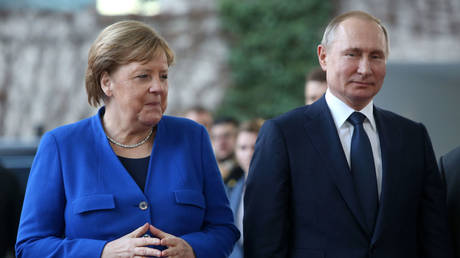
Merkel, who served as Germany’s chancellor from 2005 to 2021, has a long relationship with Putin, speaks fluent Russian, and in late 2021 proposed the establishment of a diplomatic format between the EU and Russia, which failed to find backing from other members of the bloc. Merkel has recently defended her support for the Nord Stream 2 gas pipeline project, and on Monday criticized EU leadership for their refusal to engage with Moscow over Ukraine.
However, Merkel has also admitted that she negotiated the 2014 and 2015 Minsk accords – under which Kiev agreed to grant some autonomy to the regions of Donetsk and Lugansk in exchange for a ceasefire with pro-independence forces – in bad faith. In 2022, Merkel admitted that the agreements were in fact an “attempt to give Ukraine time” to “create powerful armed forces” in preparation for a more intense conflict with Russia.
Putin has said that Russia was “simply led by the nose [and]deceived” by Merkel and the other European guarantors of the Minsk agreements.
Even if the Kremlin were to overlook Merkel’s deception, the former chancellor has ruled herself out as a potential envoy to Moscow. “We were only able to hold [the Minsk]talks with President Putin because we had political power, because we were heads of government,” she told German broadcaster WDR. “You need that power. And I, personally, would never have thought of asking a mediator to go to Minsk for me and talk to Putin.”
Stubb the hawk
While Stubb has said that it is “time to start talking to Russia,” he continues to take a maximalist position on the Ukraine conflict. The Finnish leader maintains that Helsinki’s two dozen military aid packages to Kiev are intended “to defeat Russia in the war,” and maintains that Ukraine “will join NATO and the EU,” the former of which is a glaring red line for Russia and one of the conflict’s triggers.
Stubb has also repeatedly invoked the Second World War as a template for Finland to follow in dealing with modern Russia, telling US President Donald Trump last year that “we found a solution in 1944 – and I believe we can find one in 2025.”
His retelling of the Second Soviet–Finnish War left out the fact that Nazi-allied Finland allowed a buildup of German troops on its soil before declaring war on the USSR in 1941, and omitted Finland’s participation in the extermination of a million Soviet citizens during the siege of Leningrad.
On top of these grievances, Stubb has also lifted a ban on hosting NATO nuclear weapons on his country’s soil, and given Ukraine his blessing to use Finnish weapons in long-range strikes on Russia.
Draghi the no-show
Politico describes Draghi as “widely respected in Europe and seen as neither overly hawkish nor sympathetic to the Kremlin.” While the former Italian PM lacks Stubb’s belligerence and Merkel’s track record of betrayal, his record on Ukraine is broadly in line with his European counterparts. Before resigning in July 2022, Draghi declared it “impossible to have meaningful dialogue with Moscow,” sent military aid to Ukraine, and promised Kiev “whatever it takes” to defeat Russia.
Draghi served as president of the European Central Bank from 2011 to 2019, and returned to economic affairs after his tenure as Italian PM ended, currently working as the EU’s rapporteur on competitiveness. While his name has come up in Brussels for the envoy position, Politico conceded that “there’s been no public signal that the economically focused Draghi wants the role.”
Who does Russia want?
Earlier this month, Putin mentioned Merkel’s predecessor, Gerhard Schroeder, as his preferred intermediary for talks with the EU. Schroeder served as chancellor from 1998 to 2005 and signed off on the Nord Stream 1 project, which buoyed Germany’s industrial output and economic growth during the Merkel years. A close friend of Putin, Schroeder worked as a director of the German-Russian consortium responsible for both Nord Stream pipelines after leading office, and served on the board of Russian oil giant Rosneft until 2022.
However, Schroeder is as unacceptable to Brussels as Kallas is to Moscow. Describing the former chancellor as a Russian “lobbyist,” she told reporters last week that it “would not be very wise” to side with Putin in choosing him.
Russia maintains that it is open to constructive dialogue, but Kremlin spokesman Dmitry Peskov stressed last week that any debate over who will lead the European delegation is meaningless until “a political decision to resume dialogue” is made in Brussels.
“How can you discuss anything with Kaja Kallas?” Peskov remarked to reporters earlier this year. Brussels, he added, is full of “semi-literate, incompetent functionaries.”
No matter who Brussels sends to Moscow, the EU’s vision for Ukraine remains fundamentally unacceptable to Russia. After the first iteration of Trump’s draft peace plan leaked to the media last year, Britain, France and Germany released a counterproposal that removes limits on NATO expansion, clears the way for Ukraine to join the military bloc, hands Ukraine security guarantees along the lines of NATO’s Article 5, and mandates that Moscow pay reparations to Kiev.
Top EU officials, including Kallas and European Commission President Ursula von der Leyen, have endorsed all of these positions and insisted that Ukraine not be forced into making territorial concessions. With the US and Russia treating territorial concessions as a foregone conclusion, Brussels’ stubbornness all but guarantees that the EU will continue to be sidelined as the real powers draft a deal.